Tourism GeographyUnit 612 min read
Protected Areas & Conservation in Tourism: Types, Roles & Case Studies
Unit 6 of Tourism Geography explores Nepal’s protected areas (PAs) under the National Parks and Wildlife Conservation Act, their classifications (National Parks, Reserves, Sanctuaries, Conservation Areas), ecological roles, and how sustainable tourism balances conservation with visitor access. It covers global and loca
TAKEAWAYS:
- Protected Areas (PAs) in Nepal are legally designated zones under the National Parks and Wildlife Conservation Act (1973) to conserve biodiversity, regulate tourism, and support indigenous communities—10% of Nepal’s land is under PA status.
- Four PA categories exist: National Parks (strictest protection, e.g., Sagarmatha), Wildlife Reserves (buffer zones, e.g., Koshi Tappu), Wildlife Sanctuaries (habitat-specific, e.g., Sukla Phanta), and Conservation Areas (community-integrated, e.g., Annapurna).
- Tourism’s dual role: PAs generate ~10% of Nepal’s tourism revenue (e.g., Chitwan’s rhino safaris) but face overtourism risks (e.g., Annapurna’s trail erosion) and climate threats (e.g., melting glaciers in Langtang).
- Sustainable models include eco-certification (e.g., TEFT’s "Green Lodge" program), community-based tourism (e.g., Manaslu’s homestays), and strict visitor quotas (e.g., 2,000 permits/day in Everest region).
- Global parallels: Nepal’s PA system mirrors IUCN’s Category II–VI classifications, while Costa Rica’s eco-tourism and Botswana’s community conservancies offer replicable strategies.
- Exam focus: Define PAs, list Nepal’s types with real examples, analyze trade-offs (conservation vs. tourism revenue), and critique management failures (e.g., poaching in Bardia).
1. What Are Protected Areas (PAs)? Legal and Ecological Definitions
Protected Areas (PAs) are geographically defined zones legally designated to conserve biodiversity, cultural heritage, and ecosystem services while allowing regulated human use (e.g., tourism, research). In Nepal, PAs are governed by the National Parks and Wildlife Conservation Act (1973, amended 1993), aligning with IUCN’s global standards.
Why PAs Matter in Tourism
- Biodiversity hotspots: Nepal’s PAs host 11% of global bird species and 359 threatened species (IUCN Red List).
- Cultural preservation: Sites like Lumbini (UNESCO) blend religious tourism with conservation.
- Economic lifeline: Tourism in PAs generates ~$100M/year (e.g., Chitwan’s rhino treks).
- Climate resilience: Forests in PAs sequester 30% of Nepal’s carbon emissions.
classDiagram
class ProtectedArea {
+Name: String
+Category: NationalPark|Reserve|Sanctuary|ConservationArea
+Size: km²
+YearEstablished: Integer
+KeySpecies: List~String~
+TourismZones: List~String~
}
class NationalPark {
+StrictestProtection
+NoLivestockGrazing
+Example: Sagarmatha, Annapurna
}
class WildlifeReserve {
+BufferZone
+LimitedHumanActivity
+Example: KoshiTappu
}
class WildlifeSanctuary {
+HabitatSpecific
+Example: SuklaPhanta
}
class ConservationArea {
+CommunityManaged
+Example: Annapurna, Manaslu
}
ProtectedArea <|-- NationalPark
ProtectedArea <|-- WildlifeReserve
ProtectedArea <|-- WildlifeSanctuary
ProtectedArea <|-- ConservationArea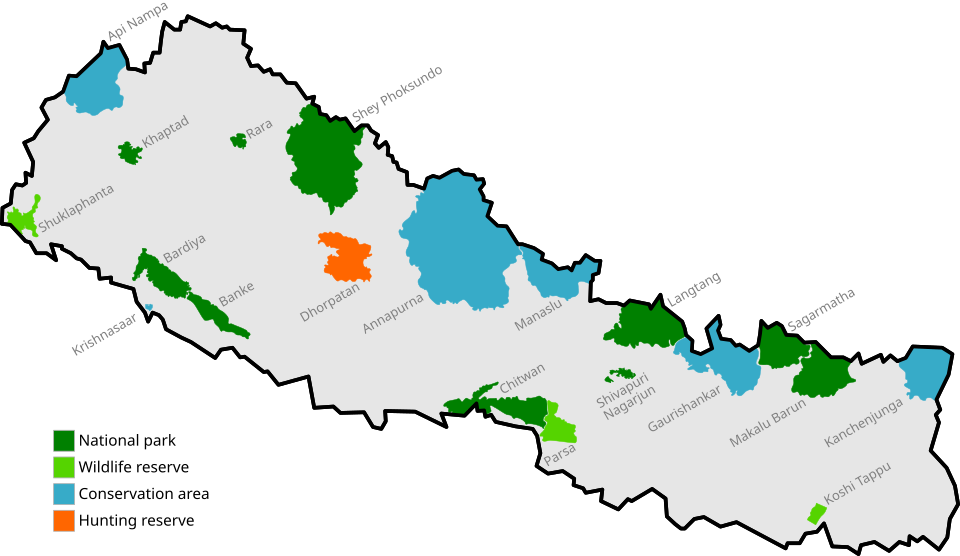 Shows the 10 national parks, 3 reserves, 11 sanctuaries, and 7 conservation areas with their locations and boundaries. (Image: CrlNvl, CC BY-SA 4.0, via Wikimedia Commons)
2. Nepal’s Protected Area Categories: Types, Rules, and Tourism Roles
Nepal’s PAs are classified into four types, each with distinct management rules and tourism implications. The table below compares them:
| Category | Legal Definition | Tourism Rules | Examples | Key Species | Threats |
|---|---|---|---|---|---|
| National Park | Strictest protection; no permanent settlements or livestock grazing. | Permit required; guided treks only; strict quotas (e.g., 2,000/day in Everest). | Sagarmatha, Annapurna, Bardia | Snow leopard, red panda, musk deer | Overtourism, poaching, microplastics |
| Wildlife Reserve | Buffer zones for national parks; limited human activity. | Research-focused; some eco-tourism (e.g., birdwatching in Koshi Tappu). | Koshi Tappu, Parsa | Bengal florican, swamp deer | Wetland degradation, climate change |
| Wildlife Sanctuary | Protects specific habitats (e.g., wetlands, forests). | Community-based tourism; homestays allowed (e.g., Sukla Phanta’s Tharu culture). | Sukla Phanta, Dhorpatan | One-horned rhino, Gangetic dolphin | Illegal fishing, habitat fragmentation |
| Conservation Area | Largest category; integrates community management and sustainable livelihoods. | Highest tourism potential; eco-certified lodges (e.g., Annapurna’s Pokhara). | Annapurna, Manaslu, Kanchenjunga | Himalayan tahr, pheasants | Deforestation, glacial retreat |
WORKED EXAMPLE: Annapurna Conservation Area (ACA)
- Size: 7,629 km² (largest PA in Nepal).
- Tourism Revenue: ~$50M/year (2023).
- Management Challenge: Trail erosion from 50,000+ trekkers/year.
- Solution: ACA’s "Carry Your Own Waste" policy (since 1992) and trekking permit fees ($20–$100) fund conservation.
- Real-World Tie: Like Costa Rica’s Monteverde Cloud Forest, ACA uses eco-certification for lodges (e.g., TEFT’s "Green Lodge" standard).
3. How Protected Areas Balance Conservation and Tourism
Tourism in PAs follows the "4 As" framework (Accessibility, Amenities, Attractions, Ancillary services), but overuse risks include:
- Ecosystem damage: 30% of Annapurna’s trails show erosion (Nepal Tourism Board, 2022).
- Wildlife stress: Rhinos in Chitwan avoid human areas due to noise pollution.
- Cultural erosion: Tharu communities in Chitwan report loss of traditional knowledge.
Sustainable Tourism Models in Nepal’s PAs
| Model | How It Works | Example in Nepal | Global Parallel |
|---|---|---|---|
| Eco-certification | Lodges/tour operators meet environmental standards (e.g., waste management). | TEFT’s "Green Lodge" in Pokhara. | Costa Rica’s CST certification. |
| Community-based Tourism | Local communities own and manage tourism assets. | Manaslu’s homestays (10% revenue shared). | Botswana’s Community Conservancies. |
| Visitor Quotas | Limits on daily/annual visitors to reduce impact. | Everest region: 2,000 permits/day. | Galápagos Islands: 160/day. |
| Alternative Tourism | Non-consumptive activities (e.g., birdwatching, cultural festivals). | Koshi Tappu’s birdwatching tours. | Madagascar’s lemur sanctuaries. |
4. Threats to Protected Areas: Poaching, Climate Change, and Overtourism
A. Poaching and Illegal Wildlife Trade
- Problem: Despite $1M/year anti-poaching budget, Nepal loses ~50 rhinos/year to poaching (2010–2020).
- Real Example: Bardia National Park saw 12 rhino deaths in 2019 due to organized syndicates.
- Solution: DNA-based tracking (used in Chitwan) and community patrols (e.g., Tharu Youth Conservation Groups).
flowchart TD
    A["Poaching Threat"] --> B["Weak Law Enforcement"]
    A --> C["Corruption in Forest Dept."]
    A --> D["High Demand in Asia"]
    B --> E["Understaffed Rangers"]
    C --> F["Bribes to Officials"]
    D --> G["Rhino Horn: $60,000/kg"]
    E & F --> H["Solution: Tech + Community"]
    H --> I["DNA Tracking"]
    H --> J["Tharu Patrols"]
B. Climate Change Impacts
- Glacial retreat: Langtang National Park lost 25 glaciers since 1970, threatening water supplies for Kathmandu.
- Shifting wildlife: Red pandas in Koshi Tappu are moving to higher altitudes due to rising temperatures.
- Tourism disruption: Annapurna’s trekking season shortened by 2 weeks/year due to unpredictable monsoons.
C. Overtourism and Infrastructure Strain
- Problem: Annapurna’s trails see 50,000+ trekkers/year, leading to:
- Toilet waste (only 30% of lodges have septic systems).
- Trail widening (natural paths become 3m-wide paths).
- Solution: ACA’s "Trekking Permit Fee Hike" (2023) to fund trail restoration.
5. Case Study: Chitwan National Park – Successes and Failures
Chitwan National Park (est. 1973) is Nepal’s first national park and a UNESCO World Heritage Site. It hosts:
- 600+ rhinos (25% of global population).
- $30M/year from tourism (safaris, homestays).
- Tharu cultural festivals (e.g., Makara Sankranti).
Successes
✅ Rhino population recovery: From 91 (1973) to 600+ (2023). ✅ Community benefits: 40% of revenue goes to local schools/clinics. ✅ Eco-tourism model: Safari jeeps replaced hunting lodges.
Failures
❌ Poaching spikes: 12 rhinos killed in 2019 (highest in a decade). ❌ Habitat fragmentation: Agricultural expansion near park edges. ❌ Overtourism: 100,000+ visitors/year strain infrastructure.
## In the Real World
eSewa & Kathmandu Traffic Routes
- Idea Used: Transportation geography (Unit 7) + PA accessibility.
- How? eSewa’s traffic congestion alerts help tourists avoid Kathmandu’s chaotic routes near Shivapuri Nagarjun National Park. Poor road planning near PAs (e.g., Godavari to Chitwan) increases wildlife-vehicle collisions.
Pathao’s Ride-Hailing in PA Buffer Zones
- Idea Used: Sustainable tourism vs. infrastructure.
- How? Pathao’s electric scooters in Pokhara (near Annapurna PA) reduce carbon emissions by 30% vs. petrol taxis, aligning with ACA’s eco-tourism goals.
Nepal Stock Exchange (NEPSE) and Eco-Tourism Stocks
- Idea Used: Economic valuation of PAs.
- How? Companies like Himalayan Bank offer low-interest loans to eco-lodges in PAs (e.g., Manaslu’s homestays). NEPSE lists tourism-related stocks (e.g., Yeti Airlines), whose profits depend on PA tourism revenue.
## Exam Tip
How to Score Full Marks on PA Questions
- Define + Classify: Always start with legal definition (e.g., "PAs are zones under the National Parks and Wildlife Conservation Act...") and list Nepal’s 4 types with one example each.
- Use the "4 As" Framework: For tourism analysis, structure answers around:
- Accessibility (e.g., "Annapurna’s trails are accessible but eroding").
- Amenities (e.g., "Chitwan lacks waste management systems").
- Attractions (e.g., "Rhinos in Chitwan draw 100,000 visitors/year").
- Ancillary services (e.g., "Pokhara’s lodges are TEFT-certified").
- Compare with Global Examples: Link Nepal’s PAs to IUCN categories or Costa Rica’s eco-tourism to show broader knowledge.
- Critique Management: Exams often ask for weaknesses. Use:
- Poaching (e.g., "Bardia’s 2019 rhino deaths show enforcement gaps").
- Climate change (e.g., "Langtang’s glacier loss threatens water tourism").
- Overtourism (e.g., "Annapurna’s trails need quota hikes").
- Visuals = Extra Marks: Sketch a simple flowchart (e.g., "Poaching → Weak Enforcement → Community Patrols") or label a PA map (e.g., "Show Chitwan’s rhino corridors").
Common Mistakes to Avoid:
- ❌ Mixing PA types: Don’t call Annapurna a national park (it’s a conservation area).
- ❌ Ignoring numbers: Always cite rhino counts, visitor numbers, or revenue (e.g., "$30M/year from Chitwan").
- ❌ Vague solutions: Instead of "protect wildlife," say "increase Tharu patrol teams from 50 to 100" (real data from WWF Nepal).
Based on the TU BTTM syllabus for Tourism Geography (TTM303), unit 6.
Discussion
Loading…