Adventure TourismUnit 316 min read
Mountaineering & Trekking: Techniques, Risks & Nepal’s Peaks
Unit 3 of Adventure Tourism explores mountaineering and trekking—core adventure activities in Nepal—covering definitions, types, equipment, safety protocols, and the technical skills needed for Himalayan expeditions, with real-world examples from Everest, Annapurna, and Annapurna Base Camp treks.
TAKEAWAYS:
- Mountaineering and trekking differ in technical demands, altitude, and gear, with trekking focusing on trails and mountaineering on climbing peaks above 6,000m.
- Nepal’s trekking routes (EBC, Annapurna Circuit, Langtang) and mountaineering peaks (Everest, Manaslu, Dhaulagiri) require permits, acclimatization, and guided expertise.
- Risk management includes altitude sickness (AMS), weather hazards, and emergency protocols like the Gamow Bag or PAP (Portable Altitude Chamber).
- Technical skills like rope work, ice axe use, and crevasse rescue are critical for mountaineering, while trekking relies on navigation, hydration, and fitness.
- Regulations in Nepal mandate permits (TIMS, Sagarmatha Permit), insurance, and licensed guides for peaks above 6,000m.
- Sustainable tourism is key—Nepal promotes Leave No Trace principles and community-based homestays (e.g., in Manang or Gorkha).
1. Definitions and Key Differences
Mountaineering and trekking are both adventure activities but serve distinct purposes and challenges.
Trekking
- Definition: A long, guided walk through natural landscapes, typically on marked trails, at altitudes below 6,000m.
- Focus: Exploration, cultural immersion, and physical endurance.
- Examples in Nepal:
- Everest Base Camp (EBC) Trek (5,364m)
- Annapurna Circuit (5,416m)
- Langtang Valley Trek (4,984m)
Mountaineering
- Definition: Climbing mountains, often involving technical skills (ropes, ice axes, crampons) and altitudes above 6,000m.
- Focus: Overcoming technical obstacles, summiting peaks, and high-altitude survival.
- Examples in Nepal:
- Mount Everest (8,848m)
- Kanchenjunga (8,586m)
- Annapurna I (8,091m)
2. Popular Trekking Routes in Nepal
Nepal’s trekking routes are world-renowned for their scenic beauty, cultural diversity, and accessibility. Below are the top 5 treks, ranked by popularity and difficulty.
| Trekking Route | Max Altitude | Duration | Key Highlights | Permit Required |
|---|---|---|---|---|
| Everest Base Camp (EBC) | 5,364m | 12–14 days | Khumbu Icefall, Namche Bazaar, Tengboche | Sagarmatha National Park + TIMS |
| Annapurna Circuit | 5,416m | 14–21 days | Thorong La Pass, Tilicho Lake, Manang | Annapurna Conservation Area + TIMS |
| Langtang Valley | 4,984m | 7–10 days | Gosainkunda Lake, Tamang heritage | Langtang National Park + TIMS |
| Mustang (Upper) | 3,840m | 10–14 days | Lo Manthang, ancient Buddhist monasteries | Restricted Area Permit + TIMS |
| Kanchenjunga Base Camp | 5,183m | 18–21 days | Remote landscapes, fewer crowds | Kanchenjunga Conservation Area + TIMS |
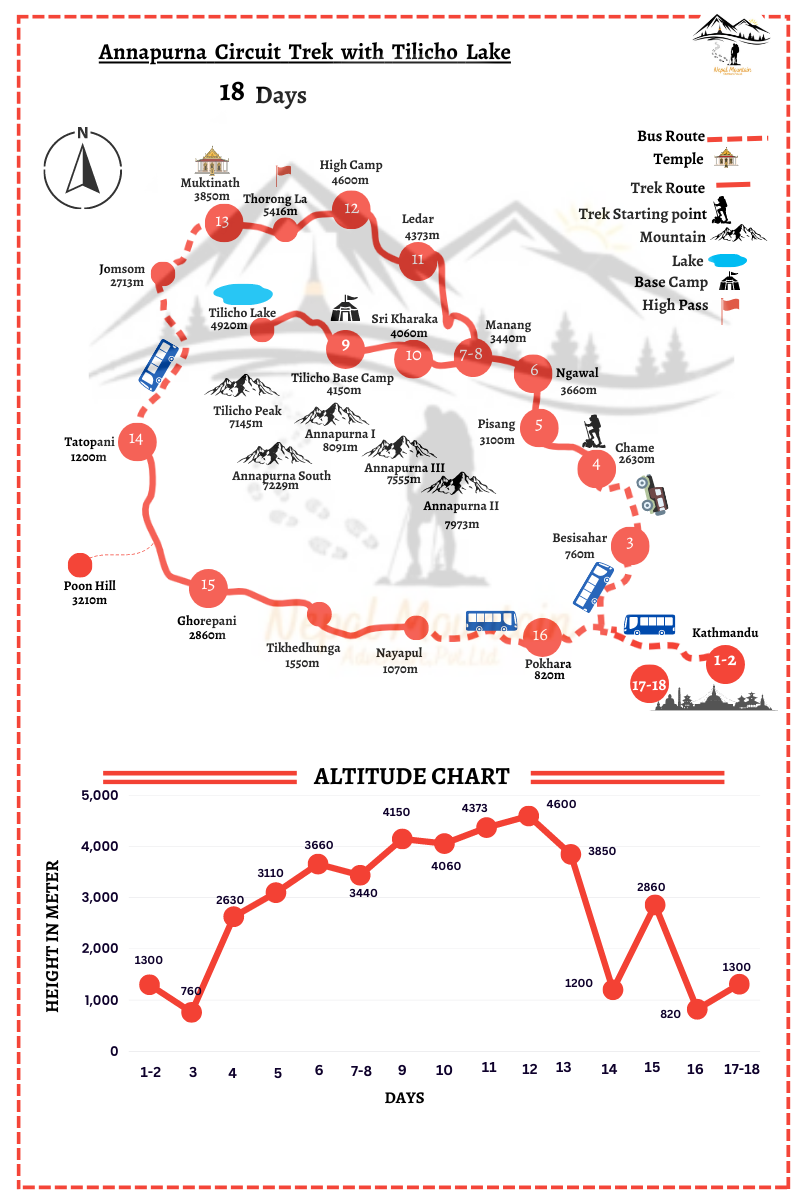 Key locations: Jomsom, Muktinath, Thorong Phedi, and Manang. (Image: Avishekkhadka111, CC BY-SA 4.0, via Wikimedia Commons)
Worked Example: Everest Base Camp Trek
- Route: Lukla → Namche Bazaar → Tengboche → Dingboche → Gorak Shep → EBC.
- Challenges:
- Acclimatization: Spend 2–3 days in Namche (3,440m) and Dingboche (4,410m) to avoid AMS.
- Weather: Monsoon (June–September) brings landslides; winter (Dec–Feb) has extreme cold.
- Permits: Sagarmatha National Park Permit (USD 30) + TIMS (Tourist Information Management System) (USD 20–30).
- Cost: USD 800–1,500 (includes guide, permits, lodges, meals).
3. Mountaineering in Nepal: Peaks and Permits
Nepal is home to 8 of the world’s 10 highest peaks, making it a global hub for mountaineering. The Nepal Mountaineering Association (NMA) regulates climbs above 6,000m.
Major Mountaineering Peaks
| Peak | Altitude | Difficulty | Best Season | Permit Cost (Foreigner) |
|---|---|---|---|---|
| Mount Everest | 8,848m | Extreme | Apr–May, Oct–Nov | USD 11,000 |
| Kanchenjunga | 8,586m | Extreme | Apr–May, Sep–Oct | USD 3,500 |
| Lhotse | 8,516m | Extreme | Apr–May, Oct–Nov | USD 2,200 |
| Makalu | 8,485m | Extreme | Apr–May, Sep–Oct | USD 2,200 |
| Cho Oyu | 8,188m | Hard | May, Sep–Oct | USD 1,000 |
| Annapurna I | 8,091m | Extreme | Mar–May, Sep–Nov | USD 1,000 |
| Dhaulagiri I | 8,167m | Extreme | Apr–May, Sep–Oct | USD 1,000 |
| Manaslu | 8,163m | Hard | Sep–Nov, Apr–May | USD 700 |
Permits and Regulations
- TIMS Card: Mandatory for all trekkers and climbers (USD 20–30).
- Peak Permits: Issued by the Nepal Mountaineering Association (NMA).
- Foreign climbers: Must hire a licensed guide and Sherpa support.
- Nepali climbers: Require a special permit and must prove experience.
- Insurance: USD 10,000 medical evacuation insurance is compulsory.
Worked Example: Climbing Cho Oyu (8,188m)
- Why Cho Oyu?: Considered the "easiest 8,000m peak" for beginners.
- Route: Base Camp (6,400m) → Camp 1 (7,000m) → Summit via the North Ridge.
- Cost: ~USD 4,000 (includes guide, permits, oxygen, tents).
- Challenges:
- Crevasse falls: Requires rope work and ice axe training.
- Altitude sickness: Mandatory acclimatization hikes before summit push.
- Weather: Strong winds at the summit (above 100 km/h).
4. Technical Skills for Mountaineering
Mountaineering requires specialized skills beyond basic trekking. Key techniques include:
A. Rope Work and Knots
- Figure-8 Follow-Through Knot: Used to attach a climber to a rope.
- Prusik Knot: Friction hitch for ascending a rope.
- Clove Hitch: Secures a rope to a fixed point (e.g., ice axe).
B. Ice Axe and Crampon Use
- Ice Axe: Used for balance, self-arrest (stopping a fall), and cutting steps in ice.
- Crampons: Provide traction on snow/ice (12-point crampons for steep terrain).
C. Crevasse Rescue
- Z-Pulley System: Used to extract a buried climber.
- Probe and Rope: Essential for locating and rescuing fallen climbers.
D. Navigation and Weather Reading
- Map and Compass: Critical in whiteouts (no visibility).
- Weather Signs:
- Red sky at night = climber’s delight (clear weather).
- Corona (halo around the sun) = storm coming.
5. Risk Management and Safety
Adventure tourism in Nepal involves high risks, including altitude sickness, avalanches, and landslides.
A. Altitude Sickness (AMS)
- Symptoms: Headache, nausea, dizziness, fatigue.
- Prevention:
- Acclimatization: Ascend 300–500m per day, with rest days every 3–4 days.
- Hydration: Drink 4–5L of water daily.
- Diamox (Acetazolamide): Prescription drug to aid acclimatization.
B. Emergency Equipment
| Equipment | Purpose | Example Use |
|---|---|---|
| Gamow Bag | Treats AMS by simulating lower altitude. | Used in Lukla or Namche for severe AMS. |
| PAP (Portable Altitude Chamber) | Advanced AMS treatment. | Deployed in Kathmandu hospitals. |
| First Aid Kit | Bandages, antiseptics, painkillers. | Treating blisters or minor injuries. |
| Satellite Phone | Emergency communication in remote areas. | Rescue coordination in Everest region. |
C. Avalanche Safety
- Avalanche Beacon: Emits a signal to locate buried climbers.
- Probe: Used to pinpoint depth after a beacon signal.
- Avalanche Transceiver Training: Mandatory for high-altitude climbs.
6. Adventure Tourism Equipment
Proper gear is essential for safety and comfort. Below is a checklist for trekking and mountaineering.
Trekking Gear
| Category | Essential Items |
|---|---|
| Footwear | Waterproof hiking boots (e.g., Salomon Quest) |
| Clothing | Moisture-wicking base layers, fleece, rain jacket |
| Backpack | 40–60L with rain cover |
| Navigation | Map, compass, GPS (Garmin inReach) |
| Hydration | 2–3L water capacity + water purification (Steripen) |
| Shelter | 4-season tent (e.g., MSR Hubba Hubba) |
Mountaineering Gear
| Category | Essential Items |
|---|---|
| Technical Clothing | Down suit, insulated gloves, balaclava |
| Rope and Harness | 60m dynamic rope, harness with carabiners |
| Ice Tools | Ice axe, crampons (12-point for steep ice) |
| Oxygen System | Supplemental oxygen (for peaks >8,000m) |
| High-Altitude Tent | -40°C rated (e.g., Hilleberg Akto) |
7. Regulations and Permits in Nepal
Nepal has strict regulations to ensure safety and sustainability in adventure tourism.
A. Trekking Permits
- TIMS Card: Mandatory for all trekkers (USD 20–30).
- National Park Permits:
- Sagarmatha (EBC): USD 30
- Annapurna: USD 30
- Langtang: USD 30
- Mustang: USD 500 (Restricted Area Permit)
B. Mountaineering Permits
- Nepal Mountaineering Association (NMA) Permit: Required for peaks >6,000m.
- Foreign Climbers:
- Must hire a licensed guide and Sherpa support.
- USD 1,000–11,000 depending on the peak (e.g., Everest: USD 11,000).
- Nepali Climbers:
- Must prove experience (previous climbs) and obtain a special permit.
C. Environmental Regulations
- Leave No Trace (LNT): Mandatory in all trekking zones.
- Waste Management: Trekkers must carry out all trash (Nepal’s "Clean Himalaya" campaign).
- Plastic Ban: Single-use plastics are prohibited in trekking areas.
8. Marketing Adventure Tourism in Nepal
Nepal promotes adventure tourism through:
- Digital Marketing: Social media (Instagram, YouTube) showcasing EBC, Annapurna, and Everest climbs.
- Tour Operators: Companies like Seven Summit Treks, Nepal Adventure Company, and Explore Himalaya.
- Government Initiatives:
- Visit Nepal 2020/2025: Focused on sustainable tourism.
- Community Homestays: Programs in Manang, Gorkha, and Mustang to support local economies.
Worked Example: Marketing the Annapurna Circuit
- Target Audience: Budget backpackers, cultural tourists, and experienced trekkers.
- Unique Selling Points (USPs):
- Thorong La Pass (5,416m): Highest trekking pass in the world.
- Muktinath Temple: Sacred Hindu/Buddhist pilgrimage site.
- Cultural Diversity: Gurung, Thakali, and Manangi communities.
- Promotion:
- YouTube Videos: "Annapurna Circuit in 10 Days" (e.g., by Adventure Pursuit).
- Influencer Partnerships: Collaborations with travel bloggers like "Nomadic Matt" or "The Broke Backpacker".
In the Real World
Adventure tourism in Nepal is a multi-billion-dollar industry, with companies and apps leveraging these concepts daily:
eSewa and Khalti for Permits
- How it works: Trekkers and climbers now book TIMS cards and permits online via eSewa or Khalti, reducing queues at Kathmandu offices.
- Example: A trekker in Pokhara can pay for the Annapurna Conservation Area Permit (USD 30) via Khalti and receive a digital receipt, which is later validated by trekking agencies.
Pathao and Ncell’s "Adventure Tour Packages"
- How it works: Ride-hailing app Pathao partners with Ncell to offer "Trekking Starter Packs"—discounted SIM cards with offline maps, emergency contacts, and weather alerts for EBC and Annapurna trekkers.
- Example: A tourist arriving in Lukla gets a Pathao voucher for USD 10, which includes 1GB data + a pre-loaded offline map of the EBC route.
Nepal’s "Adventure Tourism Insurance" via NMB Bank and Nabil Bank
- How it works: Banks like NMB and Nabil offer specialized insurance policies covering:
- Medical evacuation (e.g., helicopter rescue from Everest at USD 10,000).
- Trip cancellation (due to avalanches or political unrest).
- Gear loss (e.g., stolen oxygen tanks on the summit).
- Example: A climber on Cho Oyu takes out a USD 5,000 policy from Nabil Bank. If they suffer frostbite requiring evacuation, the bank covers hospital bills in Kathmandu.
- How it works: Banks like NMB and Nabil offer specialized insurance policies covering:
Daraz and Hiking Gear Rental
- How it works: E-commerce platform Daraz has partnered with gear rental shops in Thamel to offer "Trekking Gear Rentals"—clients can rent crampons, ice axes, and down suits for 10–15% cheaper than buying.
- Example: A backpacker planning the Langtang Trek rents a 4-season tent (USD 20/day) and crampons (USD 15/day) from Daraz’s rental section, saving USD 200 compared to purchasing.
NTC’s "Trekking Route SMS Alerts"
- How it works: Nepal Telecom (NTC) provides free SMS updates on:
- Landslide alerts (e.g., "Avalanche risk: Langtang Valley, avoid today").
- Road closures (e.g., "Jomsom Airport closed due to fog—alternate route via Pokhara").
- Example: A trekker in Manang receives an SMS: "Heavy snow forecast on Thorong La Pass—postpone summit attempt." They adjust their itinerary, avoiding danger.
- How it works: Nepal Telecom (NTC) provides free SMS updates on:
Exam Tip
This unit is heavily tested in TU exams through:
Definitions and Differences (5–10 marks):
- Expect questions like:
- "Distinguish between trekking and mountaineering with examples from Nepal."
- "Why is Cho Oyu considered easier than Everest for beginners?"
- Answer Tip: Use comparison tables and real examples (e.g., EBC vs. Everest summit).
- Expect questions like:
Permits and Regulations (10–15 marks):
- Common Questions:
- "What permits are required for the Annapurna Circuit? Calculate the total cost for a foreign trekker."
- "Explain the role of the Nepal Mountaineering Association (NMA) in regulating mountaineering."
- Answer Tip: Memorize permit costs, TIMS rules, and restricted areas (e.g., Mustang).
- Common Questions:
Risk Management and Safety (10–15 marks):
- Common Questions:
- "Describe the symptoms of Altitude Sickness (AMS) and its prevention methods."
- "How would you respond to a crevasse fall during an Everest expedition?"
- Answer Tip: Use flowcharts (e.g., AMS symptoms → treatment) and real scenarios (e.g., "A climber in Camp 2 shows confusion—what do you do?").
- Common Questions:
Case Studies and Worked Examples (10–15 marks):
- Common Questions:
- "Calculate the acclimatization days needed for a trekker ascending from Lukla (2,860m) to Everest Base Camp (5,364m)."
- "Explain why the Annapurna Circuit is more culturally diverse than the Langtang Trek."
- Answer Tip: Draw timelines for trekking routes and compare cultural stops (e.g., Manang’s Tibetan influence vs. Langtang’s Tamang heritage).
- Common Questions:
Equipment and Technical Skills (5–10 marks):
- Common Questions:
- "List the essential mountaineering gear for a winter expedition on Dhaulagiri."
- "How is a Prusik knot used in crevasse rescue?"
- Answer Tip: Labelled diagrams of knots, gear, and rescue systems score full marks.
- Common Questions:
Final Advice:
- Link theory to Nepal: Examiners love real-world applications (e.g., "How does NTC’s SMS system improve trekking safety?").
- Use visuals: Tables, mindmaps, and labelled diagrams (e.g., trekking routes, permit forms) boost your score.
- Practice calculations: Permit costs, acclimatization days, and gear budgets are common in numerical questions.
Based on the TU BTTM syllabus for Adventure Tourism, unit 3.
Discussion
Loading…