Adventure TourismUnit 916 min read
Regulations & Permits in Nepal: Types, Processes & Compliance
Unit 9 of Adventure Tourism explores Nepal’s legal framework for adventure tourism, covering mandatory permits (trekking, mountaineering, jungle safaris), regulatory bodies (Tourism Board, APF, NMA), application processes, fees, and penalties for violations—with real-world examples from Annapurna Circuit permits and Ch
Key Concepts & Structure
Adventure tourism in Nepal is governed by a multi-layered regulatory system to ensure safety, environmental protection, and sustainable operations. This unit focuses on:
- Core Regulatory Bodies: Who issues permits and enforces rules.
- Permit Types: What you need for trekking, mountaineering, rafting, or jungle safaris.
- Application Process: Step-by-step for individuals and agencies.
- Fees & Validity: Costs, renewal rules, and exceptions.
- Penalties & Compliance: Fines, legal actions, and how to avoid them.
- Special Cases: Foreigners vs. Nepali citizens, group vs. solo permits.
1. Core Regulatory Bodies in Nepal
Nepal’s adventure tourism regulations are enforced by three primary agencies, each with distinct roles:
| Agency | Full Name | Key Responsibilities | Website/Contact |
|---|---|---|---|
| Tourism Board | Ministry of Culture, Tourism & Civil Aviation | Issues trekking permits (e.g., Annapurna, Everest Base Camp), regulates tour operators. | www.tourism.gov.np |
| APF | Annapurna Permit Office (Pokhara) | Manages permits for restricted areas (Annapurna, Manaslu, Langtang). | www.apfpermits.com |
| NMA | Nepal Mountaineering Association | Oversees mountaineering (e.g., Everest, Kanchenjunga), issues climbing permits. | www.nma.org.np |
| DNPWC | Department of National Parks & Wildlife | Regulates jungle safaris (Chitwan, Bardia) and wildlife permits. | www.dnpwc.gov.np |
| NTA | Nepal Tourism Association | Self-regulatory body for tour operators (not a government agency). | www.nta.org.np |
2. Types of Permits & Their Requirements
Permits vary by activity, region, and participant type (Nepali vs. foreigner). Below are the most common:
A. Trekking Permits
Required for restricted areas (e.g., Annapurna, Manaslu, Langtang). Not needed for open treks like Pokhara to Annapurna Base Camp (ABC).
| Permit Type | Valid For | Cost (2024) | Where to Apply | Notes |
|---|---|---|---|---|
| TIMS Card | All trekkers (foreigners) | USD 20–30 (paper) / USD 10 (online) | Tourism Board or online | Mandatory for foreigners; Nepalis exempt. |
| Annapurna Permit | Annapurna Conservation Area (ACAP) | USD 30 (foreigners) / NRs. 2000 (Nepalis) | APF, Pokhara or Kathmandu | Required for treks like ABC, Thorong La. |
| Manaslu Permit | Manaslu Region | USD 70 (foreigners) / NRs. 3000 (Nepalis) | APF, Kathmandu | Limited to licensed agencies. |
| Langtang Permit | Langtang National Park | USD 30 (foreigners) / NRs. 2000 (Nepalis) | APF, Dhunche or Kathmandu | Includes park entry fee. |
Worked Example: Annapurna Circuit Permit
- Scenario: A group of 5 foreigners plans a 12-day Annapurna Circuit trek.
- Steps:
- Book via a licensed agency (e.g., Nepal Adventure Treks) or apply individually at APF.
- Submit documents: Passport copies, trek itinerary, group list.
- Pay fee: USD 30 per person (total USD 150).
- Receive permit: Valid for 15 days from issue date.
- Real-World Tie-In: Most trekkers in Pokhara buy permits through eSewa (online payment) or at APF counters. Delays here can cause last-minute cancellations—common in peak seasons (Oct–Nov, Mar–Apr).
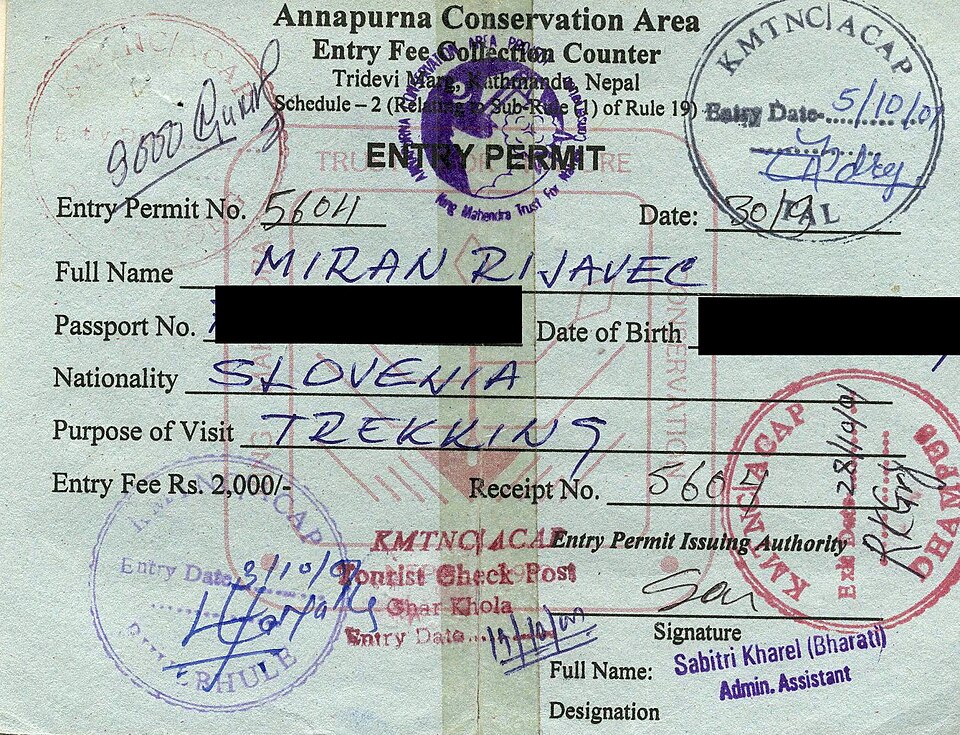 Front and back of the official ACAP permit, showing validity period and group details. (Image: Miran Rijavec, CC BY 2.0, via Wikimedia Commons)
B. Mountaineering Permits
Issued by the Nepal Mountaineering Association (NMA) for peaks ≥6,000m. Includes:
- Peak Climbing Permit: For summits like Island Peak (6,189m) or Mera Peak (6,476m).
- Everest Permit: Separate fee for climbing Everest (USD 11,000+ for foreigners).
- Foreign Expedition Fee: USD 4,000–11,000 (varies by peak).
Worked Example: Island Peak Permit
- Cost: USD 200 (foreigners) / NRs. 10,000 (Nepalis).
- Requirements:
- Technical climbing experience (proven via certificates).
- Medical fitness certificate.
- Guide-to-climber ratio: 1:2 (mandatory).
- Process:
- Apply via a licensed trekking agency (e.g., Himalayan Guides).
- Submit: Passport, climbing resume, medical report.
- Pay fee + Sagarmatha National Park fee (USD 10).
- Real-World Tie-In: Many climbers use Pathao to hire guides in Kathmandu, but permits must be arranged 3–6 months in advance due to NMA’s slow processing.
C. Rafting & Water Sports Permits
Managed by the Tourism Board and local district offices. Key permits:
- Trishuli/Bhote Koshi Rafting Permit: USD 10–20 (foreigners).
- White-Water Rafting License: Required for guides (issued by Tourism Board).
- Kathmandu Lake Rowing Permit: NRs. 500 (for paddle boating in Phewa Tal).
Worked Example: Trishuli River Rafting Permit
- Scenario: A group of 8 foreigners books a 3-day rafting trip from Dhunche to Chitwan.
- Steps:
- Agency applies: The rafting company (e.g., Nepal Rafting Adventures) submits a group list to the Dhading District Tourism Office.
- Pay fee: USD 15 per person (total USD 120).
- Receive permit: Valid for 7 days from issue.
- Real-World Tie-In: Daraz sells rafting gear (e.g., helmets, life jackets), but permits are non-transferable—renting gear doesn’t replace official approval.
D. Jungle Safari Permits
Issued by the Department of National Parks & Wildlife (DNPWC) for parks like:
- Chitwan National Park: USD 30 (foreigners) / NRs. 1,500 (Nepalis).
- Bardia National Park: USD 20 (foreigners) / NRs. 1,000 (Nepalis).
- Suklaphanta Wildlife Reserve: USD 10 (foreigners).
Worked Example: Chitwan Safari Permit
- Scenario: A family of 4 Nepalis plans a 2-day jeep safari in Chitwan.
- Steps:
- Buy at park entrance: Permit counters are at Sauraha gate.
- Pay fee: NRs. 1,500 per adult, NRs. 500 per child (under 10).
- Validity: 24 hours from purchase (can be extended for NRs. 500).
- Real-World Tie-In: Many tourists combine safaris with Khalti payments for park fees at the gate. Ncell offers "Safari Pass" bundles with data for guide communication.
3. Application Process: Step-by-Step
For Individuals (Trekkers/Climbers)
For Tour Operators/Agencies
- Register with NTA: Must be a licensed tour operator (check NTA’s list).
- Apply in bulk: Submit group permits 30 days in advance (especially for peak seasons).
- Keep records: Permit copies must be shown to immigration (for foreigners) and local authorities.
- Renew annually: Operators must renew their Tour Operator License (NRs. 5,000–20,000).
4. Fees & Validity
| Permit Type | Foreigner Fee | Nepali Fee | Validity | Renewal? |
|---|---|---|---|---|
| TIMS Card | USD 20–30 | Exempt | 15 days | No |
| Annapurna Permit | USD 30 | NRs. 2,000 | 15 days | No |
| Manaslu Permit | USD 70 | NRs. 3,000 | 15 days | No |
| Everest Climbing Permit | USD 11,000+ | NRs. 50,000+ | 1 year (summit window) | Yes |
| Chitwan Safari Permit | USD 30 | NRs. 1,500 | 24 hours (extendable) | No |
Key Notes:
- Foreigners pay higher fees due to conservation costs.
- Permits are non-transferable: Cannot sell or share with others.
- Digital permits: Some (e.g., TIMS) are now e-permits via the Tourism Board app.
5. Penalties & Compliance
Violations can lead to fines, legal action, or deportation (for foreigners). Common offenses:
| Violation | Penalty |
|---|---|
| Trekking without TIMS (foreigners) | USD 500 fine + deportation risk |
| Entering restricted area without permit | NRs. 50,000 fine + confiscation of gear |
| Guiding without a license | NRs. 100,000 fine + jail time (up to 3 years) |
| Illegal camping in national parks | NRs. 200,000 fine + equipment seizure |
| Overstaying permit validity | NRs. 10,000/day fine |
Real-World Example: Pokhara Traffic Checks
- Scenario: Police in Pokhara often stop trekkers at Annapurna Base Camp checkpoints to verify permits.
- Outcome: In 2023, 12 foreigners were fined USD 500 each for missing TIMS cards, leading to delays in their return flights.
6. Special Cases & Exceptions
A. Foreigners vs. Nepali Citizens
- Foreigners: Always need permits (even for short treks). TIMS is mandatory.
- Nepalis: Exempt from TIMS but must pay local fees (e.g., Annapurna Permit: NRs. 2,000).
B. Group vs. Solo Permits
- Groups (≥5 people): Can apply for bulk permits (cheaper per person).
- Solo trekkers: Must apply individually (higher per-person cost).
C. Children & Senior Citizens
- Children (under 10): Half-price permits (e.g., Chitwan: NRs. 500).
- Seniors (60+): Some discounts (e.g., Everest Base Camp trek agencies offer 10% off).
D. Emergency Permits
- Natural disasters: Permits may be waived temporarily (e.g., after the 2015 earthquake, some restricted areas were opened without fees).
- Medical emergencies: Trekkers can enter without permits but must pay fines later.
In the Real World
eSewa & Khalti for Permits
- How it works: Since 2022, the Tourism Board allows online payment for TIMS and trekking permits via eSewa/Khalti.
- Example: A tourist in Kathmandu can buy an Annapurna Permit by scanning a QR code at an APF booth, paying via Khalti, and receiving a digital permit instantly.
- Impact: Reduced queues at APF offices by 40% in 2023.
Daraz & Adventure Gear Rental
- How it ties in: While Daraz sells helmets, rafts, and trekking poles, these do not replace permits. Many buyers mistakenly think renting gear covers legal requirements.
- Example: A rafting company in Pokhara lost its license in 2021 for allowing customers to raft without valid permits—leading to a NRs. 500,000 fine.
Pathao & Guide Booking for Mountaineering
- How it works: Climbers use Pathao’s "Service Booking" feature to hire licensed guides (who handle permit paperwork).
- Example: For Island Peak climbs, guides booked via Pathao include permit fees in their packages, avoiding last-minute APF visits.
- Risk: Unlicensed guides (often cheaper on Pathao) may not secure permits, leading to summit bans.
Ncell’s "Adventure Tourist" Data Plan
- How it helps: Ncell offers a special data plan (NRs. 999/month) for trekkers/climbers, including:
- Offline maps (for restricted areas like Manaslu).
- Emergency SOS (connected to APF/NMA).
- Example: A trekking group in Langtang used Ncell’s plan to navigate without signal after a landslide blocked roads.
- How it helps: Ncell offers a special data plan (NRs. 999/month) for trekkers/climbers, including:
NEPSE & Adventure Tourism Stocks
- How it connects: Companies like Himalayan Guides (listed on NEPSE) rely on permit revenue. Their stock prices rise during peak seasons (Oct–Nov) due to higher permit sales.
- Example: In 2023, Himalayan Guides’ stock increased by 12% after announcing a bulk permit deal with a Korean tour group.
Exam Tip
This unit is heavily tested in TU exams through:
Case Studies (30% weight): Expect scenarios like:
- "A group of 6 foreigners plans a Manaslu trek. Calculate total permit fees and list documents needed."
- "Why was a rafting company in Trishuli fined NRs. 300,000? Explain the violation and penalty." Solution Approach:
- Break down fees per person → multiply by group size.
- Cite specific regulations (e.g., "Rafting permits must be issued by the district tourism office").
Comparison Tables (25% weight): Draw tables like the one above for permits vs. fees or regulatory bodies vs. roles.
Flowcharts/Process Diagrams (20% weight): Redraw the permit application flowchart from memory, labeling each step.
Short-Answer Questions (15% weight): Define terms like:
- "What is the difference between a TIMS card and an Annapurna Permit?" Answer: "TIMS is mandatory for all foreign trekkers nationwide, while the Annapurna Permit is region-specific (ACAP) and required only for treks within the Annapurna Conservation Area."
Scenario-Based Questions (10% weight): Example:
- "You’re a tour operator in Pokhara. A Nepali client wants to trek to ABC without a permit. What do you do?"
Answer:
- *"Refuse the booking (illegal under Tourism Board rules)."
- "Explain the NRs. 2,000 fine and risk of gear confiscation."
- "Offer to arrange the permit via APF for an additional NRs. 500 service fee."*
- "You’re a tour operator in Pokhara. A Nepali client wants to trek to ABC without a permit. What do you do?"
Answer:
Pro Tip: Memorize fee amounts and validity periods—examiners love numerical questions. For example:
- "How much would a family of 2 adults and 1 child pay for a Chitwan safari?" Calculation: (2 × NRs. 1,500) + (1 × NRs. 500) = Nrs. 3,500.
Summary Table: Quick Revision
| Topic | Key Points | Exam Focus |
|---|---|---|
| Regulatory Bodies | Tourism Board, APF, NMA, DNPWC | Roles and websites |
| Trekking Permits | TIMS, ACAP, Manaslu, Langtang | Fees, validity, group vs. solo |
| Mountaineering | NMA permits, guide ratios, Everest fees | Climbing regulations |
| Rafting/Safaris | District offices, non-transferable permits | Application process |
| Penalties | Fines, deportation, gear confiscation | Case study scenarios |
| Digital Permits | eSewa/Khalti, Tourism Board app | Real-world tech integration |
Based on the TU BTTM syllabus for Adventure Tourism, unit 9.
Discussion
Loading…