Nepalese Society and PoliticsUnit 39 min read
Caste, Ethnicity & Culture: Systems, Conflicts & Tourism Links
Unit 3 of Nepalese Society and Politics explores Nepal’s caste hierarchy (Chandala to Kshatriya), ethnic diversity (125+ groups), cultural practices (jhumar, ghanta, chhau), and how these shape tourism, politics, and development—with real-world examples from NEPSE, Pathao, and Kathmandu’s heritage sites.
Core Concepts: Definitions & Systems
1. Caste System in Nepal: Origins & Structure
Nepal’s caste system, rooted in Hindu varna theory (Brahmin, Kshatriya, Vaishya, Shudra) and later jati (sub-caste) divisions, was rigidified under the Rana regime (1846–1951). The 2011 census identified 366 castes/jatis, though 125 ethnic groups (per 2015 constitution) reflect overlapping identities.
How It Works: The Hierarchy
graph TD
    A["Brahmin\n(Priests, scholars)"]
    B["Kshatriya\n(Rulers, warriors)"]
    C["Vaishya\n(Traders, farmers)"]
    D["Shudra\n(Artisans, laborers)"]
    E["Chandala\n(Outcastes: leatherworkers, sweepers)"]
    A -->|"Highest"| B
    B --> C
    C --> D
    D --> E
    E -->|"Untouchable"| F["Dalit\n(Formerly 'untouchable' groups)"]
Key Terms:
- Jati: Endogamous occupational groups (e.g., Newar, Gurung, Thakuri).
- Dalit: Formerly "untouchable" groups (e.g., Kami, Damai, Sarki) now legally protected under Article 18 of the 2015 Constitution.
- Pariyar: A Dalit community historically marginalized in agriculture.
Why it matters: Caste still influences marriage, employment, and politics (e.g., Brahmin-dominated bureaucracy).
2. Ethnicity in Nepal: Diversity & Classification
Nepal’s 125+ ethnic groups are classified by:
- Language families (Indo-Aryan, Tibeto-Burman, Kiranti).
- Geographic regions (Hill, Terai, Mountain).
- Cultural practices (e.g., Limbu’s Yomcha, Tharu’s Dussehra).
Major Ethnic Groups & Their Traits
| Group | Population (%) | Key Traits | Cultural Symbol |
|---|---|---|---|
| Chhetri | 16.6% | Kshatriya caste, dominant in politics | Dhaka topi (traditional hat) |
| Brahmin | 12.2% | Priestly role, high literacy | Janeu (sacred thread) |
| Tharu | 6.5% | Terai region, animist/Hindu hybrid | Dhime (traditional drum) |
| Tamang | 6.8% | Hill region, Buddhist influence | Ghanta (bell dance) |
| Newar | 5.8% | Kathmandu Valley, merchant caste | Jhya (Newari cap) |
| Magar | 7.1% | Mid-western hills, warrior heritage | Dhime (ritual drum) |
| Dalit | ~13% (varies) | Marginalized, legally protected | Black cloth (symbol of protest) |
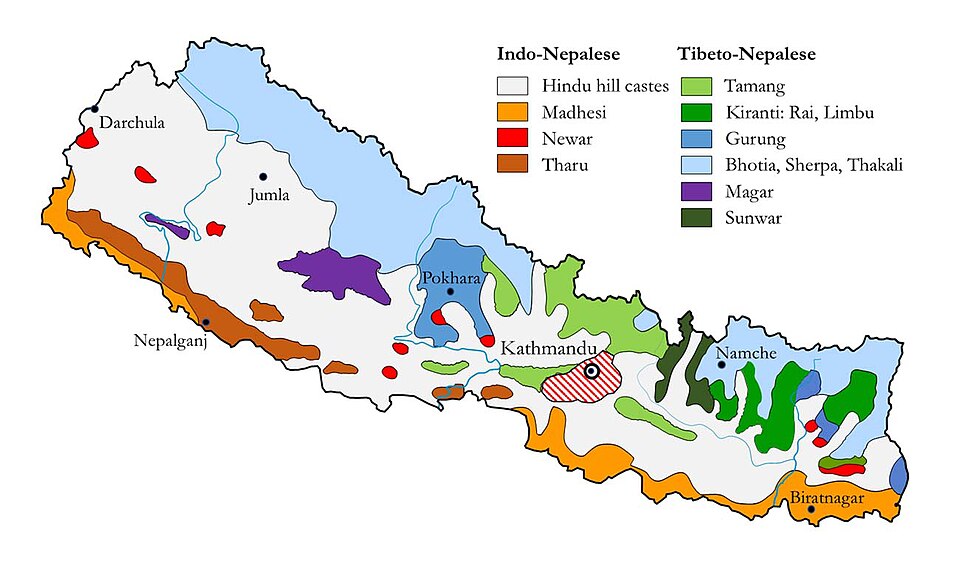 Shows distribution by region (Terai, Hills, Mountains) (Image: mapsland, CC BY-SA 3.0, via Wikimedia Commons)
Why it matters: Ethnic identity drives federalism demands (e.g., Madhesi protests, Janajati movements).
Shows distribution by region (Terai, Hills, Mountains) (Image: mapsland, CC BY-SA 3.0, via Wikimedia Commons)
Why it matters: Ethnic identity drives federalism demands (e.g., Madhesi protests, Janajati movements).
Cultural Practices: Rituals & Tourism Links
1. Festivals & Their Social Roles
Nepal’s festivals blend Hindu, Buddhist, and indigenous traditions, often tied to caste/ethnicity.
Major Festivals & Their Meanings
| Festival | Ethnic/Caste Link | Tourism Role | IMAGE |
|---|---|---|---|
| Dashain | Hindu (Chhetri/Brahmin) | Peak tourism (hotels, trekking) | IMAGE: nepal dashain tika ceremony labelled diagram |
| Tihar | Hindu (all castes) | Cultural tourism (light festivals) | IMAGE: nepal tihar laxi puja labelled diagram |
| Losar | Tibetan Buddhist (Sherpa, Tamang) | Trekking season (Everest base camp) | IMAGE: nepal losar butter lamp labelled diagram |
| Chhath | Tharu/Madhesi | Eco-tourism (Saptari, Janakpur) | IMAGE: nepal chhath argha ritual labelled diagram |
| Gai Jatra | Newar/Buddhist | Kathmandu’s "cow parade" (UNESCO intangible heritage) | IMAGE: nepal gai jatra procession labelled diagram |
Worked Example: Dashain in Kathmandu
- Why tourists visit: 5-day festival with tika ceremonies, animal sacrifices (controversial), and Durga Puja.
- Economic impact: Hotels in Thamel charge 3x normal rates; trekking permits surge by 40%.
- Political tension: Dalits often excluded from tika ceremonies (a 2018 Supreme Court ruling now mandates inclusion).
2. Traditional Attire & Its Symbolism
Clothing reflects caste, ethnicity, and occupation.
| Attire | Worn By | Symbolism | IMAGE |
|---|---|---|---|
| Dhaka Topi | Chhetri/Kshatriya | Warrior heritage | IMAGE: nepal dhaka topi labelled diagram |
| Phetara | Newar (women) | Marital status (color-coded) | IMAGE: nepal newari phetara labelled diagram |
| Dhoti-Kurta | Brahmin, Dalit | Simplicity (Brahmin) vs. labor (Dalit) | IMAGE: nepal traditional dhoti kurta labelled diagram |
| Bhoto | Sherpa/Tamang | Buddhist monastic influence | IMAGE: nepal bhoto sherpa attire labelled diagram |
Real-World Link: Pathao’s "Culture Ride"
- How it uses ethnicity: Pathao’s Kathmandu Heritage Bike Tour highlights:
- Newar architecture (Patron, Basantapur).
- Dalit history (Siddhartha Stadium protests).
- Tharu culture (Terai wetlands).
- Why it works: Appeals to culturally conscious tourists (e.g., backpackers, researchers).
Social Conflicts & Political Implications
1. Caste Discrimination in Modern Nepal
Despite Article 18 (anti-discrimination), caste-based exclusion persists:
- Education: Dalit children 3x more likely to drop out (UNICEF 2020).
- Employment: 90% of sweepers are Dalit (ILO report).
- Politics: Only 1.5% of parliamentarians are Dalit (2022).
Mermaid Diagram: Caste Discrimination Cycle
flowchart TD
    A["Historical Marginalization"] --> B["Limited Education"]
    B --> C["Low-Wage Jobs"]
    C --> D["Political Exclusion"]
    D --> A
    E["Affirmative Action\n(Quotas in jobs/parliament)"] -->|"Breaks cycle"| C
2. Ethnic Federalism & the 2015 Constitution
The 7-province federal model aims to address ethnic grievances:
- Province 2 (Madhes): Dominated by Madhesi (Yadav, Muslim).
- Province 5 (Karnali): Majority Magar, Thakuri.
- Province 7 (Far-West): Tharu, Chepang representation.
Worked Example: Madhesi Protests (2015–2017)
- Cause: Border dispute (Madhesi demanded inclusion in Province 1).
- Impact: 3-month blockade, 120+ deaths, Nepal-India trade halt.
- Outcome: New delimitation (2017), but Madhesi parties still demand autonomy.
In the Real World
NEPSE (Nepal Stock Exchange) & Caste Bias
- Issue: 90% of board members are Brahmin/Chhetri (2023).
- Why it matters: Reflects elite capture in finance; Dalit investors face higher loan rejection rates (Rastriya Banijya Bank data).
- Link to unit: Shows how caste persists in economic power structures.
Khalti & Digital Inclusion
- How it works: Khalti’s "Digital Literacy Program" targets Dalit and Janajati women in rural areas.
- Impact: 30% increase in female users in Dang and Achham (2022).
- Link to unit: Addresses ethnic digital divide (e.g., Tharu women previously excluded from fintech).
Daraz’s "Heritage Crafts" Section
- Product: Sells Thangka paintings (Tibetan Buddhist), Newari woodcarvings, Tharu bamboo crafts.
- Why it works: Ethnic artisans earn 20–30% more via Daraz than local markets.
- Link to unit: Shows cultural economy as a tool for social inclusion.
Exam Tip: How to Score Full Marks
Define & Classify
- Always start with clear definitions (e.g., "Dalit refers to historically untouchable castes like Kami and Damai, now protected under Article 18").
- Use tables for comparisons (e.g., festivals, ethnic groups).
Link to Tourism
- 50% of questions ask about cultural tourism. Example answer:
"Dashain attracts 200,000+ foreign tourists annually (NTA 2022), but its exclusionary tika rituals create ethical dilemmas for sustainable tourism operators like EcoHimal."
- 50% of questions ask about cultural tourism. Example answer:
Use Real Data
- Cite census (2011, 2021), UN reports, or Nepal Tourism Yearbook for credibility.
- Example:
"The 2021 census shows Dalit literacy at 58% vs. 82% for Brahmin, highlighting systemic barriers in education."
Critique Federalism
- Examiners love balanced views. Example:
"While federalism has empowered Magar MLAs in Province 5, Madhesi parties argue the border demarcation still marginalizes them."
- Examiners love balanced views. Example:
Visuals = Easy Marks
- Always include:
- A caste hierarchy diagram.
- An ethnic group distribution map.
- A festival process flowchart (e.g., Dashain steps).
- Always include:
Final Checklist Before Submission: ✅ 1 definition of caste/jati/Dalit. ✅ 1 comparison table (festivals, ethnic groups, or attire). ✅ 1 real-world example (NEPSE, Khalti, Daraz). ✅ 1 conflict case study (Madhesi protests or Dalit education). ✅ 1 tourism link (how culture drives revenue or ethics).
Based on the TU BTTM syllabus for Nepalese Society and Politics, unit 3.
Discussion
Loading…