Tourism Planning and PoliciesUnit 814 min read
Stakeholders in Tourism: Roles, Types & Collaboration
Unit 8 of Tourism Planning and Policies explores the diverse stakeholders shaping Nepal’s tourism sector—government agencies, private businesses, communities, NGOs, and international partners—along with their roles, conflicts, and collaborative frameworks. Learn how their interactions drive sustainable tourism policies
TAKEAWAYS:
- Stakeholders in tourism planning include public (government), private (businesses), community-based (local groups), and international (NGOs, donors) actors, each with distinct roles and influence.
- Government stakeholders (e.g., Ministry of Culture, Tourism and Civil Aviation, Local Governances) set policies, regulate activities, and allocate resources, while private stakeholders (hotels, tour operators) drive economic growth but often face regulatory hurdles.
- Community-based stakeholders (e.g., homestay owners, cultural groups) ensure authenticity and local benefits but may lack resources or political voice.
- Collaboration frameworks (e.g., public-private partnerships, multi-stakeholder forums) are critical to balancing economic, social, and environmental goals in tourism planning.
- Conflicts arise when stakeholders have competing priorities (e.g., profit vs. conservation), requiring mediation through stakeholder analysis tools (e.g., power-interest grids, SWOT analysis).
- Monitoring and evaluation (Unit 9) depend on clear stakeholder roles to track policy implementation and impact.
1. Defining Stakeholders in Tourism Planning
Stakeholders are individuals, groups, or organizations directly or indirectly affected by tourism development and policies. Their involvement ensures inclusive, sustainable, and equitable tourism growth. In Nepal, stakeholders range from national government bodies to grassroots communities and global tourism organizations.
Key Characteristics of Stakeholders
classDiagram
    class Stakeholder {
        +Name: String
        +Role: String
        +Influence: High/Medium/Low
        +Interest: High/Medium/Low
        +Impact: Positive/Negative/Neutral
    }
    class Government {
        +Regulates policies
        +Allocates budgets
    }
    class PrivateSector {
        +Drives investment
        +Creates jobs
    }
    class Community {
        +Preserves culture
        +Shares benefits
    }
    class International {
        +Provides funding/technical support
        +Influences global trends
    }
    Stakeholder <|-- Government
    Stakeholder <|-- PrivateSector
    Stakeholder <|-- Community
    Stakeholder <|-- International
2. Types of Stakeholders and Their Roles
Stakeholders can be categorized based on their sphere of influence and level of engagement. Below is a comparison of the four primary types:
| Type | Examples (Nepal) | Roles | Challenges |
|---|---|---|---|
| Government | Ministry of Culture, Tourism and Civil Aviation (MoCTCA), Local Governances (e.g., Kathmandu Metropolitan City), Nepal Tourism Board (NTB) | - Policy formulation <br> - Infrastructure development <br> - Regulation and licensing <br> - Promotion (e.g., "Visit Nepal 2020") | Bureaucracy, corruption, slow decision-making |
| Private Sector | Hotels (e.g., Himalayan Hotel Group), Tour Operators (e.g., Seven Summit Treks), Airlines (e.g., Yeti Airlines), Online Platforms (e.g., Daraz for tourism products) | - Service delivery <br> - Job creation <br> - Investment in tourism products <br> - Marketing (e.g., digital campaigns) | High operational costs, dependency on government permits, seasonal demand |
| Community-Based | Homestay owners (e.g., in Pokhara, Mustang), Cultural groups (e.g., Newari communities in Bhaktapur), Eco-tourism cooperatives (e.g., Annapurna Conservation Area Project) | - Cultural preservation <br> - Local employment <br> - Authentic experiences (e.g., Tharu cultural dances) <br> - Environmental stewardship | Lack of training, limited access to markets, exploitation by larger businesses |
| International | United Nations World Tourism Organization (UNWTO), World Wildlife Fund (WWF), Donor agencies (e.g., USAID, ADB), Global hotel chains (e.g., Marriott in Kathmandu) | - Funding (e.g., ADB’s tourism projects in Nepal) <br> - Technical assistance <br> - Global advocacy (e.g., sustainable tourism standards) <br> - Knowledge sharing | Misalignment with local priorities, conditional aid, cultural insensitivity |
3. How Stakeholders Interact: Collaboration Frameworks
Effective tourism planning requires coordination among stakeholders. Common frameworks include:
A. Public-Private Partnerships (PPPs)
- Definition: Collaborations between government agencies and private businesses to fund and manage tourism projects.
- Example in Nepal:
- Lumbini Development Trust (LDT): A PPP between the Government of Nepal and international donors to develop Lumbini as a UNESCO World Heritage Site.
- Kathmandu Valley Preservation Trust (KVPT): Works with hotels and local governments to restore heritage sites.
- Advantages:
- Shared costs and risks.
- Faster project implementation.
- Access to private-sector expertise.
- Disadvantages:
- Potential for profit-driven decisions over public good.
- Complex contract negotiations.
B. Multi-Stakeholder Forums
- Definition: Platforms where government, private sector, communities, and NGOs discuss tourism issues.
- Example in Nepal:
- Nepal Tourism Board’s Stakeholder Consultations: Regular meetings with tour operators, hoteliers, and local governments to align policies.
- Community-Led Tourism Initiatives: Forums in Pokhara where homestay owners and trekking agencies collaborate on marketing.
- Tools Used:
- Stakeholder Analysis Matrices: To identify key players based on power and interest (see below).
- SWOT Analysis: To assess strengths, weaknesses, opportunities, and threats in tourism planning.
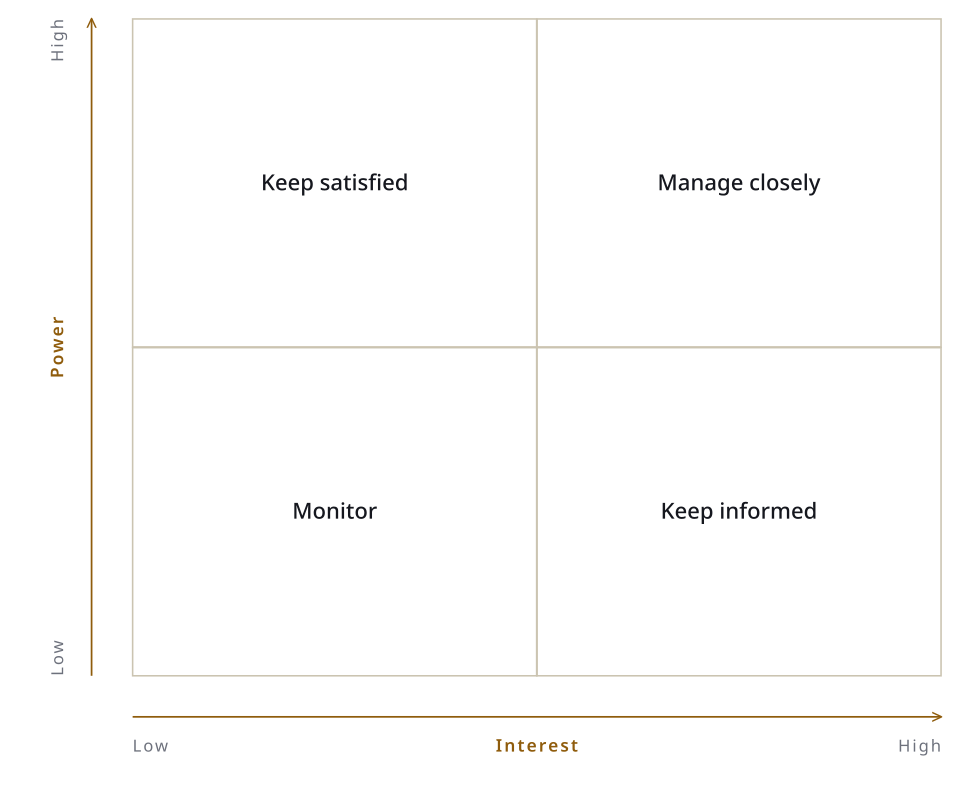 A grid showing how to classify stakeholders based on their power (high/low) and interest (high/low) in tourism projects. (Image: Peter Gladdish, CC BY 4.0, via Wikimedia Commons)
Explanation:
- High Power + High Interest (e.g., MoCTCA, NTB): Manage closely (direct involvement).
- High Power + Low Interest (e.g., some local governments): Keep satisfied (regular updates).
- Low Power + High Interest (e.g., community groups): Keep informed (consultation).
- Low Power + Low Interest (e.g., distant NGOs): Minimal effort (monitor).
4. Conflicts Among Stakeholders and Resolution Mechanisms
Conflicts arise due to competing priorities, such as:
- Economic growth vs. environmental conservation (e.g., trekking routes in Annapurna vs. wildlife protection).
- Profit maximization vs. community welfare (e.g., luxury hotels vs. local homestays).
- Cultural preservation vs. modernization (e.g., heritage sites in Kathmandu vs. urban development).
Case Study: Kathmandu Traffic and Tourism
Problem:
- Kathmandu’s traffic congestion (caused by private vehicles, buses, and tourist taxis) disrupts tourism flow and harms local businesses.
- Stakeholders involved:
- Government (NTC, Metropolitan City): Responsible for traffic management and public transport.
- Tour Operators: Need reliable transport for tourists.
- Local Taxi Drivers: Fear loss of income if regulated.
- NGOs (e.g., Clean Energy Nepal): Advocate for sustainable transport.
Conflict Resolution:
- Stakeholder Workshop: Organized by the Kathmandu Metropolitan City to discuss solutions.
- Pilot Project: Introduction of electric rickshaws (supported by ADB) and dedicated tourist bus routes.
- Incentives: Subsidies for taxi drivers to switch to eco-friendly vehicles.
- Monitoring: Real-time traffic data shared with all stakeholders via a mobile app (e.g., Kathmandu Traffic Alert).
Outcome:
- Reduced congestion in tourist hotspots (e.g., Thamel, Durbar Square).
- Increased tourist satisfaction and repeat visits.
5. The Role of Stakeholders in Nepal’s Tourism Policy
Nepal’s Tourism Policy (2017) and Master Plans explicitly recognize stakeholder involvement. Key policies include:
- Community-Based Tourism (CBT): Encourages locals to participate in tourism (e.g., homestays, cultural festivals).
- Public-Private Partnerships: For infrastructure like airports (e.g., Bhaktapur Airport developed with private investment).
- Sustainable Tourism Standards: Aligns with Global Sustainable Tourism Council (GSTC) criteria, involving NGOs like WWF Nepal.
In the Real World
eSewa and Digital Tourism Booking
- Idea Used: Private Sector Stakeholder Collaboration
- How: eSewa partners with hotels, trekking agencies, and airlines (e.g., Nepal Airlines, Buddha Air) to offer online booking and payment for tourism services. This reduces transaction costs and increases accessibility for tourists.
- Stakeholder Roles:
- eSewa: Digital platform provider.
- Hotels/Tour Operators: Service providers.
- Nepal Rastra Bank (NRB): Regulates digital payments.
- Tourists: End-users benefiting from convenience.
Pathao’s Ride-Hailing and Local Transport
- Idea Used: Private Sector vs. Government Regulation
- How: Pathao competes with traditional taxis in Kathmandu, offering cheaper, app-based rides. However, it faces resistance from local taxi unions (who see it as unfair competition) and government regulations on permits.
- Conflict Example:
- Pathao (private sector) wants to expand rapidly.
- Taxi Unions (community-based) demand equal opportunities.
- Government (MoCTCA) must balance innovation with job security.
- Resolution: Pathao now offers shared rides to reduce congestion, aligning with government sustainability goals.
Annapurna Conservation Area Project (ACAP)
- Idea Used: Multi-Stakeholder Collaboration for Conservation
- How: ACAP involves:
- Government (Department of National Parks and Wildlife Conservation): Manages the park.
- Local Communities (Gurung, Magar, Thakali): Guides, porters, and homestay owners.
- NGOs (WWF, ICIMOD): Provide funding and technical support.
- Tour Operators: Pay entry fees and follow sustainability guidelines.
- Outcome: $10 million+ annual revenue shared between conservation and local livelihoods.
6. Stakeholder Analysis Tools for Exam Preparation
To identify and prioritize stakeholders, use these tools:
A. Power-Interest Grid
| High Power | Low Power |
|---|---|
| High Interest | Manage Closely (e.g., MoCTCA, NTB) |
| Low Interest | Keep Satisfied (e.g., Local Governments) |
B. SWOT Analysis for Tourism Planning
| Strengths | Weaknesses |
|---|---|
| - Rich cultural heritage (e.g., UNESCO sites) | - Poor infrastructure (roads, airports) |
| - Diverse ecosystems (Himalayas, Terai) | - Political instability affecting tourism |
| - Skilled trekking guides and porters | - Seasonal dependency (peak: Oct–Nov) |
| Opportunities | Threats |
|---|---|
| - Growth of digital tourism (e.g., eSewa, Daraz) | - Climate change (affecting trekking) |
| - Medical tourism potential (e.g., Ayurveda in Pokhara) | - Competition from Bangladesh/Bhutan |
| - Eco-tourism funding (e.g., ADB, WWF) | - Over-tourism in Kathmandu Valley |
Exam Tip
Define Stakeholders Clearly:
- Always start by classifying stakeholders (government, private, community, international) with examples from Nepal (e.g., NTB, Seven Summit Treks, Tharu communities).
- Avoid vague answers: Instead of "local people," specify homestay owners in Pokhara or trekking guides in Langtang.
Use Real-World Examples:
- Examiners love case studies. Link theories to:
- eSewa (private sector collaboration).
- Pathao vs. Taxi Unions (conflict resolution).
- ACAP (multi-stakeholder conservation).
- Trace the process: Show how stakeholders interacted (e.g., workshops, PPPs) and the outcome.
- Examiners love case studies. Link theories to:
Diagrams and Tables Score Marks:
- Draw a stakeholder power-interest grid or SWOT table in your answer.
- Label a real organizational chart (e.g., NTB’s structure) to show relationships.
Highlight Conflicts and Solutions:
- Questions often ask: "How can conflicts among stakeholders in tourism planning be resolved?"
- Structure your answer:
- Identify the conflict (e.g., hotels vs. homestays).
- Analyze root causes (e.g., unequal access to markets).
- Propose solutions (e.g., fair trade certification, government subsidies).
Policy Connection:
- Relate stakeholders to Nepal’s Tourism Policy 2017 or Master Plans.
- Example: "The policy emphasizes CBT, requiring collaboration between government (MoCTCA) and community groups like homestay networks."
Common Mistakes to Avoid:
- ❌ Listing stakeholders without roles or examples.
- ❌ Ignoring conflicts—always discuss how they are managed.
- ❌ Overlooking international stakeholders (e.g., UNWTO, donors).
Final Note: Stakeholder management is the backbone of sustainable tourism. Whether it’s eSewa’s digital ecosystem, Pathao’s ride-sharing, or ACAP’s conservation model, success depends on balancing diverse interests. Master this unit by practicing case analyses and linking theories to Nepal’s tourism reality.
Based on the TU BTTM syllabus for Tourism Planning and Policies, unit 8.
Discussion
Loading…