Tourism LegislationUnit 610 min read
Aviation Laws: ICAO, Nepal's CAAN, Airline Rules & Passenger Rights
Unit 6 of Tourism Legislation explores Nepal’s aviation laws under the Civil Aviation Authority of Nepal (CAAN), ICAO standards, airline regulations, passenger rights, and key legal frameworks governing air travel—essential for tourism operations, flight bookings, and safety compliance.
TAKEAWAYS:
- Nepal’s aviation laws are governed by the Civil Aviation Authority of Nepal (CAAN) and aligned with ICAO’s Annex 6 for international flights.
- Passenger rights under Nepal’s laws include compensation for delays/cancellations, baggage protection, and medical emergencies—similar to EU Regulation 261/2004.
- Airline regulations mandate safety checks, crew qualifications, and operational procedures (e.g., Nepal’s Air Operator Certificate for domestic/foreign carriers).
- Tourism applications: Airlines like Yeti Airlines and Buddha Air must comply with CAAN’s rules for trekking flights (e.g., Pokhara-Kathmandu routes), while Nepalgunj Airport follows ICAO’s Annex 14 for infrastructure.
- Worked example: A delayed Pokhara–Kathmandu flight (due to weather) triggers CAAN’s compensation rules (₹5,000–₹20,000 for passengers).
- Exam focus: Compare CAAN vs. ICAO, list passenger rights, and explain safety regulations with real-world cases (e.g., 2023 Buddha Air incident).
Core Concepts of Aviation Laws
Aviation laws ensure safety, security, and passenger rights in air travel. Nepal’s framework is built on:
- International Standards (ICAO)
- National Regulations (CAAN)
- Airline Operational Rules
- Passenger Protection Laws
1. International Civil Aviation Organization (ICAO) Standards
ICAO, a UN agency, sets global aviation rules via Annexes (e.g., Annex 6: Air Transport Operations, Annex 14: Aerodromes). Nepal follows these for:
- Flight operations (e.g., minimum safe altitudes, navigation routes).
- Aircraft certification (e.g., FAA/EASA compliance for foreign planes).
- Safety management systems (SMS) for airlines.
Why it matters for tourism?
- Airlines like Yeti Airlines (operating Pokhara–Jomsom trekking flights) must align with ICAO’s Annex 6 for passenger safety.
- Nepalgunj Airport (a key hub for Indian flights) follows Annex 14 for runway/taxiway standards.
2. Civil Aviation Authority of Nepal (CAAN): National Framework
CAAN enforces laws under the Civil Aviation Act, 2015, covering:
- Airline licensing (e.g., Air Operator Certificate (AOC) for domestic/foreign carriers).
- Pilot/crew training (minimum 1,500 flight hours for commercial pilots).
- Aircraft maintenance (mandatory 6-month inspections).
- Passenger rights (compensation for delays, baggage liability).
Key CAAN Regulations for Tourism:
| Regulation | Application | Example |
|---|---|---|
| AOC for Airlines | Operates flights (e.g., Buddha Air) | Yeti Airlines’ Pokhara–Lukla permits. |
| Pilot Licensing | Crew qualifications for trekking flights | Type rating for Dornier 228 (used in Himalayas). |
| Baggage Rules | Liability for lost/damaged luggage | ₹1,000/kg compensation (CAAN, 2023). |
| Flight Delay Compensation | Passenger rights for cancellations | ₹5,000–₹20,000 for delays >2 hours. |
3. Passenger Rights Under Nepal’s Aviation Laws
Nepal’s laws protect passengers from delays, cancellations, and poor service. Key rights:
- Compensation for delays/cancellations:
- Domestic flights: ₹5,000–₹20,000 (varies by airline).
- International flights: Follow ICAO/CAAN guidelines (e.g., ₹10,000+ for long delays).
- Baggage protection:
- ₹1,000/kg for lost/damaged luggage (max ₹50,000).
- Priority handling for fragile items (e.g., trekking gear).
- Medical emergencies:
- Airlines must assist passengers (e.g., oxygen for high-altitude sickness on Lukla flights).
- Refunds for overbooking:
- Passengers can choose alternate flights or refunds.
Worked Example: Delayed Pokhara–Kathmandu Flight Scenario: A Yeti Airlines flight from Pokhara to Kathmandu is delayed by 3 hours due to fog. Solution:
- Check CAAN’s compensation table: Delay >2 hours → ₹10,000 per passenger.
- Passenger submits a complaint to CAAN or airline with:
- Flight details (YT 234, 10 AM delay).
- Boarding pass + delay proof (ATC logs).
- Airline issues payment within 15 days.
sequenceDiagram
    Passenger->>Yeti Airlines: Books Flight (Pokhara-KTM)
    Yeti Airlines-->>Passenger: Confirmation
    Passenger->>Yeti Airlines: Arrives 2 hrs late
    Passenger->>CAAN: Files Complaint (₹10,000)
    CAAN->>Yeti Airlines: Verify Delay Cause
    Yeti Airlines-->>Passenger: Issues Compensation
4. Airline Operational Regulations
Airlines must comply with CAAN’s safety and operational rules:
- Safety checks:
- Pre-flight inspections (e.g., Dornier 228 checks for Himalayan routes).
- Black box requirements (mandatory for all commercial flights).
- Crew qualifications:
- Pilots: Minimum 1,500 hours, multi-engine rating.
- Cabin crew: First aid certified, high-altitude training (for Lukla flights).
- Emergency procedures:
- Diversion airports (e.g., Pokhara for Kathmandu-bound flights).
- Evacuation drills (monthly for all crews).
Comparison: CAAN vs. ICAO Safety Rules
| Aspect | CAAN (Nepal) | ICAO (Global) |
|---|---|---|
| Pilot Hours | 1,500 hrs (domestic) | 1,500 hrs (Annex 1) |
| Aircraft Inspections | Every 6 months | Every 6 months (Annex 6) |
| Emergency Exits | 2 per 50 passengers (CAAN Rule 4.2) | 1 per 50 passengers (Annex 6) |
| Baggage Liability | ₹1,000/kg | USD 17/kg (ICAO standard) |
5. Tourism-Specific Aviation Laws
Tourism relies on domestic/regional flights (e.g., Pokhara–Jomsom, Kathmandu–Lukla). Key rules:
- Trekking flight permits:
- Airlines need CAAN approval for routes like Lukla Airport (high-altitude operations).
- Charter flights:
- Private operators (e.g., Simrik Airlines) must follow CAAN’s charter rules.
- Baggage for trekkers:
- Extra weight limits for trekking gear (e.g., 20 kg per passenger on Lukla flights).
Worked Example: Booking a Lukla Flight Scenario: A tourist books a Kathmandu–Lukla flight with Buddha Air. Steps:
- Airline checks: Buddha Air verifies CAAN’s Lukla flight permit.
- Baggage rules: Tourist declares 15 kg gear (within 20 kg limit).
- Safety briefing: Crew explains high-altitude oxygen use.
- Compensation clause: If delayed, ₹15,000 (long delay on remote route).
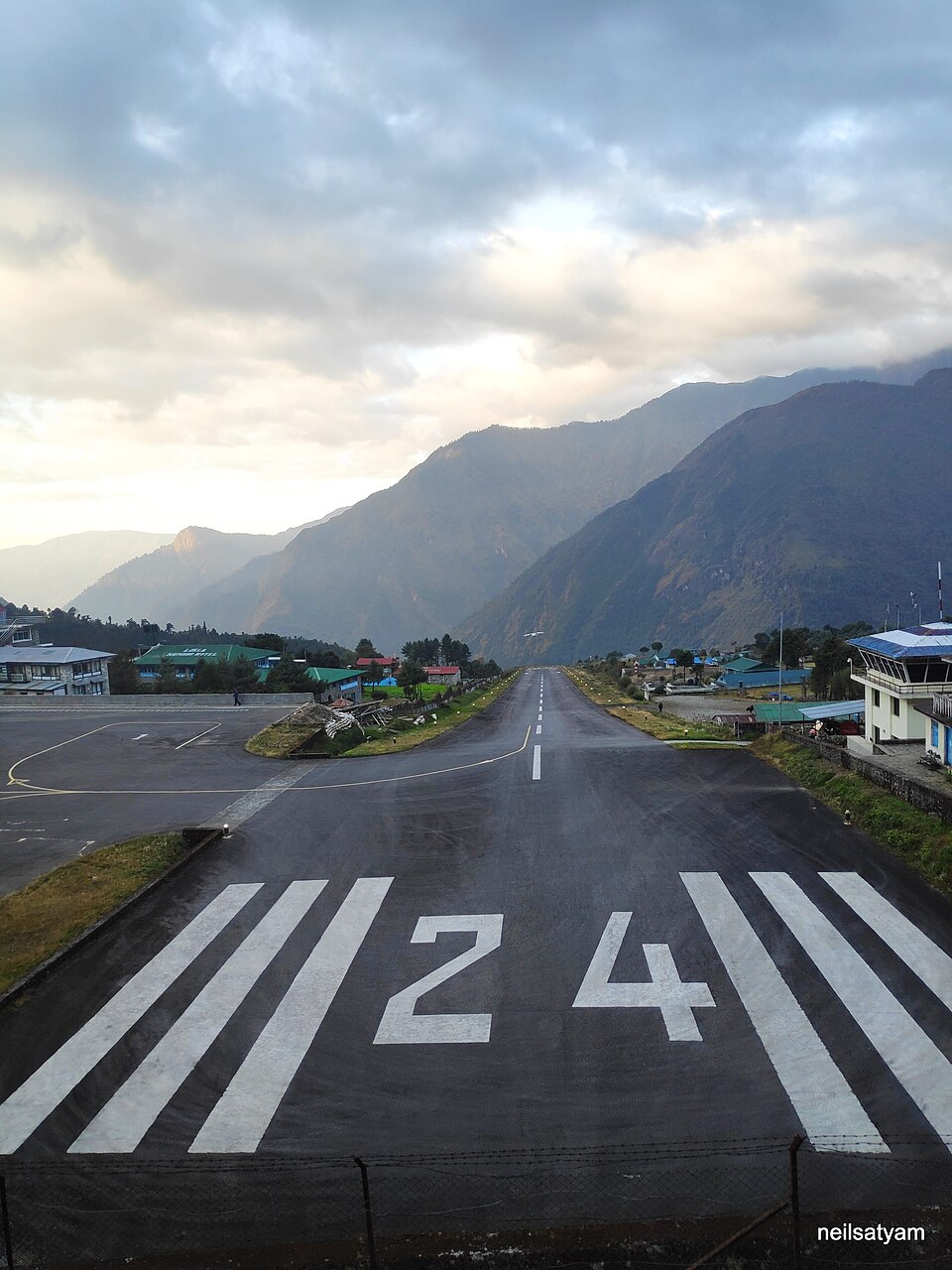 High-altitude airstrip for Everest Base Camp trekkers (Image: Neil Satyam, CC BY-SA 4.0, via Wikimedia Commons)
## In the Real World
Yeti Airlines (Pokhara–Jomsom Flights)
- Idea Used: CAAN’s Air Operator Certificate (AOC) for Himalayan routes.
- How: Yeti must comply with ICAO’s Annex 6 for high-altitude operations (e.g., Dornier 228 safety checks before every flight to Jomsom).
Buddha Air (Kathmandu–Lukla Trekking Flights)
- Idea Used: Passenger rights for delays (CAAN’s ₹10,000–₹20,000 compensation).
- How: In 2023, a 3-hour delay due to weather triggered claims from 50+ passengers, resolved via CAAN mediation.
Nepalgunj Airport (Indian Flight Hub)
- Idea Used: ICAO Annex 14 aerodrome standards.
- How: The airport’s runway length (2,500m) meets ICAO’s Class 4C for international flights (e.g., IndiGo, Vistara).
eSewa/Khalti for Flight Bookings
- Idea Used: Electronic ticketing regulations (CAAN’s e-ticketing rules).
- How: When booking via eSewa, passengers see CAAN-mandated terms (e.g., "No refunds for no-shows").
## Exam Tip
Compare CAAN vs. ICAO:
- CAAN = National rules (e.g., ₹1,000/kg baggage liability).
- ICAO = Global standards (e.g., USD 17/kg).
- Exam trick: Use a table to contrast the two (as shown above).
Passenger Rights Scenarios:
- Always calculate compensation (e.g., 2-hour delay = ₹5,000).
- Mention CAAN’s complaint process (submit to airline/CAAN within 30 days).
Tourism Applications:
- Link Lukla flights to CAAN permits and high-altitude safety.
- Relate Pokhara–Jomsom routes to ICAO’s Annex 6.
Visuals in Exams:
- Draw a flowchart for delay compensation claims.
- Label a diagram of Lukla Airport’s runway (show 2,700m length).
Common Pitfalls:
- ❌ Mixing ICAO and CAAN rules (e.g., saying ICAO sets baggage limits—it’s CAAN!).
- ❌ Ignoring tourism-specific cases (e.g., trekking flight permits).
Final Note: Aviation laws are critical for tourism operations—from flight bookings to passenger safety. Focus on CAAN’s regulations, ICAO standards, and real-world cases (e.g., Yeti Airlines delays). Use tables, flowcharts, and labelled diagrams to score full marks!
Based on the TU BTTM syllabus for Tourism Legislation, unit 6.
Discussion
Loading…