Science and TechnologyUnit 33 min read
Honey Bee: Structure, Life Cycle, and Economic Importance
Unit 3 of Science and Technology explains the anatomy, behavior, life cycle, and role of honey bees in pollination and honey production, with practical examples and exam-focused questions.
---

## **What is a Honey Bee?**
Honey bees (*Apis mellifera*) are small, social insects that live in colonies. They play a crucial role in nature and human life by producing honey, beeswax, and pollinating crops. Bees are divided into three main types of workers:

- **Queen bee**: The only female that lays eggs.
- **Worker bees**: Female bees that perform all tasks (e.g., collecting nectar, building hives, feeding larvae).
- **Drone bees**: Male bees whose only job is to mate with the queen.


---

## **Structure of a Honey Bee**
A honey bee has three main body parts:

1. **Head**: Contains eyes (compound and simple), antennae (for sensing smells), and mouthparts (for collecting nectar).
2. **Thorax**: Attached to six legs and two pairs of wings (used for flying).
3. **Abdomen**: Contains the stomach, digestive system, and stinger (only in worker bees and drones).


---

## **Life Cycle of a Honey Bee**
The life cycle of a honey bee has four stages:

1. **Egg**: Laid by the queen in hexagonal cells.
2. **Larva**: Fed royal jelly (for queens) or bee bread (for workers/drones).
3. **Pupa**: Enclosed in a cocoon, where it transforms.
4. **Adult**: Emerges after 21 days (workers), 24 days (drones), or 16 days (queens).

```mermaid
flowchart TD
    A[Egg] --> B[Larva]
    B --> C[Pupa]
    C --> D[Adult]
    D -->|Queen| E[Lays Eggs]
    D -->|Worker| F[Collects Nectar]
    D -->|Drone| G[Mates with Queen]
Behavior and Communication
Honey bees communicate using dance language:
- Round dance: Indicates food sources within 50 meters.
- Waggle dance: Shows direction and distance of food sources (e.g., 10 seconds of waggling = 500 meters away).
Role in Pollination and Honey Production
- Pollination: Bees transfer pollen from flower to flower, helping plants reproduce.
- Honey production: Bees collect nectar, store it in honeycombs, and convert it into honey.
Advantages and Disadvantages of Honey Bees
| Advantages | Disadvantages |
|---|---|
| Produce honey, beeswax, and royal jelly | Can sting if threatened |
| Help pollinate crops (increasing food supply) | Some people are allergic to bee stings |
| Provide economic benefits (beekeeping industry) | Pesticides can harm bee colonies |
Solved Example
Q: If a bee performs a waggle dance for 15 seconds, how far is the food source? A: Each second of waggling ≈ 33 meters. Calculation: 15 × 33 = 495 meters away.
SEE-Style Questions
Short Answer:
- Name the three types of bees in a colony.
- What is the role of the queen bee?
Long Answer:
- Explain the life cycle of a honey bee with a diagram.
- How do bees communicate the location of food?
Multiple Choice:
- Which part of the bee’s body is used for collecting nectar? a) Antennae b) Mouthparts c) Legs d) Wings
Exam Tip
- Remember key facts: Life cycle stages, bee types, and dance communication.
- Draw diagrams: Label bee anatomy and waggle dance in exams.
- Apply concepts: Use dance duration to calculate food distance.
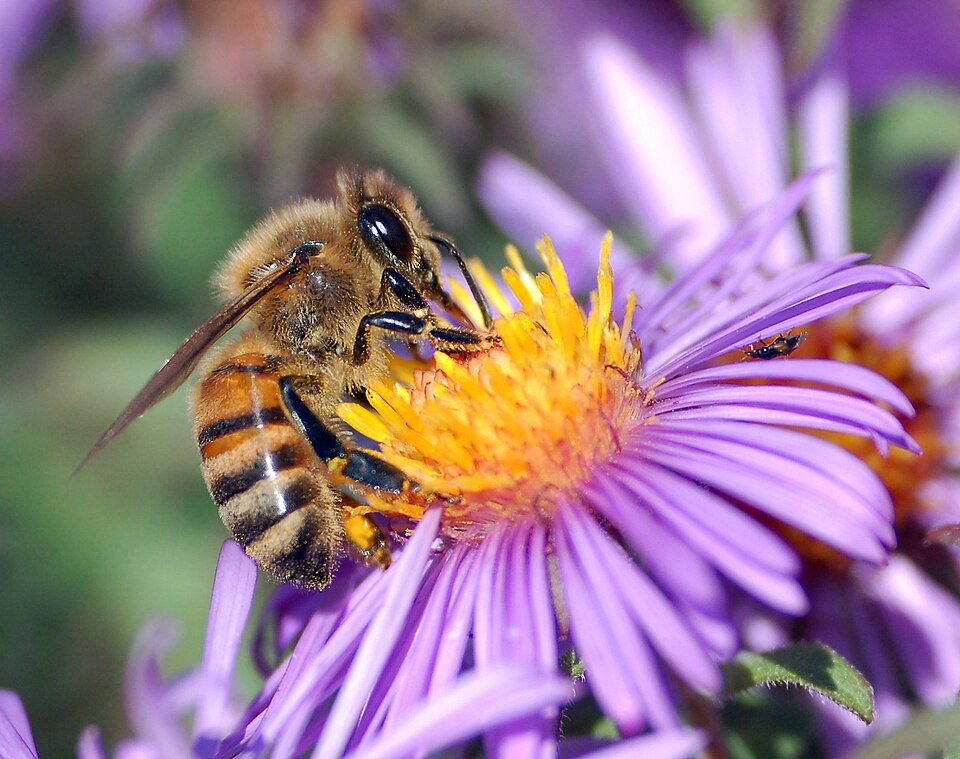 A worker bee collecting nectar from a flower. (Image: John Severns (Severnjc), Public domain, via Wikimedia Commons)
 A modern beehive used for honey production. (Image: CC BY-SA 3.0, via Wikimedia Commons)
Based on the NEB Class 10 syllabus for Science and Technology (Science), unit 3.
Discussion
Loading…