EconomicsUnit 111 min read
Intro to Economics: Definitions, Scarcity & Choices
Unit 1 of Economics introduces the core ideas of what economics is, why it matters, and how scarcity forces individuals and societies to make choices. Learn definitions, key principles, and real-world examples of economic problems.
TAKEAWAYS:
- Economics studies how people satisfy unlimited wants with limited resources.
- Scarcity forces choices, leading to trade-offs and opportunity costs.
- Microeconomics focuses on individual choices, while macroeconomics looks at the whole economy.
- Positive economics is fact-based, while normative economics involves opinions.
- Economic models simplify reality to explain complex problems.
What is Economics?
Economics is the social science that studies how individuals, businesses, and governments make choices about how to use limited resources to satisfy unlimited wants.
Why Study Economics?
- Helps us understand why prices change.
- Explains why some people are rich and others are poor.
- Helps governments make better policies (like taxes, healthcare, and education).
- Helps individuals make smart financial decisions (like saving, investing, and spending).
The Economic Problem: Scarcity
Scarcity means not having enough resources to satisfy all our wants. Since resources (like time, money, land, and labor) are limited, we must make choices.
Example: Imagine you have Rs. 1000 and want to buy:
- A new phone (Rs. 800)
- A book (Rs. 200)
- A movie ticket (Rs. 100)
You cannot buy all three because you don’t have enough money. This is scarcity!
Basic Economic Concepts
1. Needs vs. Wants
| Needs | Wants |
|---|---|
| Essential for survival (food, shelter, clothing) | Desires beyond basic survival (luxury cars, vacations, gadgets) |
| Limited in number | Unlimited (keep increasing) |
| Example: Water, food, medicine | Example: Smartphone, designer clothes, holidays |
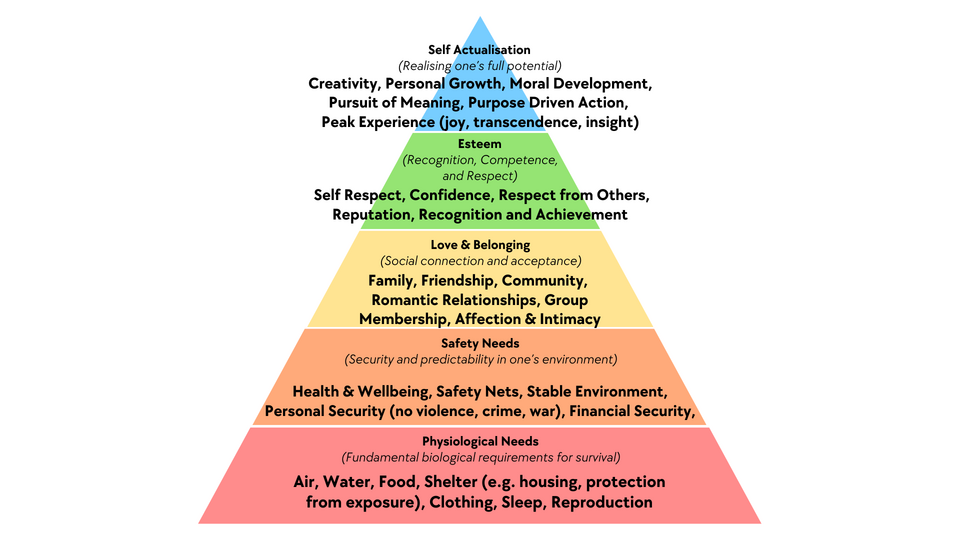 Hierarchy of human needs (Physiological, Safety, Social, Esteem, Self-Actualization) (Image: Hamish.croker, CC BY-SA 4.0, via Wikimedia Commons)
Why does this matter?
- Scarcity affects needs first (like food and healthcare).
- Wants depend on income and culture.
2. Resources (Factors of Production)
Economics studies how we use four types of resources to produce goods and services:
- Land: Natural resources (soil, water, forests, minerals).
- Labor: Human effort (workers, doctors, teachers).
- Capital: Man-made tools (machines, buildings, roads).
- Entrepreneurship: Risk-taking and innovation (business owners, inventors).
Example: A farm uses:
- Land (soil, water)
- Labor (farmers)
- Capital (tractors, irrigation systems)
- Entrepreneurship (farm owner’s decisions)
3. Goods vs. Services
| Goods | Services |
|---|---|
| Physical things you can touch (books, cars, food) | Actions or work done for others (teaching, haircuts, banking) |
| Can be stored (e.g., rice in a warehouse) | Cannot be stored (e.g., a movie ticket) |
| Example: Mobile phone, shirt, bread | Example: Doctor’s check-up, bus ride, movie screening |
Why does this matter?
- Goods are easier to measure and trade.
- Services depend on labor and skills.
4. Production Possibility Frontier (PPF)
The PPF shows the maximum possible production of two goods when all resources are used efficiently.
Example: Suppose Nepal can produce:
- Rice (in tons) and Cloth (in meters).
- With all resources, it can produce:
- 0 cloth and 100 tons of rice, or
- 0 rice and 500 meters of cloth, or
- 50 tons of rice and 250 meters of cloth.
Key Points:
- Points on the curve = efficient use of resources.
- Points inside the curve = wasted resources (unemployment, inefficiency).
- Points outside the curve = impossible (not enough resources).
What happens if Nepal gets better technology? The PPF shifts outward (more production possible).
5. Opportunity Cost
The opportunity cost is the next best alternative given up when making a choice.
Example: If Nepal spends Rs. 1 billion on:
- Option 1: Building a new hospital (saves 1000 lives), or
- Option 2: Building a new road (creates 500 jobs).
If Nepal chooses the hospital, the opportunity cost is the 500 jobs lost.
Another Example (Personal Choice): If you spend 1 hour studying economics instead of playing football:
- Opportunity cost = The fun of playing football (and maybe a better score in the match).
6. Microeconomics vs. Macroeconomics
| Microeconomics | Macroeconomics |
|---|---|
| Studies individual choices (households, firms) | Studies the whole economy (inflation, unemployment, GDP) |
| Example: Why does the price of a phone increase? | Example: Why is Nepal’s unemployment rate high? |
| Focuses on markets (supply and demand) | Focuses on government policies (taxes, interest rates) |
Real-Life Connection:
- Micro: Why do some shops close in Kathmandu?
- Macro: Why is Nepal’s inflation rising?
7. Positive vs. Normative Economics
| Positive Economics | Normative Economics |
|---|---|
| Fact-based (what is) | Opinion-based (what should be) |
| Example: "Nepal’s unemployment rate is 15%." | Example: "Nepal should reduce unemployment to 5%." |
| Can be proven true or false | Depends on values and beliefs |
Why does this matter?
- Economists use positive economics to analyze problems.
- Normative economics helps in policy-making (but is subjective).
Economic Models and Assumptions
Economists use simplified models to explain real-world problems.
Example: The Circular Flow Model Shows how money and goods flow between households and businesses.
graph LR
    A["Households"] -->|"Spend Money"| B["Businesses"]
    B -->|"Pay Wages, Rent, Profit"| A
    A -->|"Provide Labor, Land, Capital"| B
    B -->|"Provide Goods & Services"| A
Key Points:
- Households provide labor, land, and capital.
- Businesses provide goods and services.
- Money flows in the opposite direction.
Why Do We Need Economics?
Helps in Decision-Making
- Should you buy a car or save money?
- Should Nepal invest in education or infrastructure?
Explains Economic Problems
- Why are some countries rich while others are poor?
- Why do prices rise during festivals?
Guides Government Policies
- Should Nepal increase taxes to build roads?
- How can unemployment be reduced?
Exam Tip: How to Score Full Marks
- Define Key Terms Clearly
- Example: "Economics is the study of how society allocates scarce resources to satisfy unlimited wants."
- Do not just write "Economics is a social science."
Use Real-Life Examples
- Instead of just saying "scarcity exists," give an example: "If you have Rs. 500 and want to buy a book (Rs. 300) and snacks (Rs. 200), you cannot buy both—this is scarcity."
Draw Diagrams (PPF, Circular Flow)
- The PPF graph is often asked. Label axes and show efficient, inefficient, and unattainable points.
Differentiate Between Micro and Macro
- Always give one micro and one macro example when asked about the difference.
Explain Opportunity Cost with Numbers
- Example: "If Nepal spends Rs. 10 billion on healthcare instead of education, the opportunity cost is the lost education benefits."
Avoid Normative Statements in Positive Questions
- If the question asks "Why does inflation rise?" (positive), do not say "The government should control inflation" (normative).
NEB Board-Style Questions (Practice)
Short Answer (5 marks)
Define scarcity. How does it lead to economic choices? Give an example from Nepal.
- Answer: Scarcity means limited resources but unlimited wants. It forces choices because we cannot have everything. Example: Nepal has limited water resources, so it must choose between drinking water, irrigation, and hydroelectricity. If it uses more water for hydroelectricity, the opportunity cost is less water for farming.
What is the difference between microeconomics and macroeconomics? Give one example of each.
- Answer:
Microeconomics Macroeconomics Studies individual units (firms, households) Studies the whole economy Example: Why did the price of rice increase? Example: Why is Nepal’s unemployment rate high?
- Answer:
Draw a PPF curve showing the trade-off between guns and butter. What does a point outside the curve mean?
- Answer:
```figure
{"type":"curves","lines":[{"label":"PPF Curve","from":[0,10],"to":[10,0],"expr":"10 - x"}],"points":[{"x":2,"y":8,"label":"Efficient Point (Inside Curve)"},{"x":5,"y":5,"label":"Efficient Point (On Curve)"},{"x":8,"y":2,"label":"Efficient Point (On Curve)"},{"x":6,"y":6,"label":"Unattainable (Outside Curve)"}],"xlabel":"Guns (Military Goods)","ylabel":"Butter (Consumer Goods)","caption":"Production Possibility Frontier (PPF) showing trade-offs and unattainable production"}
- A point **outside the curve** means **more production than possible with current resources** (e.g., due to **new technology or more resources**).
Long Answer (10 marks)
Explain the economic problem of scarcity with the help of a PPF diagram. How does opportunity cost relate to this problem?
- Answer:
- Scarcity means limited resources but unlimited wants.
- The PPF diagram shows the maximum possible production of two goods (e.g., rice and cloth).
- Opportunity cost is the next best alternative given up when choosing one option over another.
- Example: If Nepal produces less rice to make more cloth, the opportunity cost is the rice not produced.
- Visual:
- Answer:
Differentiate between positive and normative economics. Why is it important for economists to separate the two?
- Answer:
- Positive economics is fact-based (e.g., "Nepal’s inflation is 6%.").
- Normative economics is opinion-based (e.g., "Nepal should reduce inflation to 3%.").
- Importance:
- Helps in objective analysis (avoids bias).
- Guides evidence-based policies (not just opinions).
- Example: A positive statement is "Taxes increase government revenue." A normative statement is "Taxes should be increased to fund healthcare."
- Answer:
Final Tip:
- Memorize definitions (scarcity, opportunity cost, PPF).
- Practice drawing diagrams (PPF, circular flow).
- Relate theory to Nepal (use local examples like agriculture, unemployment, inflation).
Based on the NEB +2 Humanities syllabus for Economics (Eco), unit 1.
Discussion
Loading…