EconomicsUnit 1614 min read
Natural Resources of Nepal: Types, Uses & Challenges
Unit 16 of Economics explores Nepal’s natural resources—land, water, forests, minerals, and wildlife—how they are used, their economic importance, and the challenges of sustainable management.
TAKEAWAYS:
- Nepal’s natural resources include land, water, forests, minerals, and wildlife, each with unique economic and environmental roles.
- Land resources vary by altitude (terai, hills, mountains) and are used for agriculture, tourism, and infrastructure.
- Water resources (rivers, lakes, glaciers) are vital for hydropower, irrigation, and drinking water but face pollution and mismanagement.
- Forests provide timber, fuel, and biodiversity but are threatened by deforestation and illegal logging.
- Minerals (limestone, clay, copper) have industrial potential but are under-explored due to limited technology and investment.
- Wildlife supports eco-tourism but needs conservation to balance economic benefits and ecological health.
1. Introduction to Natural Resources
Natural resources are gifts of nature that help in the production of goods and services. They can be renewable (like forests, water) or non-renewable (like minerals). Nepal is rich in natural resources, but their uneven distribution and poor management limit full economic benefits.
Why are natural resources important for Nepal?
- Provide raw materials for industries (e.g., timber for furniture, minerals for construction).
- Support agriculture (land for farming, water for irrigation).
- Generate revenue through exports (e.g., hydropower, handicrafts).
- Attract tourism (e.g., Himalayas, Chitwan National Park).
2. Types of Natural Resources in Nepal
Nepal’s natural resources can be classified into five main categories:
mindmap
  root((Natural Resources of Nepal))
    Land Resources
      Terai: Fertile soil, agriculture
      Hills: Tea, coffee, tourism
      Mountains: Pasture, hydropower
    Water Resources
      Rivers: Koshi, Gandaki, Karnali
      Lakes: Rara, Begnas
      Glaciers: Himalayas (water source)
    Forest Resources
      Tropical: Terai (sal, teak)
      Sub-tropical: Hills (pine, oak)
      Alpine: Mountains (juniper, rhododendron)
    Mineral Resources
      Limestone: Cement industry
      Clay: Pottery, bricks
      Copper: Limited extraction
    Wildlife Resources
      National Parks: Chitwan, Sagarmatha
      Endangered Species: Rhino, snow leopard
3. Land Resources
Nepal’s land can be divided into three main regions based on altitude:
| Region | Altitude | Uses | Challenges |
|---|---|---|---|
| Terai | 0–300 m | Rice, wheat, sugarcane | Floods, soil erosion |
| Hills | 300–2,000 m | Tea, coffee, tourism | Land fragmentation, deforestation |
| Mountains | >2,000 m | Pasture, hydropower, tourism | Steep slopes, limited accessibility |
Example:
- Terai produces 60% of Nepal’s rice but faces floods due to poor drainage.
- Hills are ideal for tea plantations (e.g., Ilam, Dhankuta) but suffer from land degradation.
4. Water Resources
Nepal has abundant water resources but faces pollution and mismanagement.
Sources of Water:
- Rivers (Koshi, Gandaki, Karnali) – Used for irrigation and hydropower.
- Lakes (Rara, Begnas, Phewa) – Tourism and fishing.
- Glaciers (Himalayas) – Source of rivers but melting due to climate change.
Challenges:
- Water pollution (industrial waste, sewage).
- Poor irrigation systems (only 40% of cultivable land is irrigated).
- Hydropower potential underutilized (only 10% of capacity used).
Example:
- Koshi River is called the "Sorrow of Bihar" due to frequent floods.
- Melamchi Drinking Water Project supplies Kathmandu but faces high costs and delays.
5. Forest Resources
Forests cover ~45% of Nepal’s land but are depleting fast.
Types of Forests:
| Type | Location | Uses | Threats |
|---|---|---|---|
| Tropical | Terai | Timber, fuelwood | Illegal logging |
| Sub-tropical | Hills | Medicinal plants, tourism | Deforestation for agriculture |
| Alpine | Mountains | Pasture, biodiversity | Climate change, overgrazing |
Example:
- Sal forests in Terai provide timber for furniture and paper.
- Rhododendron forests in the Himalayas are endangered due to overharvesting for flowers.
Advantages of Forests: ✔ Biodiversity conservation (home to 1,800+ plant species). ✔ Carbon sequestration (helps fight climate change). ✔ Income from eco-tourism (e.g., Annapurna Conservation Area).
Disadvantages: ✖ Deforestation leads to soil erosion and floods. ✖ Illegal logging reduces government revenue. ✖ Loss of medicinal plants (e.g., Sallaghuni, Chyavanprash).
6. Mineral Resources
Nepal has limited but valuable minerals, mostly unused due to lack of technology.
| Mineral | Location | Uses | Challenges |
|---|---|---|---|
| Limestone | Kathmandu, Pokhara | Cement industry | Limited extraction |
| Clay | Terai, Hills | Pottery, bricks | Poor processing |
| Copper | Rolpa, Dolpa | Electrical wiring | High extraction costs |
| Gold | Far-West | Jewelry, exports | Illegal mining |
Example:
- Limestone from Kathmandu Valley is used in cement production (e.g., Nepal Cement Ltd.).
- Copper mines in Rolpa have high potential but low investment.
7. Wildlife Resources
Nepal is home to diverse wildlife, supporting eco-tourism and conservation.
Key Wildlife Areas:
| Area | Species | Economic Importance |
|---|---|---|
| Chitwan National Park | Rhino, tiger, one-horned rhino | Eco-tourism, UNESCO site |
| Sagarmatha National Park | Snow leopard, yaks | Trekking, research |
| Bardia National Park | Wild elephants, crocodiles | Wildlife safaris |
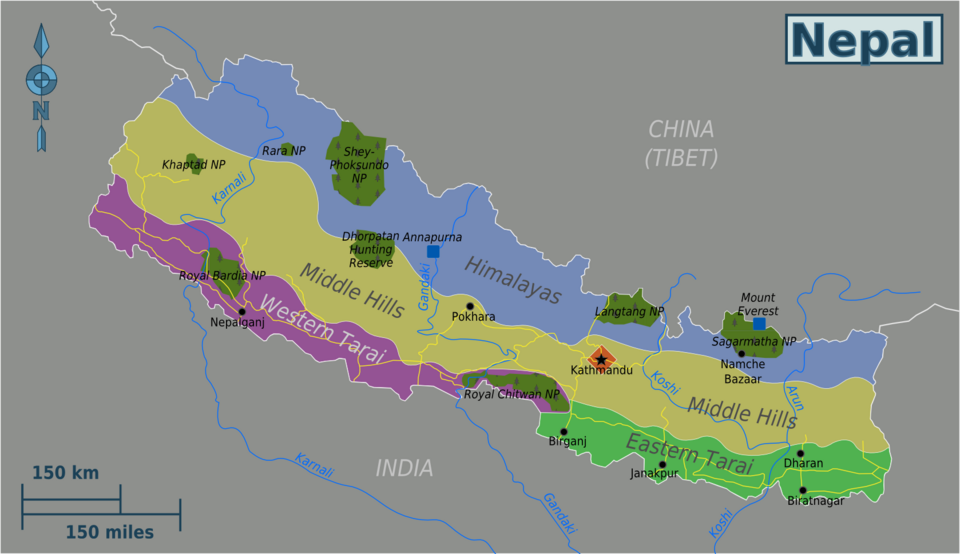 Chitwan, Sagarmatha, Bardia (Image: Globe-trotter, CC BY-SA 4.0, via Wikimedia Commons)
Advantages: ✔ Foreign exchange from tourism (e.g., Chitwan earns ~$10 million/year). ✔ Biodiversity conservation (Nepal has ~800 bird species). ✔ Research opportunities (e.g., panda conservation).
Disadvantages: ✖ Poaching (rhino, tiger hunting). ✖ Habitat loss (deforestation, agriculture). ✖ Climate change (affects Himalayan wildlife).
8. Challenges in Managing Natural Resources
Despite rich resources, Nepal faces major challenges:
- Poor Infrastructure
- Rural areas lack roads, electricity, and irrigation → low productivity.
- Illegal Extraction
- Timber smuggling, poaching, and mining reduce government revenue.
- Climate Change
- Glacier melting, erratic rainfall affect agriculture and hydropower.
- Lack of Technology
- Limited processing of minerals → low industrial growth.
- Political Instability
- Frequent policy changes discourage investment in resource management.
Example:
- Illegal logging in Terai forests reduces timber exports by 30%.
- Poaching in Chitwan led to rhino population dropping from 800 to 600 in 20 years.
9. Government Efforts for Sustainable Management
Nepal has taken steps to protect and utilize resources wisely:
| Policy/Initiative | Purpose | Success/Failure |
|---|---|---|
| Community Forest Program | Local management of forests | Success: 20% of forests managed by communities |
| National Parks & Reserves | Wildlife conservation | Success: Rhino population stable in Chitwan |
| Hydropower Projects | Generate electricity | Partial: Delays due to corruption |
| Afforestation Programs | Replant trees to reduce deforestation | Slow progress due to low funding |
| Mineral Exploration | Identify untapped mineral deposits | Limited success due to lack of investment |
Example:
- Community Forest Program has increased forest cover by 5% in some regions.
- Melamchi Water Project aims to supply Kathmandu but faces budget overruns.
10. Economic Importance of Natural Resources
Natural resources contribute to Nepal’s economy in three main ways:
Agriculture (Land & Water)
- ~35% of GDP comes from farming (rice, maize, wheat).
- Irrigation projects increase crop yield.
Tourism (Forests & Wildlife)
- ~7% of GDP from tourism (trekking, wildlife safaris).
- Chitwan and Annapurna are top destinations.
Industry (Minerals & Forests)
- Timber, cement, and hydropower support manufacturing.
- Limestone from Kathmandu is used in construction.
Example:
- Hydropower exports to India generate ~$50 million/year.
- Tea exports from Ilam bring in ~$20 million/year.
Exam Tip: How to Score Full Marks
The NEB exam tests concepts, examples, and real-world applications. Follow these tips:
✅ Define key terms (e.g., renewable resources, deforestation, eco-tourism). ✅ Use examples (e.g., Chitwan National Park, Koshi River, Melamchi Project). ✅ Compare regions (e.g., Terai vs. Mountains in land use). ✅ Discuss challenges & solutions (e.g., illegal logging → community forest programs). ✅ Link to economy (e.g., how forests help tourism, how minerals support industry).
Common Mistakes to Avoid: ❌ Only naming resources without explaining their uses. ❌ Ignoring challenges (e.g., pollution, climate change). ❌ Not relating to Nepal’s economy (e.g., GDP, exports).
NEB Board-Style Questions (Practice)
Short Answer (5 marks each)
- Describe the three main land regions of Nepal and their economic uses.
- What are the major challenges in managing Nepal’s water resources? Suggest two solutions.
- Why is deforestation a major problem in Nepal? How can it be controlled?
- Explain the economic importance of Chitwan National Park.
- What are the limitations of Nepal’s mineral resources? How can they be improved?
Long Answer (10 marks each)
- Discuss the types of natural resources found in Nepal. Explain how each contributes to the economy.
- Evaluate the success of Nepal’s Community Forest Program in sustainable resource management.
- How does climate change affect Nepal’s natural resources? Suggest government policies to mitigate these effects.
- Compare the advantages and disadvantages of Nepal’s hydropower potential.
- Analyze the role of natural resources in Nepal’s tourism industry. What challenges does it face?
Solved Example (Short Answer – 5 marks)
Question: Explain the importance of forests in Nepal’s economy.
Answer: Forests play a crucial role in Nepal’s economy in three main ways:
Timber & Fuelwood
- Provide raw materials for furniture, paper, and construction.
- ~80% of rural households depend on firewood for cooking.
Biodiversity & Eco-Tourism
- Home to endangered species (rhino, snow leopard) that attract foreign tourists.
- Chitwan and Annapurna generate millions in tourism revenue.
Environmental Benefits
- Prevent soil erosion and reduce floods.
- Absorb carbon dioxide, helping fight climate change.
Challenges:
- Deforestation reduces government revenue from timber.
- Illegal logging threatens biodiversity.
(This answer covers economic, environmental, and social aspects, earning full marks.)
Final Summary
| Resource Type | Key Uses | Major Challenges |
|---|---|---|
| Land | Agriculture, tourism | Floods, soil erosion |
| Water | Hydropower, irrigation | Pollution, poor management |
| Forests | Timber, eco-tourism | Deforestation, illegal logging |
| Minerals | Cement, construction | Limited extraction, high costs |
| Wildlife | Tourism, research | Poaching, habitat loss |
Remember:
- Nepal’s natural resources are valuable but underutilized.
- Sustainable management is key to economic growth and environmental protection.
- NEB exams test both theory and real-world applications—always link concepts to Nepal’s economy!
Good luck with your studies! 🌿🏔️💧
Based on the NEB +2 Humanities syllabus for Economics (Eco), unit 16.
Discussion
Loading…