Rural DevelopmentUnit 411 min read
Rural Poverty: Causes, Effects, and Solutions
Unit 4 of Rural Development explores the meaning of rural poverty, its causes (economic, social, and environmental), its impacts on families and communities, and strategies to reduce it in Nepal, with real-world examples and exam-focused questions.
TAKEAWAYS:
- Rural poverty is a multidimensional problem affecting income, health, education, and dignity in Nepal’s villages.
- Causes include low agricultural productivity, lack of infrastructure, social discrimination, and climate shocks.
- Effects of poverty create cycles of debt, malnutrition, child labor, and migration, worsening inequality.
- Solutions involve government programs (e.g., social security), cooperatives, women’s empowerment, and sustainable livelihoods.
- NEB exam focus: Define poverty, compare causes/effects, and evaluate solutions with case studies (e.g., Terai vs. Himalayan regions).
- Key term: "Poverty trap" explains how poor families stay poor due to lack of resources to escape.
What is Rural Poverty?
Rural poverty means not having enough income, food, healthcare, education, or basic needs to live a decent life in villages. Unlike urban poverty, rural poverty is worse because:
- Fewer jobs: Most rural people depend on farming, which is risky.
- Poor infrastructure: Bad roads, no electricity, and far hospitals make life harder.
- Social exclusion: Dalits, Janajatis, and women often get less help.
Visual 1: Poverty Line in Nepal
pie
    title Rural Poverty in Nepal (2022)
    "Extreme Poverty (below $1.90/day)" : 12.9%
    "Moderate Poverty (below $3.20/day)" : 28.7%
    "Non-poor" : 58.4%
Source: World Bank (adapted for NEB context). Caption: Nepal’s rural poverty rates by income threshold (2022). Extreme poverty means survival on less than $1.90/day.
Why Does Rural Poverty Happen?
Poverty in Nepal’s villages is caused by three big groups of problems:
1. Economic Causes
- Low farm income: Small landholdings (often <1 hectare), old farming methods, and climate change reduce crop yields.
- Lack of non-farm jobs: Villages have few factories, shops, or services.
- Debt traps: Farmers borrow money for seeds/fertilizers but can’t repay due to crop failures.
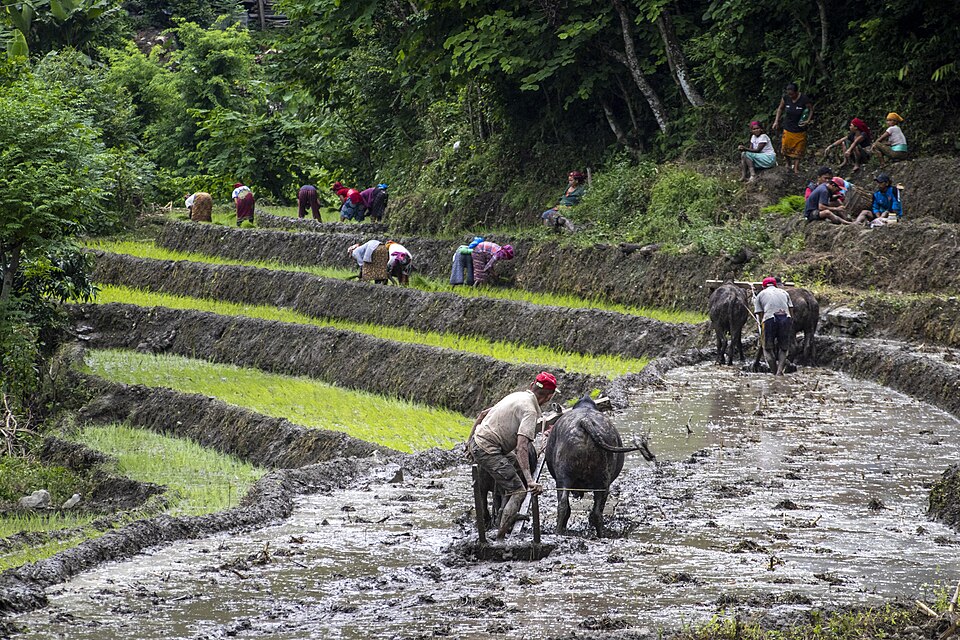 Farmers use oxen and outdated tools, reducing productivity. (Image: Vijaythapa333, CC BY-SA 4.0, via Wikimedia Commons)
2. Social Causes
- Caste discrimination: Dalits and Janajatis face barriers to land, loans, and education.
- Gender inequality: Women own only 15% of farmland and earn less than men for the same work.
- Low education: Poor families pull children out of school for farm work.
Visual 2: Gender Gap in Rural Nepal
3. Environmental Causes
- Climate change: Erratic rains, droughts, and landslides destroy crops.
- Land degradation: Over-farming and deforestation reduce fertile land.
- Natural disasters: Floods (Terai) and avalanches (Himalayas) displace families.
How Does Poverty Affect Rural Lives?
Poverty doesn’t just mean hunger—it creates cycles of suffering:
1. Health Problems
- Malnutrition: 30% of Nepali children under 5 are stunted due to poor diets.
- No healthcare: 40% of rural families can’t afford medicine or hospital trips.
- Disease spread: Dirty water and poor sanitation cause diarrhea and parasites.
Visual 3: Malnutrition Cycle
flowchart TD
    A["Poor Diet"] --> B["Weak Immunity"]
    B --> C["Frequent Illness"]
    C --> D["Missed School/Work"]
    D --> E["Lower Earnings"]
E --> ACaption: How malnutrition traps families in poverty.
2. Education Crisis
- Child labor: 1.5 million children (ages 5–14) work in farms instead of school.
- School dropouts: Families sell children to pay debts or marry them off early.
- Low literacy: Only 50% of rural women can read/write (vs. 75% of men).
3. Social Issues
- Migration: Young men/women leave for cities (e.g., Kathmandu, India) for low-paid jobs.
- Suicides: Farmers in debt (e.g., after failed crops) sometimes take their lives.
- Alcoholism: Poor families spend savings on raksi (local alcohol) to cope.
4. Economic Stagnation
- Debt cycles: Families borrow from moneylenders at 30–50% interest.
- Asset loss: They sell land, livestock, or jewelry to repay loans.
- No savings: Even if they earn more, they spend it all on survival.
How Can Rural Poverty Be Reduced?
Nepal and NGOs use five main strategies:
1. Government Programs
| Program | What It Does | Example in Nepal |
|---|---|---|
| Social Security | Cash transfers to poor families | Indira Awas Yojana (free housing) |
| Subsidies | Cheaper fertilizers, seeds, fuel | PM Kisan Samman Nidhi (₹6,000/year) |
| Food for Work | Jobs in exchange for food/grain | Food for Education (school meals) |
| Microfinance | Small loans for women entrepreneurs | Nepal Women’s Bank (₹50,000 loans) |
2. Agricultural Solutions
- High-yield crops: Teaching farmers to grow maize, potatoes, or hybrid rice (2x yield).
- Irrigation: Building check dams and drip irrigation to reduce water waste.
- Livestock: Raising goats, poultry, or fish for extra income.
Visual 4: Sustainable Farming Techniques
3. Infrastructure Development
- Roads: Connecting villages to markets (e.g., East-West Highway).
- Electricity: Solar panels in remote areas (e.g., Alternative Energy Promotion Centre).
- Health posts: Bringing clinics closer to homes.
4. Empowering Women
- Land rights: Giving women joint ownership of farmland.
- Training: Teaching sewing, baking, or dairy farming for side income.
- Cooperatives: Women’s groups (e.g., SEWA) sell handicrafts or save money together.
Visual 5: Women’s Cooperatives in Nepal
classDiagram
    class Women {
        +Owns 15% of farmland
        +Earns 30% less than men
        +Runs 60% of home businesses
    }
    class Cooperative {
        +Pool money for loans
        +Sell products together
        +Train in new skills
    }
    Women --> Cooperative : "Joins to earn more"
5. Community Participation
- Self-help groups (SHGs): Villagers save money together (e.g., Nepal Rural Women’s Development Fund).
- Forest user groups: Managing local forests for timber/fuelwood.
- Disaster preparedness: Training in first aid, flood drills, and seed banks.
Case Study: Poverty in Terai vs. Himalayas
| Feature | Terai Region | Himalayan Region |
|---|---|---|
| Main Livelihood | Rice, wheat, jute farming | Potatoes, buckwheat, livestock |
| Biggest Problem | Floods, waterlogging | Landslides, short growing season |
| Government Help | Irrigation projects | Road construction, solar power |
| Migration Rate | High (to India for labor) | Moderate (to Kathmandu for jobs) |
| Success Story | Kosi Basin Program (flood control) | Himalayan Climate Resilience (terracing) |
Exam Tip: How to Score Full Marks
NEB exams test definitions, causes/effects, and solutions. Follow this structure:
1. Define Key Terms (2–3 marks)
Question: What is rural poverty? Answer:
Rural poverty is a multidimensional condition where people in villages lack income, food, healthcare, education, and dignity due to economic, social, and environmental barriers. Unlike urban poverty, it is worsened by limited job opportunities, poor infrastructure, and caste/gender discrimination. For example, a Dalit farmer in the Terai may earn only ₹5,000/month but spend ₹4,000 on food and medicine, trapping them in poverty.
2. Compare Causes/Effects (4–5 marks)
Question: Compare the economic and social causes of rural poverty in Nepal. Answer:
| Cause Type | Economic Causes | Social Causes |
|---|---|---|
| Definition | Problems related to money and jobs | Problems related to society and culture |
| Examples | - Small landholdings <1 hectare <br> - Debt from moneylenders (50% interest) <br> - No non-farm jobs | - Dalits excluded from land ownership <br> - Women own only 15% of farmland <br> - Child labor (1.5M children) |
| Impact | Families sell assets (land, livestock) to repay loans | Girls marry young; boys migrate for work |
| Solution | Government subsidies, cooperatives | Land rights for women, education programs |
3. Evaluate Solutions (5–6 marks)
Question: Evaluate the effectiveness of microfinance in reducing rural poverty. Answer: Strengths:
- Empowers women: 70% of microloan borrowers are women (e.g., Nepal Women’s Bank).
- Low-cost loans: Interest rates (10–15%) are cheaper than moneylenders (30–50%).
- Business growth: Loans help start small shops, dairy farms, or tailoring (e.g., SEWA’s success in Kavrepalanchok).
Weaknesses:
- Debt traps: If businesses fail, families struggle to repay.
- Limited reach: Only 30% of rural women have access to microfinance.
- High repayment pressure: Groups shame defaulters, causing stress.
Conclusion: Microfinance is partially effective—it helps some families but fails others due to lack of training and market access. For better results, it should be combined with government subsidies and skill training.
4. Short-Answer Tips (1–2 marks)
- Use examples: "In Sindhupalchowk, 60% of farmers are in debt due to landslides."
- Link to NEB keywords: "This shows multidimensional poverty affecting livelihoods and human development."
- Avoid vague answers: ❌ "Poverty is bad." ✅ "Poverty forces 40% of rural families to skip meals, weakening their productivity."
Practice Questions (NEB Style)
- Define: What is the "poverty trap"? Give one example from Nepal.
- Compare: How do climate change and caste discrimination contribute to rural poverty? Use a table.
- Evaluate: "Government programs alone cannot reduce rural poverty." Do you agree? Justify with two reasons.
- Case Study: Explain how the Indira Awas Yojana helps poor families in the Terai.
- Diagram: Draw a flowchart showing how child labor → poverty → migration.
Final Note: Rural poverty is not just about money—it’s about dignity, opportunity, and fairness. Nepal’s progress depends on combining government help, community effort, and women’s empowerment. Study the causes, effects, and solutions carefully for your exam!
Based on the NEB +2 Humanities syllabus for Rural Development (RD), unit 4.
Discussion
Loading…