Social Studies and Life SkillsUnit 710 min read
Nepal's Foreign Policy & Global Ties: Goals, Partners & Challenges
Unit 7 of Social Studies and Life Skills explains Nepal’s foreign policy framework, its key relationships with neighbors (India, China) and global partners (UN, SAARC), and how diplomacy balances sovereignty with development needs—with real-world examples and exam-style questions.
TAKEAWAYS:
- Nepal’s foreign policy is guided by five principles (peace, sovereignty, non-alignment, friendship, and mutual respect) to protect its independence while cooperating with others.
- India and China are Nepal’s most important neighbors, but their influence creates both opportunities (trade, infrastructure) and challenges (dependence, border disputes).
- Nepal engages with global organizations (UN, SAARC, BIMSTEC) to address issues like climate change, poverty, and regional security.
- Economic diplomacy (hydroelectricity exports, labor migration) and cultural diplomacy (Buddhist heritage, tourism) are key tools for Nepal’s foreign relations.
- Challenges include balancing superpower interests, managing migration risks, and ensuring fair treatment in international forums.
- NEB exams test definitions, comparisons (India vs. China), case studies (blockades, treaties), and opinion-based questions on Nepal’s role in global affairs.
Nepal’s Foreign Policy: The Big Picture
Nepal’s foreign policy is like a tightrope walk—it must stay balanced between powerful neighbors while pursuing its own interests. The policy is built on five core principles (learn these by heart!):
mindmap
  root((Nepal's Foreign Policy Principles))
    Peace
    Sovereignty
    Non-Alignment
    Friendship
    Mutual Respect
Why these principles?
- Peace: Nepal avoids conflicts and promotes regional stability.
- Sovereignty: Nepal refuses to let other countries control its decisions (e.g., rejecting military bases).
- Non-Alignment: Nepal does not join military alliances (like NATO) but works with all countries.
- Friendship: Nepal maintains good relations with all neighbors, especially India and China.
- Mutual Respect: Nepal expects other countries to respect its borders, culture, and independence.
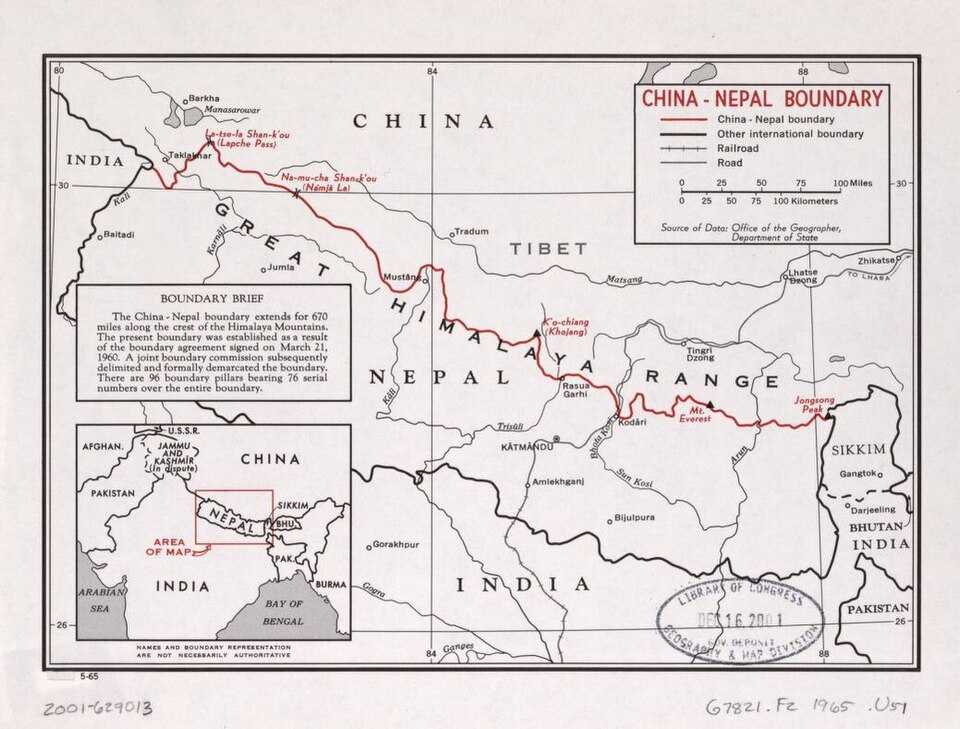 A labeled map showing Nepal’s borders with India (south, east, west) and China (north), with key cities (Kathmandu, Lumbini, Kerung border). (Image: Central Intelligence Agency, Public domain, via Wikimedia Commons)
Nepal’s Neighbors: India and China
Nepal’s foreign policy is heavily influenced by its two giant neighbors: India and China. Both are important, but they have different strengths and challenges for Nepal.
1. Nepal-India Relations: The "Brotherly" but Complex Tie
Strengths:
- Economic lifeline: India is Nepal’s biggest trading partner (60% of Nepal’s trade).
- Energy imports: Nepal depends on India for petroleum, medicines, and machinery.
- Cultural links: Hinduism and Buddhism connect the two countries. Many Nepalis live and work in India.
- Development aid: India helps build roads, schools, and hospitals (e.g., Pancheshwar Multipurpose Project).
Challenges:
- Trade blockade (2015): India closed borders over a new Nepalese constitution, causing fuel and medicine shortages.
- Dependence: Nepal imports 80% of its oil from India, making it vulnerable.
- Political pressure: India sometimes influences Nepal’s internal politics (e.g., supporting certain political parties).
2. Nepal-China Relations: The Rising Power
Strengths:
- Infrastructure projects: China has funded roads, bridges, and airports (e.g., Kathmandu-Terai-Mahendra Nagar Highway).
- Hydroelectricity deals: China invests in Nepal’s hydropower plants (e.g., Pancheshwar Dam).
- Belt and Road Initiative (BRI): Nepal is part of China’s global infrastructure plan, offering loans for development.
- Diplomatic support: China supports Nepal in international forums (e.g., UN, SAARC).
Challenges:
- Debt trap risk: China’s loans come with high interest, and Nepal may struggle to repay.
- Border disputes: China controls Nepal’s northern border, but some areas (like Lipulekh) are disputed.
- Less cultural connection: Unlike India, China has fewer historical or cultural ties with Nepal.
Comparison Table: Nepal-India vs. Nepal-China Relations
| Aspect | Nepal-India Relations | Nepal-China Relations |
|---|---|---|
| Trade Share | 60% of Nepal’s trade | Growing, but smaller share |
| Energy Dependence | Nepal depends on India for oil | China invests in Nepal’s hydropower |
| Infrastructure | Roads, schools (but sometimes delayed) | Highways, airports (faster projects) |
| Political Influence | Strong (sometimes seen as interference) | Growing, but less direct pressure |
| Cultural Ties | Deep (Hinduism, Buddhism, migration) | Limited (mostly economic) |
| Biggest Challenge | Trade blockades, dependence | Debt, border disputes |
Nepal’s Role in Global Organizations
Nepal is a small but active player in global groups. These organizations help Nepal with money, security, and global voice.
1. United Nations (UN)
- Nepal is a member of the UN since 1955.
- Why it matters:
- Nepal gets aid for poverty, education, and health (e.g., UNICEF for child welfare).
- Nepal’s voice is heard on climate change, peacekeeping, and human rights.
- Example: Nepal sends peacekeepers to UN missions in South Sudan, Congo, and Lebanon.
2. South Asian Association for Regional Cooperation (SAARC)
- A group of 8 South Asian countries (India, Pakistan, Bangladesh, etc.).
- Key issues Nepal pushes for:
- Free trade (but progress is slow).
- Disaster management (floods, earthquakes).
- Territorial disputes (e.g., India-Pakistan tensions affect Nepal).
3. Bay of Bengal Initiative for Multi-Sectoral Technical and Economic Cooperation (BIMSTEC)
- A regional group (India, Bangladesh, Myanmar, etc.) focusing on trade and security.
- Nepal joins to boost trade (especially with India and Bangladesh).
Economic Diplomacy: How Nepal Earns Money Abroad
Nepal uses foreign policy to make money through:
- Hydroelectricity Exports
- Nepal has huge water resources but lacks electricity for everyone.
- Solution: Sell electricity to India and Bangladesh.
- Example: The West Seti Project exports power to India.
Labor Migration
- Over 2 million Nepalis work abroad (India, Gulf countries, Malaysia).
- Pros: Sends $8 billion/year to Nepal (helps families and economy).
- Cons: Workers face exploitation, unsafe jobs, and homesickness.
Tourism and Cultural Diplomacy
- Nepal promotes Buddhist pilgrimage sites (Lumbini, Swayambhunath).
- Challenge: Political instability and earthquakes hurt tourism.
Challenges in Nepal’s Foreign Policy
Nepal faces big problems in its foreign relations:
graph LR
  A["India’s Influence"] -->|"Trade dependence"| B["Vulnerability to blockades"]
  A -->|"Political pressure"| C["Internal policy interference"]
  D["China’s Influence"] -->|"BRI loans"| E["Debt trap risk"]
  D -->|"Border disputes"| F["Territorial insecurity"]
  G["Global Organizations"] -->|"Limited leverage"| H["Small-state challenges"]
Key challenges in Nepal’s foreign policy balance (2020s)
Dependence on India
- Nepal imports 80% of its oil from India.
- Solution: Nepal is building hydropower plants to reduce dependence.
China’s Debt Trap
- China gives loans for infrastructure, but Nepal may struggle to repay.
- Example: The Kerung-Kathmandu rail project is expensive.
Border Disputes
- India: Disputes over Kalapani, Limpiyadhura, Lipulekh.
- China: Dispute over Sikkim border (Nepal claims it belongs to China).
Migration Risks
- Nepali workers in Gulf countries face abuse and unsafe conditions.
- Solution: Nepal signs labor agreements with Qatar and Malaysia.
Exam Tip: How to Score Full Marks
NEB exams test facts, comparisons, and opinions. Here’s how to ace this unit:
1. Remember Key Definitions
- Foreign Policy: A country’s strategy in dealing with other nations.
- Non-Alignment: Not joining military alliances (like NATO).
- BIMSTEC: A regional group for trade and security.
2. Compare India and China
- Use the table above in your answers.
- Example answer:
"Nepal’s relations with India are stronger due to cultural ties, but China offers faster infrastructure projects. However, Nepal risks debt with China and faces border disputes with both."
3. Explain Real-World Examples
- Trade Blockade (2015): India closed borders → fuel shortage → Nepal suffered.
- Pancheshwar Dam: China and India both want it → Nepal must balance both.
4. Opinion-Based Questions
- Example Question: "Should Nepal depend more on China or India?"
- Your Answer:
"Nepal should balance both. India is crucial for trade, but China’s infrastructure help is valuable. Nepal must avoid over-dependence on either to protect its sovereignty."
- Your Answer:
5. Diagram Practice
- Draw a mindmap of Nepal’s foreign policy principles.
- Sketch a map of Nepal’s neighbors (India, China, Tibet) with key border points.
NEB Board-Style Questions (Practice These!)
Short Answer (5 marks)
- Explain three principles of Nepal’s foreign policy and give one example for each.
- Why does Nepal depend on India for oil? What are the risks of this dependence?
- What is BIMSTEC? How does Nepal benefit from it?
Long Answer (10 marks)
- "Nepal’s foreign policy is like walking a tightrope." Explain this statement with reference to Nepal’s relations with India and China.
- Discuss the challenges Nepal faces in labor migration. How can Nepal protect its workers abroad?
Map Work (5 marks)
- On a blank map of Nepal, mark:
- The border with India and China.
- Kalapani, Lipulekh, and Kerung border.
- Major hydropower projects (West Seti, Pancheshwar).
Final Tip: Always link theory to real examples (like blockades, hydropower deals). NEB loves case studies! Good luck! 🚀
Based on the NEB +2 Humanities syllabus for Social Studies and Life Skills (SSLS), unit 7.
Discussion
Loading…