SociologyUnit 1111 min read
Nepali Society: Diversity, Ethnicity & Social Structure
Unit 11 of Sociology explores Nepal’s ethnic diversity, caste systems, regional cultures, and how these shape social identity, conflict, and unity. Learn about federalism, indigenous rights, and the challenges of multicultural coexistence through real examples and NEB-style questions.
TAKEAWAYS:
- Nepal’s 125+ ethnic groups and 36+ caste groups create a mosaic of languages, religions, and traditions, protected by federalism.
- Ethnicity is not just race—it includes culture, history, and political identity (e.g., Tharu vs. Newar).
- Social exclusion persists despite constitutional guarantees, seen in marginalized groups like Dalits and Janajatis.
- Federalism (7 provinces) aims to balance diversity but faces challenges like resource distribution and identity politics.
- Cultural homogenization (e.g., Hindi dominance) threatens indigenous languages and traditions.
- NEB exams test definitions, case studies (e.g., Madhesi protests), and comparisons (e.g., caste vs. class).
1. Nepal’s Ethnic and Cultural Diversity
Nepal is a multicultural, multiethnic, and multilingual society. The 2011 census identified 125 ethnic groups and 36 caste groups, each with unique languages, religions, and traditions. This diversity is a result of Nepal’s geographical, historical, and social complexity.
Key Ethnic Groups
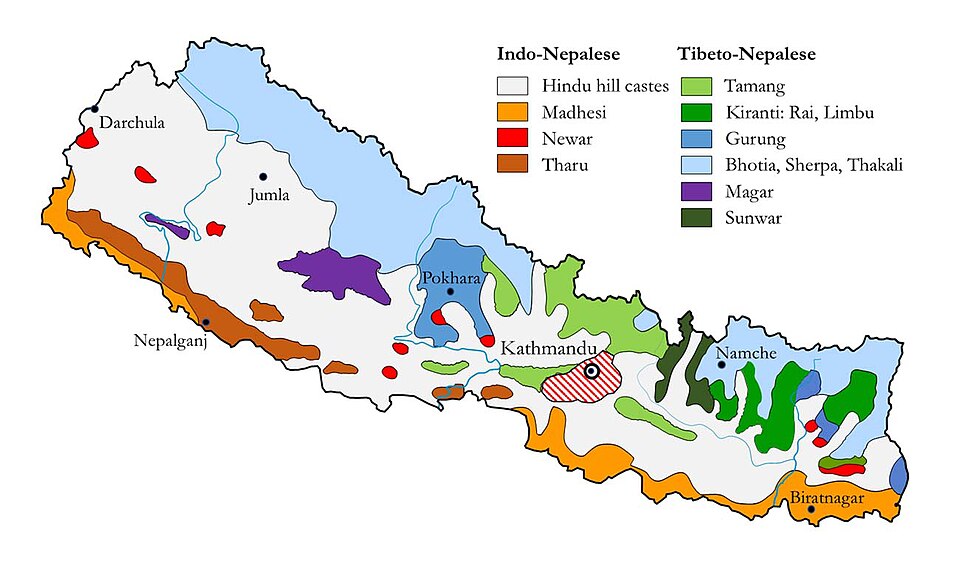
Nepal’s ethnic groups can be broadly categorized into:
Indigenous Nationalities (Adivasi-Janajati):
- Tharu: Live in the Terai, practice animism, and face displacement due to infrastructure projects.
- Newar: Dominant in Kathmandu Valley, known for Buddhist culture, architecture (e.g., Pashupatinath Temple), and Newari language.
- Magar, Gurung, Rai, Limbu: Found in hilly and mountainous regions, with distinct agricultural practices and shamanistic beliefs.
- Dalit (Untouchables): Historically marginalized, now constitutionally recognized as Dalit Janajati.
Caste Groups (Jati):
- Brahmin/Chhetri: Traditionally upper caste, dominant in politics and administration.
- Thakuri: Landowning caste in the Hills.
- Kami (blacksmiths), Damai (barbers): Considered low caste but not Dalit.
Migrant and Foreign Groups:
- Madhesi: Ethnic Indo-Nepali people from the Terai, speak Maithili/Bhojpuri, and face citizenship disputes.
- Tibetan refugees: Fleeing Chinese occupation, now integrated into Nepali society.
Visual: Nepal’s Ethnic Map
Why Does Ethnicity Matter?
- Identity: People take pride in their language, dress, and festivals (e.g., Dashain by Hindus, Losar by Tibetans).
- Politics: Ethnic groups demand proportional representation (e.g., Madhesi protests for federalism).
- Economy: Some groups (e.g., Newars in trade, Gurungs in tourism) dominate certain sectors.
2. Caste System in Nepal: Myths and Realities
Unlike India, Nepal’s caste system is less rigid but still influences marriage, occupation, and social mobility.
How Caste Works in Nepal
| Aspect | Description |
|---|---|
| Hierarchy | Brahmin/Chhetri (highest) → Thakuri → Kami/Damai → Dalit (lowest). |
| Endogamy | Marriage within the same caste is preferred. |
| Occupation | Traditionally, Brahmin = priests, Kami = blacksmiths, Damai = barbers. |
| Discrimination | Dalits face denial of temple entry, water sources, and education. |
Changes After 2006 (People’s Movement)
- Caste-based discrimination banned by the Interim Constitution (2007).
- Affirmative action for Dalits and Janajatis in education and jobs.
- Dalit rights movements (e.g., Bhim Dahal’s leadership) pushed for legal reforms.
Visual: Caste Hierarchy in Nepal
3. Federalism and Ethnic Rights
Nepal’s 2015 Constitution introduced federalism to address ethnic demands. The country is now divided into 7 provinces, each with autonomy over culture, language, and resources.
How Federalism Helps Ethnic Groups
| Province | Major Ethnic Groups | Key Demands |
|---|---|---|
| Province 1 | Limbu, Rai, Yakkha | More education in mother tongue. |
| Province 2 | Tharu, Musahar, Dhanuk | Land rights and Terai development. |
| Province 5 | Magar, Gurung, Tamang | Hill region autonomy. |
| Madhesh | Madhesi, Tharu, Muslim | Citizenship rights and resource sharing. |
Challenges of Federalism
- Resource distribution: Wealthier provinces (e.g., Kathmandu Valley) hoard funds.
- Identity conflicts: Some groups (e.g., Newars) want separate provinces.
- Political instability: Frequent protests and strikes (e.g., Madhesi bandhs).
Visual: Nepal’s Federal Provinces
4. Language and Cultural Homogenization
Nepal has 123 languages, but Nepali and Maithili dominate due to state policies.
Threats to Indigenous Languages
- Schools teach in Nepali, sidelining Tharu, Rai, or Magar.
- Media and government use Nepali/Hindi, marginalizing others.
- Urbanization makes youth prefer Nepali over local languages.
Efforts to Preserve Diversity
- Mother Tongue Education: Some schools now teach in local languages (e.g., Tharu-medium schools in Terai).
- Constitutional guarantees: Article 6 protects indigenous languages.
- UNESCO recognition: Some languages (e.g., Chepang, Bajjika) are endangered.
Visual: Language Diversity in Nepal
5. Social Exclusion and Marginalization
Despite constitutional protections, Dalits and Janajatis face:
- Denial of basic rights (e.g., water sources, temple entry).
- Poor access to education/healthcare.
- Landlessness (e.g., Dalits in Chitwan).
Case Study: Dalit Struggles
- 2001 Royal Massacre: Dalit activists were targeted by the monarchy.
- 2006 People’s Movement: Dalits joined protests for equality.
- 2015 Constitution: Dalit rights included, but implementation is weak.
Visual: Dalit Discrimination in Nepal
6. Nepali Society: Unity vs. Division
Nepal’s diversity is both a strength and a challenge: ✅ Strengths:
- Rich cultural heritage (e.g., Living Human Treasures like Umanath Shastri).
- Tourism and global recognition (e.g., UNESCO sites like Lumbini).
- Federalism gives local autonomy.
❌ Challenges:
- Ethnic conflicts (e.g., Madhesi protests, Tharu land grabs).
- Economic inequality (e.g., Dalits in poverty, Newars in business).
- Political instability (e.g., frequent strikes, weak governance).
Exam Tip: How to Score Full Marks in NEB
NEB exams on this unit test definitions, comparisons, and real-world examples. Follow this strategy:
1. Understand Key Terms
- Ethnicity: Not just race—includes culture, history, and politics.
- Federalism: Power-sharing between center and provinces.
- Social exclusion: Systematic denial of rights to certain groups.
2. Compare and Contrast
NEB loves tables and comparisons. Example:
| Caste | Class | Ethnicity |
|---|---|---|
| Based on: Birth, occupation | Based on: Income, education | Based on: Culture, language, history |
| Example: Brahmin vs. Dalit | Example: Rich businessman vs. poor farmer | Example: Newar vs. Tharu |
| Mobility: Limited (traditionally) | Mobility: Possible (wealth can change class) | Mobility: Fluid (can adopt new culture) |
3. Use Real Examples
NEB hates vague answers. Always link to:
- Madhesi protests (citizenship, federalism).
- Dalit rights movements (2006, 2015 Constitution).
- Tharu land struggles (infrastructure projects in Terai).
4. Short-Answer Practice (NEB Style)
Q1: Define ethnicity. How does it differ from caste?
Answer: Ethnicity refers to shared culture, language, and history (e.g., Tharu identity). Unlike caste, which is hierarchical and occupation-based, ethnicity is fluid and self-identified. While caste is ascribed at birth, ethnicity can change over time (e.g., a Newar adopting Tharu traditions).
Q2: Explain two challenges of federalism in Nepal.
Answer:
- Resource inequality: Wealthier provinces (e.g., Bagmati) get more funds, leaving Terai provinces poor.
- Identity conflicts: Groups like Newars want separate provinces, causing political tensions.
Q3: How does Nepal’s constitution protect ethnic diversity?
Answer:
- Article 6: Recognizes 123 languages and mother-tongue education.
- Federalism: 7 provinces allow local cultural autonomy.
- Affirmative action: Reserved seats for Dalits/Janajatis in parliament and jobs.
Solved Example: Trace the Evolution of Dalit Rights
Question: Trace the historical struggles of Dalits in Nepal from pre-2006 to post-2015.
Answer:
Pre-2006 (Monarchy Era):
- Dalits were untouchables, denied temple entry, water sources.
- No political representation (e.g., 2001 Royal Massacre targeted Dalit activists).
2006 (People’s Movement):
- Dalits joined protests against the monarchy.
- Interim Constitution (2007) banned caste-based discrimination.
2015 (Federal Democracy):
- New Constitution recognized Dalit Janajati as a separate identity.
- Affirmative action in education and jobs.
- Challenges remain: Caste violence (e.g., 2017 Dalit rape case in Rautahat).
Visual Timeline:
Final Checklist for NEB Exam
✅ Memorize:
- 125 ethnic groups, 36 caste groups (from 2011 census).
- 7 federal provinces and their dominant ethnicities.
- Key dates: 2006 (People’s Movement), 2015 (Constitution).
✅ Practice:
- Compare caste vs. class vs. ethnicity (use tables).
- Explain federalism with one challenge and one benefit.
- Link theories to Nepal (e.g., Gurung’s adaptation to tourism).
✅ Avoid:
- Vague answers (e.g., “Ethnicity is important” → Why?).
- Ignoring real cases (e.g., Madhesi protests, Dalit struggles).
- Assuming all ethnic groups are the same (e.g., Tharu ≠ Newar).
Good luck! This unit is high-scoring if you link theory to Nepal’s real struggles. 🚀
Based on the NEB +2 Humanities syllabus for Sociology (Soc), unit 11.
Discussion
Loading…