EconomicsUnit 813 min read
Inflation & Deflation: Causes, Types, Effects & Policies
Unit 8 of Economics explains inflation (rising prices) and deflation (falling prices), their causes, types, effects on society, and government policies to control them—with real-world examples and NEB-style questions.
TAKEAWAYS:
- Inflation is a general rise in prices over time, while deflation is a general fall in prices—both disrupt economies differently.
- Causes include demand-pull (too much money chasing goods), cost-push (rising production costs), and built-in inflation (wage-price spiral).
- Types: Creeping (mild), Walking (moderate), Galloping (severe), and Hyperinflation (catastrophic).
- Effects: Inflation reduces purchasing power and encourages speculation, while deflation increases unemployment and debt burdens.
- Governments use monetary policies (interest rates, money supply) and fiscal policies (taxes, spending) to control inflation/deflation.
What Are Inflation and Deflation?
Inflation and deflation are opposite trends in the general price level of goods and services in an economy over time.
- Inflation: A sustained increase in the price level of goods and services, leading to a decline in the purchasing power of money.
- Deflation: A sustained decrease in the price level, meaning money becomes more valuable over time.
Why does this matter? If prices rise too fast (inflation), your money buys less. If prices fall too fast (deflation), people delay spending, hurting businesses.
Causes of Inflation
Inflation happens due to too much money chasing too few goods. The main causes are:
1. Demand-Pull Inflation
- What happens? When demand for goods increases faster than supply, prices rise.
- Why? People have more money to spend (e.g., higher wages, more loans), but factories can’t produce enough.
- Example:
- After a bonus season, people spend more on electronics → shortage → price rise.
- Government spending too much (e.g., building roads, subsidies) without increasing production.
2. Cost-Push Inflation
- What happens? When production costs rise, businesses increase prices to maintain profits.
- Why? Higher wages, raw material costs, or taxes force firms to charge more.
- Example:
- Oil price shock (e.g., 2022 Ukraine war) → transport costs rise → food prices increase.
- Minimum wage hike → labor costs rise → companies raise product prices.
3. Built-in Inflation (Wage-Price Spiral)
- What happens? Workers demand higher wages to keep up with rising prices → businesses raise prices → workers demand more wages → cycle continues.
- Example:
- In the 1970s, unions pushed for higher wages → companies increased prices → workers demanded more → inflation worsened.
4. Monetary Inflation (Excess Money Supply)
- What happens? When a central bank prints too much money (or lowers interest rates too much), money loses value.
- Why? Too much money chases the same amount of goods → prices rise.
- Example:
- Nepal Rastra Bank (NRB) prints extra rupees to fund government spending → inflation rises.
- Low interest rates → people borrow more → more spending → prices rise.
Types of Inflation
Inflation is classified based on how fast prices rise:
| Type | Rate of Inflation | Example | Effect on Economy |
|---|---|---|---|
| Creeping | 1-3% per year | Normal price increases | Stable, good for growth |
| Walking | 3-10% per year | Noticeable price hikes | Moderate impact, savings lose value |
| Galloping | 10-100% per year | Prices double in months | Economic crisis, hyperinflation risk |
| Hyperinflation | >100% per year | Money becomes worthless | Society collapses, people use barter |
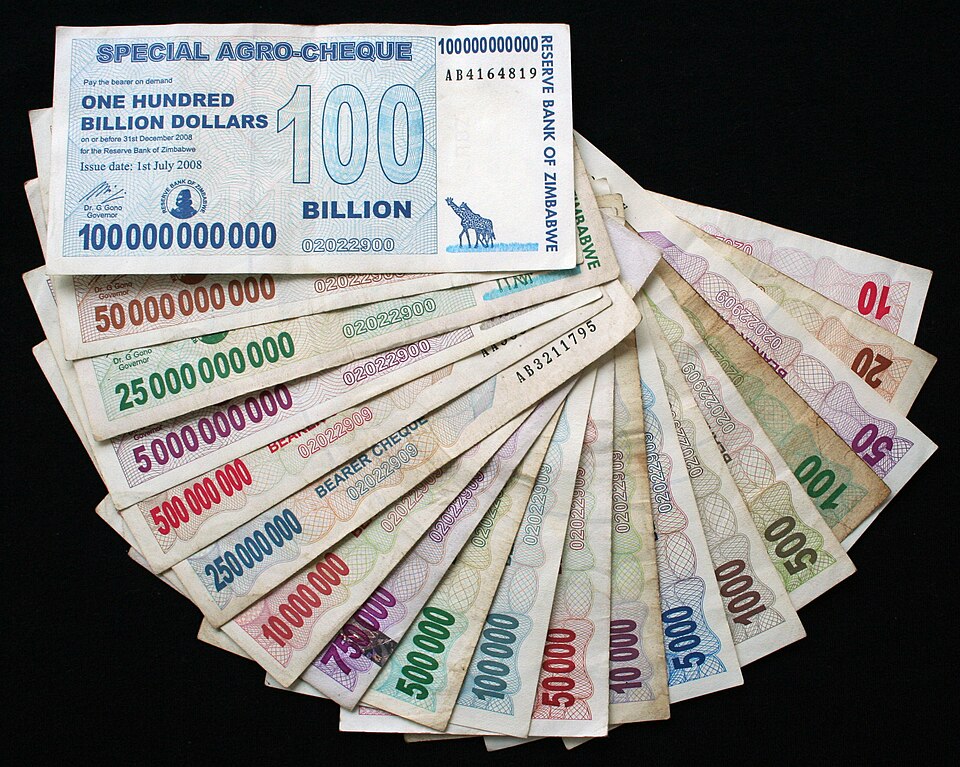 Zimbabwe’s 500 billion dollar note (2008) – worth less than a loaf of bread (Image: en:User:Discott, Public domain, via Wikimedia Commons)
Effects of Inflation
Inflation affects consumers, businesses, and governments differently.
Advantages of Mild Inflation (1-3%)
✅ Encourages spending (people buy now before prices rise). ✅ Reduces unemployment (businesses hire more to meet demand). ✅ Helps debtors (money loses value, so loans are easier to repay).
Disadvantages of High Inflation (>10%)
❌ Reduces purchasing power (your salary buys less). ❌ Uncertainty in business (prices keep changing). ❌ Savings lose value (money in banks earns less than inflation). ❌ Speculation increases (people hoard goods to sell later at higher prices). ❌ Wage-price spiral (workers demand more pay → businesses raise prices → cycle repeats).
Effects of Deflation
Deflation is dangerous because it discourages spending.
Advantages of Mild Deflation (rare)
✅ Increases purchasing power (money buys more). ✅ Encourages saving (people hold money instead of spending).
Disadvantages of Deflation
❌ Reduces consumer spending (people wait for prices to fall further). ❌ Increases unemployment (businesses cut jobs because demand drops). ❌ Debt becomes harder to repay (loans are worth more in real terms). ❌ Bankruptcies rise (businesses can’t sell goods at a profit).
How to Measure Inflation?
Governments use price indices to measure inflation:
Consumer Price Index (CPI)
- Measures price changes of a basket of goods (food, housing, transport) bought by average households.
- Formula:
- Example:
- 2020 (Base Year): Basket costs ₹10,000 → CPI = 100
- 2023: Same basket costs ₹12,000 → CPI = 120 → 20% inflation
Wholesale Price Index (WPI)
- Measures price changes at the wholesale level (raw materials, bulk goods).
- Used to predict future inflation.
GDP Deflator
- Measures price changes of all goods and services in an economy.
- Used by central banks for policy decisions.
Government Policies to Control Inflation & Deflation
Governments use two main tools:
1. Monetary Policy (Controlled by Central Bank – NRB in Nepal)
| Policy | How It Works | Effect on Inflation | Effect on Deflation |
|---|---|---|---|
| Increase Interest Rates | Banks charge more for loans | Reduces spending, slows inflation | Encourages borrowing, helps economy |
| Decrease Money Supply | NRB sells government bonds, reduces credit | Less money in circulation → prices fall | Not used (deflation needs stimulus) |
| Open Market Operations | NRB buys/sells bonds to control money | Buys bonds → more money → inflation rises | Sells bonds → less money → deflation eases |
2. Fiscal Policy (Controlled by Government)
| Policy | How It Works | Effect on Inflation | Effect on Deflation |
|---|---|---|---|
| Increase Taxes | Government takes more from people | Reduces spending → prices fall | Not used (hurts economy more) |
| Decrease Government Spending | Cuts subsidies, public projects | Less demand → prices stabilize | Not used (worsens recession) |
| Subsidies & Public Works | Government spends on roads, jobs | Not direct, but helps long-term growth | Helps by increasing demand |
Real-World Example: Inflation in Nepal (2022-2023)
Problem:
- Global oil price shock (Russia-Ukraine war) → transport costs rise.
- Floods & droughts → food production drops → rice & wheat prices rise.
- NRB kept interest rates low → more borrowing → more spending → demand-pull inflation.
Solution by NRB:
- Increased repo rate (from 5.5% to 7.5% in 2022) → banks lent less.
- Sold government bonds → reduced money supply.
- Encouraged imports (e.g., rice from India) → stabilized food prices.
Result:
- Inflation fell from 9.2% (2022) to 6.5% (2023).
NEB-Style Questions & Solutions
Short Answer Questions (5 marks each)
Q1. What are the main causes of inflation? Explain with examples. Answer: Inflation occurs due to:
- Demand-Pull: When demand > supply (e.g., Diwali season – high demand for electronics → prices rise).
- Cost-Push: Rising production costs (e.g., oil price hike → transport costs rise → food prices increase).
- Built-in Inflation: Wage-price spiral (e.g., Nepal’s 2015 wage hike → businesses raised product prices).
- Monetary Inflation: Excess money supply (e.g., NRB printing extra rupees → money loses value).
Q2. Distinguish between creeping and hyperinflation with examples. Answer:
| Feature | Creeping Inflation | Hyperinflation |
|---|---|---|
| Rate | 1-3% per year | >100% per year |
| Example | Nepal’s inflation in 2019 (5.5%) | Zimbabwe (2008) – prices doubled daily |
| Effect on Economy | Stable, minor impact | Collapse, money becomes worthless |
| Government Response | No action needed | Emergency measures (new currency, price controls) |
Long Answer Questions (10 marks)
Q3. Explain the effects of inflation on different sections of society. How can the government control inflation? Answer: Inflation affects society in three main ways:
On Consumers
- Negative: Purchasing power falls (salary buys less).
- Positive: Debtors benefit (loans become cheaper to repay).
On Businesses
- Negative: Uncertainty (prices keep changing), costs rise (raw materials expensive).
- Positive: Exporters gain (foreign buyers pay more in their currency).
On Government
- Negative: Tax revenue falls (people earn less), subsidies become expensive.
- Positive: Debt repayment easier (money loses value).
Government Policies to Control Inflation:
- Monetary Policy:
- Increase repo rate → banks lend less → spending decreases.
- Sell government bonds → money supply reduces.
- Fiscal Policy:
- Increase taxes → people spend less.
- Reduce subsidies → government spending cuts.
- Supply-Side Policies:
- Improve agriculture (e.g., irrigation projects) → food supply increases.
- Encourage imports (e.g., cheap rice from India) → prices stabilize.
Example:
- In 2022, Nepal’s inflation was 9.2% due to oil & food price shocks.
- NRB’s solution:
- Increased repo rate to 7.5% → banks lent less.
- Encouraged rice imports → food prices fell.
- Result: Inflation dropped to 6.5% in 2023.
Multiple Choice Questions (MCQs)
Q4. Which of the following is NOT a cause of inflation? A) Demand-pull B) Cost-push C) Deflation D) Built-in inflation Answer: C) Deflation (Deflation is the opposite of inflation.)
Q5. If CPI in 2020 was 100 and in 2023 it is 130, what is the inflation rate? A) 20% B) 30% C) 10% D) 5% Answer: B) 30% (Inflation = (130 - 100)/100 × 100 = 30%)
Exam Tip: How to Score Full Marks in NEB Economics (Unit 8)
Understand the Difference:
- Inflation = Prices ↑, Deflation = Prices ↓.
- Never confuse them—examiners check this!
Use Real Examples:
- Nepal’s 2022 inflation (oil crisis).
- Zimbabwe’s hyperinflation (2008).
- Japan’s deflation (1990s).
Diagrams Help!
- Draw inflation vs. deflation effects table.
- Show CPI calculation with numbers.
Policy Mix is Key:
- Inflation? → Higher interest rates, less money supply.
- Deflation? → Lower interest rates, more government spending.
Common Mistakes to Avoid: ❌ Saying "Inflation is good" (only mild inflation is okay). ❌ Forgetting built-in inflation (wage-price spiral). ❌ Mixing CPI and WPI (CPI = consumers, WPI = wholesalers).
Based on the NEB +2 Humanities syllabus for Economics (Eco), unit 8.
Discussion
Loading…