EconomicsNEB 2076 (old course)
Explain the law of variable proportions.
10Answer
Law of Variable Proportions
The Law of Variable Proportions (also known as the Law of Diminishing Returns) is a fundamental principle in economics that explains the relationship between the quantity of a variable input (such as labor) and the total output produced, while keeping other inputs (like capital and technology) constant. This law was first formulated by David Ricardo and later expanded by Alfred Marshall in his book Principles of Economics.
Key Concepts of the Law of Variable Proportions
- Variable Input: A factor of production that can be changed in the short run (e.g., labor, raw materials).
- Fixed Input: A factor of production that cannot be changed in the short run (e.g., machinery, factory size).
- Total Product (TP): The total output produced by varying the quantity of the variable input.
- Average Product (AP): The output per unit of the variable input, calculated as:
- Marginal Product (MP): The additional output produced by adding one more unit of the variable input, calculated as:
Stages of Production Under the Law of Variable Proportions
The law divides production into three distinct stages, based on how the marginal product (MP) behaves as more units of the variable input are added:
Stage I: Increasing Returns (Increasing Marginal Returns)
- Characteristics:
- As more units of the variable input (e.g., labor) are added, the marginal product (MP) increases.
- The total product (TP) increases at an increasing rate.
- The average product (AP) also rises.
- Reason:
- Initially, fixed inputs (like machinery) are underutilized. Adding more labor leads to better specialization and efficiency, increasing output per additional worker.
- Example:
- If a farmer hires more workers on a fixed plot of land, each new worker can contribute more than the previous one due to better coordination and division of labor.
Stage II: Diminishing Returns (Diminishing Marginal Returns)
- Characteristics:
- As more units of the variable input are added, the marginal product (MP) starts to decline.
- The total product (TP) still increases but at a decreasing rate.
- The average product (AP) may rise, fall, or remain constant, but it eventually declines.
- Reason:
- The fixed inputs (like land or machinery) become overcrowded, leading to less efficiency per additional worker.
- For example, if too many workers are added to a fixed factory, they may get in each other’s way, reducing productivity per worker.
- Key Point:
- This stage is the most important because it explains why firms face diminishing returns in the short run.
Stage III: Negative Returns (Negative Marginal Returns)
- Characteristics:
- The marginal product (MP) becomes negative.
- The total product (TP) starts to decline.
- The average product (AP) also falls.
- Reason:
- Too many workers are added relative to fixed inputs, leading to overcrowding and inefficiency.
- Workers may interfere with each other’s work, reducing total output.
- Example:
- If a small bakery hires too many bakers, they may block ovens, waste ingredients, or slow down production, reducing total bread output.
Graphical Representation
The figure above illustrates the three stages of production with:
- TP (Total Product): Increases, reaches a maximum, then declines.
- AP (Average Product): Rises, peaks, and then falls.
- MP (Marginal Product): Increases in Stage I, decreases in Stage II, and becomes negative in Stage III.
The optimal level of production occurs where MP = 0 (the peak of TP), as beyond this point, adding more labor reduces total output.
Assumptions of the Law of Variable Proportions
- Technology remains constant: No new inventions or improvements in production methods.
- Fixed inputs are truly fixed: Land, machinery, and capital cannot be changed in the short run.
- Homogeneous units of variable input: All units of labor are identical in skill and efficiency.
- Perfect competition: Firms can hire or fire workers at the same wage rate.
Real-World Applications
- Agriculture:
- Adding more labor to a fixed plot of land initially increases output (Stage I), but beyond a point, too many workers reduce efficiency (Stage III).
- Manufacturing:
- A factory with fixed machinery may see increasing returns when hiring more workers up to a limit, but overcrowding leads to diminishing returns.
- Service Sector:
- A restaurant may increase output efficiently with more chefs (Stage I), but too many cooks in a small kitchen reduce productivity (Stage III).
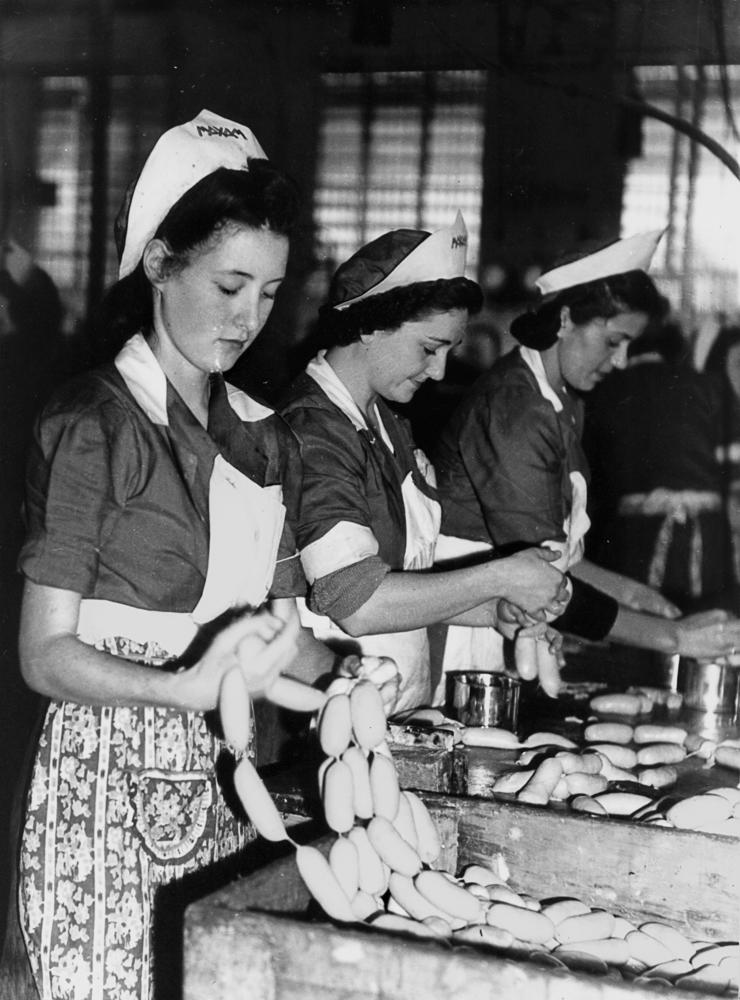 Illustration of a factory where labor is a variable input (Image: Contributor(s): Queensland Newspapers Pty Ltd, Public domain, via Wikimedia Commons)
Difference Between Short Run and Long Run
| Feature | Short Run | Long Run |
|---|---|---|
| Fixed Inputs | At least one factor is fixed (e.g., machinery). | All factors can be varied. |
| Law of Variable Proportions | Applies (diminishing returns occur). | Does not apply (all inputs are variable). |
| Production Adjustment | Firms adjust variable inputs (labor, raw materials). | Firms can change all inputs (build new factories, hire more managers). |
| Decision Making | Firms focus on optimizing variable inputs. | Firms plan for long-term growth and expansion. |
Conclusion
The Law of Variable Proportions explains why firms face diminishing returns when they increase only one input while keeping others fixed. It helps businesses and policymakers understand optimal production levels and resource allocation in the short run. By recognizing the three stages of production, firms can avoid over-employment (Stage III) and maximize efficiency in Stage II.
Discussion
Loading…