EconomicsNEB 2075 (old course)
How are price and output determined under perfect competition? [5]
5Answer
Under perfect competition, price and output are determined through the interaction of market demand and supply forces, guided by the profit-maximizing behavior of individual firms. The determination process can be analyzed at two levels: market equilibrium and individual firm equilibrium.
1. Market Equilibrium (Price Determination)
In perfect competition, the market price is determined by the aggregate demand (D) and aggregate supply (S) curves. The equilibrium price () and quantity () emerge where these two curves intersect. This is because:
- At , the quantity demanded by consumers equals the quantity supplied by all firms.
- No individual firm can influence the market price due to the homogeneity of products and large number of buyers and sellers.
- Firms are price takers, meaning they accept the prevailing market price as given.
 Real-world example: Wheat market in Nepal (homogeneous product, many small farmers) (Image: Agathathomas1810332, CC BY-SA 4.0, via Wikimedia Commons)
2. Individual Firm Equilibrium (Output Determination)
While the market determines the price, each firm decides its profit-maximizing output based on:
- Price (P): Given by the market (horizontal demand curve for the firm).
- Marginal Cost (MC): The cost of producing one additional unit.
- Marginal Revenue (MR): In perfect competition, because firms can sell any quantity at the market price.
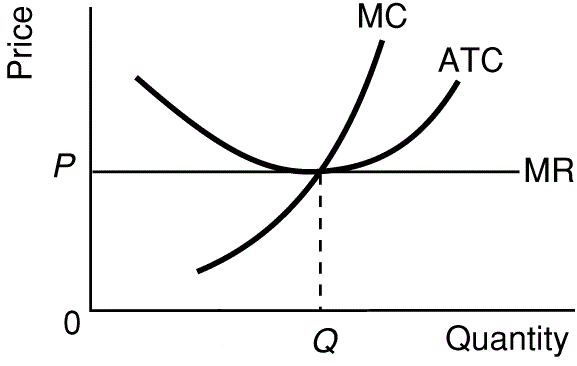
A firm maximizes profit where: Since , the firm produces where: Additionally, the firm must ensure that: If , the firm shuts down in the short run.
Steps to Determine Output:
- Identify the market price () from the market equilibrium.
- Find the MC curve of the firm.
- Locate the intersection of to determine the profit-maximizing output ().
- Check the shutdown condition: If , the firm exits the market in the long run.
Long-Run Equilibrium
In the long run, firms earn normal profits (zero economic profit) because:
- Free entry and exit ensure that (minimum average cost).
- No economic profits attract new firms, and losses force exit until equilibrium is restored.
Thus, under perfect competition:
- Price is determined by market demand and supply.
- Output per firm is determined by (with ).
- The market reaches an efficient allocation of resources.
Discussion
Loading…