HistoryUnit 512 min read
World War I: Causes, Events, Impact & Legacy
Unit 5 of History explores the origins, key battles, turning points, and consequences of World War I (1914–1918), including the Treaty of Versailles and its global effects—essential for NEB exams.
TAKEAWAYS:
- WWI was caused by alliances, militarism, imperialism, and nationalism (the "MAIN" causes).
- The war began with Austria-Hungary’s ultimatum to Serbia after Archduke Franz Ferdinand’s assassination.
- Trench warfare and new weapons (machine guns, tanks, poison gas) made WWI the deadliest conflict before WWII.
- The Treaty of Versailles (1919) punished Germany harshly, planting seeds for WWII.
- WWI reshaped global politics, ended empires (Ottoman, Austro-Hungarian, Russian), and created the League of Nations.
- Nepal remained neutral but faced economic and social changes due to the war’s global impact.
Introduction: Why Did WWI Happen?
World War I (1914–1918) was the first global war in history. It involved 30+ countries and killed 20 million people. To understand it, we must look at its causes, key events, and consequences.
1. Causes of World War I (The "MAIN" Causes)
Use this mindmap to remember the four main causes:
Key Idea:
- Militarism: Countries built huge armies and navies, making war more likely.
- Alliances: Like a domino effect—if one country fought, its allies had to join.
- Imperialism: Fighting over colonies (e.g., Morocco Crisis, 1905–1911).
- Nationalism: Strong pride in one’s country led to conflicts (e.g., Serbia vs. Austria-Hungary).
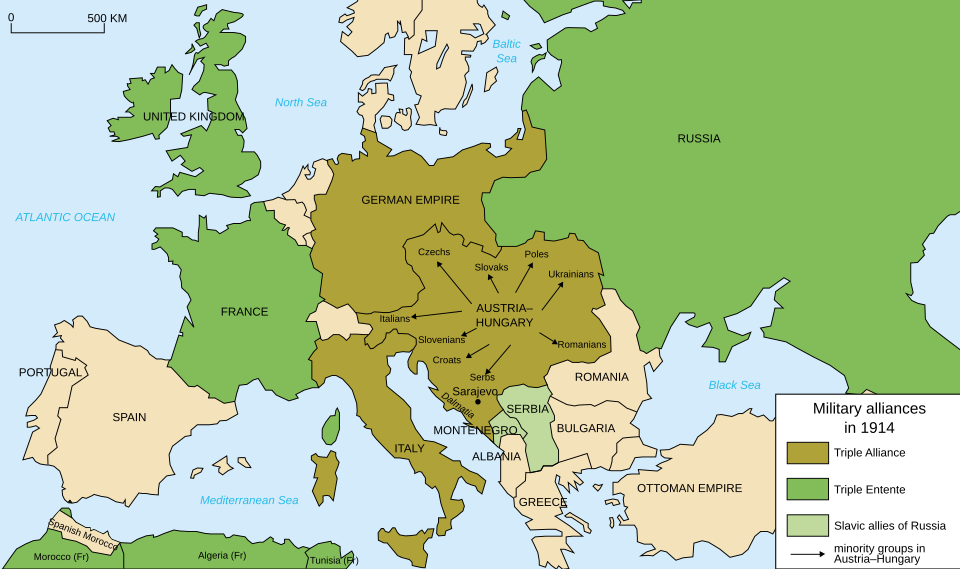 Shows Triple Entente vs. Triple Alliance (Image: historicair (French original) Fluteflute & User:Bibi Sai, CC BY-SA 2.5, via Wikimedia Commons)
2. The Spark: Assassination of Archduke Franz Ferdinand
The immediate cause of WWI was the assassination of Archduke Franz Ferdinand (heir to Austria-Hungary’s throne) on June 28, 1914, in Sarajevo (Bosnia).
Who Killed Him?
- Gavrilo Princip, a 19-year-old Serbian nationalist (member of the Black Hand group).
- Austria-Hungary blamed Serbia and gave it a harsh ultimatum (July 23, 1914).
How Did the War Start?
- Austria-Hungary declared war on Serbia (July 28, 1914).
- Russia mobilized to defend Serbia (allied with Serbia).
- Germany declared war on Russia (August 1) and then on France (August 3).
- Germany invaded Belgium (neutral) to attack France → Britain declared war on Germany (August 4).
Result: The alliance system turned a small conflict into a world war.
3. Key Events of WWI (1914–1918)
WWI had three main phases:
- 1914–1916: Stalemate & Trench Warfare
- 1917: Turning Points (USA joins, Russia quits)
- 1918: Allied Victory
A. 1914–1916: Trench Warfare & New Weapons
- Soldiers fought in muddy trenches (long ditches) for years.
- No side could break through → stalemate.
- New weapons made war even deadlier:
- Machine guns (killed hundreds in minutes)
- Poison gas (mustard gas blinded/suffocated soldiers)
- Tanks (first used by Britain in 1916)
- Airplanes (used for spying and dogfights)
B. Major Battles
| Battle | Year | Where? | Why It Matters |
|---|---|---|---|
| Battle of Marne | 1914 | France | Stopped Germany’s advance into France. |
| Battle of Gallipoli | 1915–1916 | Turkey (Dardanelles) | Failed Allied invasion; Turkey stayed in war. |
| Battle of Verdun | 1916 | France | Longest battle (10 months); 300,000+ deaths. |
| Battle of Somme | 1916 | France | 1 million casualties; tanks used for first time. |
| Battle of Passchendaele | 1917 | Belgium | Muddy, bloody battle; showed horrors of war. |
Key Idea:
- No side won in these battles → millions died for little land gain.
- Trench foot (from wet conditions) and shell shock (PTSD) were common.
C. 1917: Turning Points
Russia Quits the War (February Revolution)
- Russia was weak due to food shortages and poor leadership.
- Bolsheviks (Communists) took over (led by Vladimir Lenin).
- Treaty of Brest-Litovsk (1918): Russia gave up land to Germany and quit the war.
USA Joins the War (April 1917)
- Germany used unrestricted submarine warfare (sinking US ships like the Lusitania).
- US President Woodrow Wilson declared war on Germany.
- Fresh troops and supplies helped the Allies win.
4. End of the War (1918) & Treaty of Versailles
A. Germany’s Defeat (November 1918)
- Germany ran out of soldiers and food.
- Kaiser Wilhelm II fled, and Germany became a democracy.
- Armistice signed on November 11, 1918 → war ended.
B. Treaty of Versailles (1919)
The Allied leaders (USA, Britain, France) punished Germany:
- Germany had to:
- Accept full blame (Article 231: "War Guilt Clause").
- Pay huge reparations (£6.6 billion).
- Give up colonies and land (Alsace-Lorraine to France, Danzig to Poland).
- Reduce its army and navy.
- New countries created:
- Poland, Czechoslovakia, Yugoslavia (from Austria-Hungary).
- Turkey lost land (Middle East became British/French mandates).
Problems with the Treaty
✅ Good:
- Ended the war.
- Created the League of Nations (first global peace organization).
❌ Bad:
- Harsh terms humiliated Germany → led to Hitler’s rise and WWI.
- No real disarmament (Germany’s neighbors kept big armies).
- Colonial powers (Britain/France) took over Middle East (later caused conflicts).
5. Impact of WWI on the World
A. Human Cost
- 20 million dead, 21 million wounded.
- Spanish Flu (1918) killed 50–100 million (worse than the war!).
B. Political Changes
- End of Empires:
- Ottoman Empire → Turkey + Middle East mandates.
- Austro-Hungarian Empire → Austria, Hungary, Czechoslovakia, Yugoslavia.
- Russian Empire → Soviet Union (Communist).
- New Countries:
- Poland, Finland, Estonia, Latvia, Lithuania became independent.
- Women’s Rights:
- Women worked in factories → voting rights expanded (e.g., Britain in 1918).
C. Economic Changes
- USA became the world’s leading economy (Europe was poor).
- War debts: Germany owed money to Allies, Allies owed money to USA.
D. Nepal’s Experience
- Nepal stayed neutral (King Prithvi Narayan Shah’s policy of non-interference).
- Economic impact:
- Salt trade declined (British blocked routes).
- Army (Gurkhas) fought for Britain → some Nepali soldiers died.
- Social changes:
- Returning Gurkha soldiers influenced Nepali society.
- Western ideas spread (democracy, nationalism).
6. Legacy of WWI
- Set the stage for WWII:
- Treaty of Versailles made Germany angry → Hitler rose to power.
- League of Nations failed (no real power to stop aggression).
- Changed warfare forever:
- Tanks, airplanes, and machine guns became standard.
- Total war: Governments controlled economies, propaganda, and people’s lives.
- Redrew the world map:
- Colonialism weakened → led to decolonization after WWII.
Exam Tip: How to Score Full Marks in NEB Exams
NEB exams on World War I usually ask:
Short questions (5–10 marks):
- "What were the main causes of WWI?" → Use MAIN (Militarism, Alliances, Imperialism, Nationalism).
- "Why did the USA join WWI?" → Unrestricted submarine warfare, Lusitania sinking.
- "What were the terms of the Treaty of Versailles?" → Blame, reparations, land loss, League of Nations.
Long questions (15–20 marks):
- "Describe the major events of WWI." → Use timeline (1914–1918) with battles, alliances, turning points.
- "What was the impact of WWI on Europe?" → Political (new countries), economic (USA rises), social (women’s rights).
- "How did WWI lead to WWII?" → Treaty of Versailles → Hitler → Nazi Germany.
Map-based questions:
- Label the Western Front, Eastern Front, and key battles (Marne, Somme, Verdun).
- Show the spread of the war (how alliances dragged in more countries).
Common Mistakes to Avoid
❌ Memorizing dates without explanation → Always explain why a date matters. ❌ Ignoring causes/effects → NEB loves cause-and-effect questions. ❌ Forgetting Nepal’s role → Mention neutrality, Gurkha soldiers, economic impact.
Sample NEB-Style Questions & Answers
Question 1 (Short Answer – 5 marks)
"What were the immediate and long-term causes of World War I?"
Answer: Immediate Cause:
- The assassination of Archduke Franz Ferdinand (June 28, 1914) by Gavrilo Princip (Serbian nationalist).
Long-term Causes (MAIN):
- Militarism: Arms race between Germany and Britain (dreadnought battleships).
- Alliances: Triple Entente (France, Russia, Britain) vs. Triple Alliance (Germany, Austria-Hungary, Italy).
- Imperialism: Competition over colonies (Morocco Crisis, 1905–1911).
- Nationalism: Serbia wanted independence from Austria-Hungary; France wanted revenge for 1871 defeat.
Question 2 (Long Answer – 15 marks)
"Describe the major events of World War I from 1914 to 1918. How did the war end?"
Answer: World War I (1914–1918) can be divided into three phases:
1914: Outbreak & Stalemate
- July 28, 1914: Austria-Hungary declared war on Serbia.
- August 1914: Germany invaded Belgium → Britain joined.
- Battle of Marne (Sept 1914): Germany failed to defeat France → trench warfare began.
1915–1916: War of Attrition
- Gallipoli Campaign (1915): Allied failure in Turkey.
- Battle of Verdun (1916): 10-month battle, 300,000+ deaths (Germany vs. France).
- Battle of Somme (1916): 1 million casualties; tanks used for first time.
1917: Turning Points
- February Revolution (Russia): Bolsheviks took over → Russia quit war (Treaty of Brest-Litovsk, 1918).
- USA joined (April 1917): Helped Allies with troops and supplies.
1918: Allied Victory
- Germany launched final offensive (Spring 1918) but failed.
- November 11, 1918: Armistice signed → war ended.
- Treaty of Versailles (1919): Germany blamed, punished, and disarmed.
How the War Ended:
- Germany ran out of soldiers and resources.
- Kaiser Wilhelm II abdicated → Germany became a democracy.
- Allied forces (including USA) pushed Germany back.
- Armistice signed on November 11, 1918 at 11 AM ("11/11 at 11").
Question 3 (Map-Based – 10 marks)
*"On the outline map of Europe, mark and label the following:
- Western Front
- Eastern Front
- Battle of Marne
- Battle of Somme
- Battle of Verdun"*
Answer: (Since we can’t draw here, here’s how to do it in the exam:)
- Western Front: Draw a line from Belgium to Switzerland (France-Germany border).
- Eastern Front: Draw a line from Poland to Romania (Germany-Russia border).
- Battle of Marne: Mark near Paris, France (1914).
- Battle of Somme: Mark near Amiens, France (1916).
- Battle of Verdun: Mark near Verdun, France (1916).
Tip: Use different colors for Allied vs. Central Powers and label clearly.
Final Revision Checklist
Before the exam, revise: ✔ MAIN causes (Militarism, Alliances, Imperialism, Nationalism). ✔ Key dates: 1914 (start), 1917 (USA/Russia changes), 1918 (end). ✔ Major battles: Marne, Somme, Verdun, Gallipoli. ✔ Treaty of Versailles terms (blame, reparations, League of Nations). ✔ Nepal’s role (neutrality, Gurkhas, economic impact).
Good luck! 🚀 You’ve got this!
Based on the NEB +2 Humanities syllabus for History (His), unit 5.
Discussion
Loading…