Life Skill EducationUnit 310 min read
Decision Making & Problem Solving: Models, Steps & Real-Life Skills
Unit 3 of Life Skill Education explains how to make smart choices and solve problems using clear steps, tools like SWOT analysis, and real-world examples—essential for exams and daily life.
TAKEAWAYS:
- Decision making is choosing between options after careful thought, while problem solving is finding ways to fix issues.
- The 5-step decision-making model (identify, gather info, explore options, decide, act) helps avoid mistakes.
- SWOT analysis (Strengths, Weaknesses, Opportunities, Threats) is a powerful tool for evaluating choices.
- Problem-solving techniques include brainstorming, trial-and-error, and seeking expert advice.
- Barriers to decision making (fear, lack of info, peer pressure) can be overcome with practice and confidence.
- Critical thinking (questioning assumptions, weighing pros/cons) improves both decision making and problem solving.
What is Decision Making?
Decision making is the process of choosing the best option from available alternatives to solve a problem or achieve a goal. It is a daily skill—whether you’re picking a career, managing money, or resolving conflicts with friends.
Why is Decision Making Important?
- Helps you avoid mistakes (e.g., choosing a bad friend or a risky job).
- Saves time and money (e.g., planning purchases wisely).
- Builds confidence in handling life challenges.
- Improves relationships (e.g., resolving family disputes fairly).
Types of Decisions
Decisions can be classified based on importance, frequency, and consequences:
mindmap
  root((Decision Types))
    Personal
      Routine["Daily choices (e.g., what to eat)"]
      Important["Major life choices (e.g., marriage, career)"]
    Group/Team
      Family["Decisions affecting family (e.g., vacation plans)"]
      Workplace["Office decisions (e.g., project tasks)"]
    Financial
      Short-term["Small purchases (e.g., buying a phone)"]
      Long-term["Big investments (e.g., buying a house)"]
Example:
- Routine decision: Choosing between tea and coffee in the morning.
- Important decision: Deciding whether to study abroad or stay in Nepal.
The 5-Step Decision-Making Model
A structured approach reduces confusion. Follow these steps:
Identify the Problem
- Ask: What is the exact issue?
- Example: "I’m struggling with low grades in exams."
Gather Information
- Collect facts (e.g., past exam papers, teacher feedback).
- Avoid rumors or emotions—stick to facts.
Explore Possible Solutions
- List 3-5 options (e.g., study harder, change subjects, seek tutoring).
- Use the "Pros and Cons" table (see below).
Make a Decision
- Choose the best option based on research.
- Example: "I’ll join a coaching class for weak subjects."
Act and Review
- Implement the decision.
- Check results after some time (e.g., next exam scores).
- If it fails, re-evaluate and try another option.
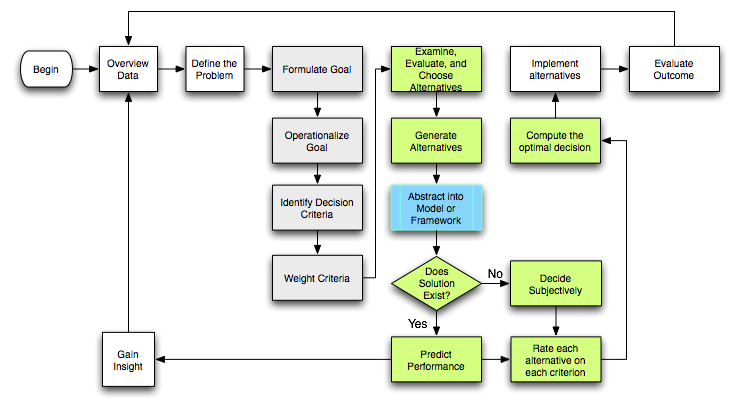 A simple 5-step flowchart showing the process from problem identification to review. (Image: DavidLevinson, CC BY-SA 3.0, via Wikimedia Commons)
Tools for Better Decision Making
1. SWOT Analysis
SWOT helps analyze Strengths, Weaknesses, Opportunities, and Threats before deciding.
| Category | Example (Choosing a Career) |
|---|---|
| Strengths | Good at math, hardworking |
| Weaknesses | Shy, poor communication skills |
| Opportunities | Many IT jobs in Nepal/Pokhara |
| Threats | High competition in IT field |
How to Use SWOT?
- List internal factors (Strengths/Weaknesses) you control.
- List external factors (Opportunities/Threats) outside your control.
- Weigh options based on SWOT results.
Example: If you want to be a doctor:
- Strengths: Good in biology, patient with people.
- Weaknesses: Low budget for MBBS.
- Opportunities: Scholarships available.
- Threats: High competition in medical exams. → Decision: Apply for scholarships and prepare for NEET.
2. Pros and Cons List
A simple table to compare options:
| Option | Pros | Cons |
|---|---|---|
| Option 1 | High salary, stable job | Long working hours, stressful |
| Option 2 | Flexible timings, creative work | Lower pay, unstable income |
Example: Choosing between college in Kathmandu vs. Pokhara:
- Kathmandu: More job opportunities, but expensive.
- Pokhara: Cheaper, but fewer companies.
3. Cost-Benefit Analysis
Compare costs vs. benefits of each choice (money, time, effort).
| Option | Cost (Money/Time) | Benefit |
|---|---|---|
| Buy a new phone | Rs. 50,000 | Better camera, longer battery |
| Repair old phone | Rs. 10,000 | Works for 1 more year |
Decision: If you need the phone for studies, repairing may be better.
Problem Solving: Turning Issues into Solutions
Problem solving is finding solutions to challenges. Unlike decision making (which is about choosing), it focuses on fixing the root cause.
Steps in Problem Solving
Define the Problem Clearly
- Example: "My friends ignore me" → Is it loneliness or poor communication?
Brainstorm Solutions
- List all possible ideas (even silly ones!).
- Example:
- Talk to friends openly.
- Join a new group (club, sports).
- Spend more time with family.
Evaluate Solutions
- Which one is realistic, ethical, and effective?
- Example: "Talking to friends is best—it builds trust."
Implement the Best Solution
- Take small steps (e.g., initiate a conversation with one friend).
Check if It Worked
- If friends still ignore you, try joining a club.
Common Barriers to Decision Making & Problem Solving
Even smart people struggle due to:
| Barrier | Example | How to Overcome |
|---|---|---|
| Fear of Failure | "What if I choose wrong?" | Accept mistakes as learning. |
| Lack of Information | "I don’t know enough about the topic." | Research or ask experts. |
| Peer Pressure | "Everyone is doing it, so I should too." | Trust your values. |
| Overwhelm | "Too many options—can’t decide!" | Narrow down to 2-3 choices. |
| Emotions | "I’m too angry/sad to think clearly." | Take a break, calm down. |
Example:
- Barrier: "My parents want me to be an engineer, but I love art."
- Solution: Use SWOT analysis to compare both paths, then discuss with parents calmly.
Decision Making vs. Problem Solving: Key Differences
| Aspect | Decision Making | Problem Solving |
|---|---|---|
| Focus | Choosing between options | Fixing a specific issue |
| Outcome | A selected choice (e.g., "I’ll study law.") | A resolved problem (e.g., "My grades improved.") |
| Tools Used | SWOT, Pros/Cons, Cost-Benefit | Brainstorming, Root Cause Analysis |
| Example | Deciding between PU vs. TU for college | Solving low confidence before exams |
Real-Life Examples
Example 1: Career Choice
Problem: "Should I study commerce or science after +2?" Steps:
- Identify: I’m good at math but also like English.
- Research:
- Commerce: Jobs in banking, accounting (stable but less creative).
- Science: Can study medicine/engineering (higher risk, higher reward).
- SWOT Analysis:
- Commerce Strengths: Easy to find jobs in Nepal.
- Science Weakness: Competitive exams (NEET, etc.).
- Decision: Choose commerce if I want stability, or science if I’m willing to work hard for a dream job.
Example 2: Daily Conflict
Problem: "My sibling keeps borrowing my things without asking." Solutions:
- Talk calmly: "I feel upset when my things are taken without permission."
- Set rules: "Ask before borrowing, and return on time."
- Consequence: "If it happens again, I’ll stop lending." Result: Better communication, fewer fights.
Exam Tips for NEB Life Skill Education (Unit 3)
Understand the Difference
- Decision making = Choosing (e.g., "Should I move to Pokhara?").
- Problem solving = Fixing (e.g., "How to reduce exam stress?").
- Exam question: "Distinguish between decision making and problem solving." → Use the table above.
Practice SWOT & Pros/Cons
- NEB often asks for real-life applications.
- Example question: "You want to start a small business. Use SWOT analysis to evaluate it." → Answer: List strengths (low cost), weaknesses (no experience), opportunities (online market), threats (competition).
Use Step-by-Step Answers
- For short questions (e.g., "Explain the 5 steps of decision making"), write bullet points with examples.
- For long questions (e.g., "How would you solve the problem of low confidence?"), use:
- Define the problem.
- Brainstorm solutions.
- Choose the best one.
- Implement and review.
Common Exam Questions
- "What are the barriers to decision making?" → List fear, lack of info, peer pressure (with examples).
- "How does SWOT help in decision making?" → Explain internal vs. external factors.
- "Solve a problem of your choice." → Pick a school-related issue (e.g., noise in class) and apply steps.
Avoid Vague Answers
- ❌ "Decision making is important." (Too general)
- ✅ "Decision making helps reduce mistakes by analyzing options systematically, like choosing a career based on SWOT analysis."
Quick Revision Summary
graph TD
  A["Decision Making"] --> B["5 Steps: Identify, Gather, Explore, Decide, Act"]
  A --> C["Tools: SWOT, Pros/Cons, Cost-Benefit"]
  B --> D["Example: Choosing College"]
  C --> E["Example: Career vs. Job"]
  F["Problem Solving"] --> G["5 Steps: Define, Brainstorm, Evaluate, Implement, Check"]
  F --> H["Tools: Brainstorming, Root Cause"]
  G --> I["Example: Fixing Friendship Issues"]
  H --> J["Example: Solving Low Grades"]
  K["Barriers"] --> L["Fear, Lack of Info, Peer Pressure"]
Final Note: Decision making and problem solving are skills you use every day. The more you practice (even in small choices like what to eat), the better you get. For NEB exams, remember steps, use tables, and give real examples—this will fetch you full marks! 🚀
Based on the NEB +2 Humanities syllabus for Life Skill Education (LSE), unit 3.
Discussion
Loading…