Rural DevelopmentUnit 310 min read
Natural Resource Management: Types, Uses & Sustainable Practices
Unit 3 of Rural Development explains how Nepal’s forests, water, land, and biodiversity are managed for rural prosperity, covering definitions, types, conservation methods, and real-world challenges like deforestation and soil erosion.
TAKEAWAYS:
- Natural resources (land, water, forests, minerals) are the backbone of rural livelihoods but face overuse and mismanagement.
- Sustainable practices like agroforestry, watershed management, and community forestry protect resources while improving incomes.
- Government policies (e.g., Community Forest Act 1993) and NGOs play key roles in resource conservation.
- Climate change and population pressure worsen resource depletion, requiring participatory approaches.
- NEB exams test definitions, case studies (e.g., Chitwan National Park), and solutions to rural resource crises.
What Are Natural Resources?
Natural resources are gifts of nature that humans use for survival and development. They are classified into two main types:
mindmap
  root((Natural Resources))
    Renewable
      "Water (rivers, ponds)"
      "Forests (timber, fuelwood)"
      "Soil (farming)"
      "Wildlife (hunting, ecotourism)"
    Non-Renewable
      "Minerals (limestone, clay)"
      "Fossil fuels (coal, oil)"
Why does this matter?
- Renewable resources (like forests) can replenish if managed well.
- Non-renewable resources (like minerals) deplete over time and cannot be replaced.
Key Natural Resources in Nepal’s Rural Areas
Nepal’s rural economy depends on land, water, forests, and biodiversity. Let’s explore each:
1. Land Resources
Land is used for farming, grazing, and settlements. However, deforestation, soil erosion, and urban expansion threaten its quality.
How is land degraded?
- Soil erosion: Heavy rainfall washes away topsoil (seen in hilly regions like Pokhara).
- Overgrazing: Too many livestock destroy grasslands (common in Terai).
- Chemical pollution: Excessive pesticide use harms soil fertility.
Solution: Sustainable Land Use
- Terracing: Builds steps on slopes to prevent erosion (used in Ilam and Sindhupalchok).
- Crop rotation: Alternates crops to restore soil nutrients.
- Afforestation: Planting trees to stabilize soil.
2. Water Resources
Nepal has abundant water (rivers like Koshi, Gandaki, and Karnali), but mismanagement causes:
- Floods (due to deforestation).
- Droughts (in dry seasons).
- Water pollution (from industries and waste).
How is water managed sustainably?
- Watershed management: Protects forests to regulate water flow.
- Rainwater harvesting: Stores rainwater for dry seasons (used in Mustang and Dolpa).
- Check dams: Small barriers that slow water flow and recharge groundwater.
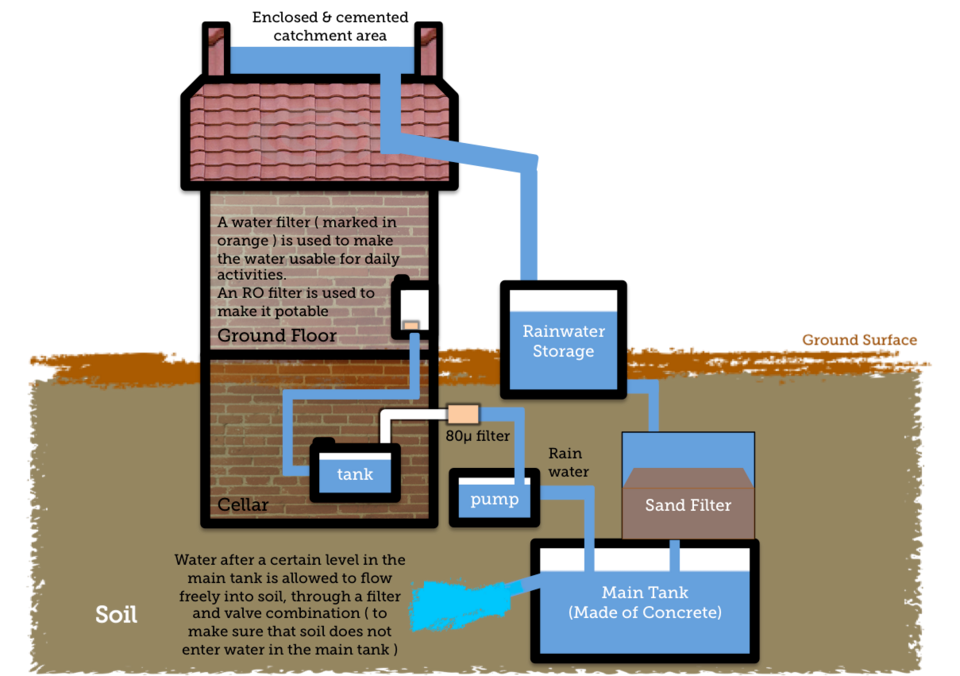 A traditional Nepali rooftop water collector (Image: Adityamail, CC BY 3.0, via Wikimedia Commons)
3. Forest Resources
Forests cover ~45% of Nepal and provide:
- Fuelwood (for cooking).
- Timber (for construction).
- Medicinal plants (e.g., Jatamansi, Yarsagumba).
- Ecotourism (e.g., Chitwan, Annapurna).
Threats to Forests
- Illegal logging (for profit).
- Shifting cultivation (slash-and-burn farming).
- Climate change (droughts, wildfires).
Solution: Community Forestry
- Community Forest User Groups (CFUGs) manage forests locally.
- Example: The Community Forest Act 1993 gave villages control over their forests.
- Result: Forest cover increased from 38% (1990) to 45% (2020).
4. Biodiversity & Wildlife
Nepal is home to:
- Endemic species (e.g., Red Panda, Snow Leopard).
- Wetlands (e.g., Kosi Tappu Wildlife Reserve).
- National Parks (e.g., Sagarmatha, Bardia).
Threats
- Poaching (for ivory, rhino horn).
- Habitat loss (deforestation for agriculture).
- Climate change (affects migration patterns).
Solution: Conservation Programs
- Ecotourism (e.g., Chitwan National Park).
- Community-based conservation (e.g., Transboundary conservation with India).
- Legal protection (e.g., Wildlife Conservation Act 2029).
Government Policies for Natural Resource Management
Nepal has laws to protect resources:
| Policy/Law | Year | Key Provisions | Impact |
|---|---|---|---|
| Community Forest Act | 1993 | Gives villages control over forests. | Forest cover increased. |
| Water Resources Act | 1992 | Regulates water use and pollution. | Reduced illegal water extraction. |
| National Parks & Wildlife Conservation Act | 1973 | Protects wildlife and habitats. | Saved endangered species like rhinos. |
| Soil Conservation Act | 1982 | Promotes terracing and afforestation. | Reduced soil erosion in hills. |
Why are these policies important?
- They involve local communities (not just the government).
- They balance economic needs (timber, farming) with conservation.
- They adapt to climate change (e.g., drought-resistant crops).
Challenges in Natural Resource Management
Despite policies, Nepal faces hurdles:
Population Pressure
- More people = more demand for land, water, and fuelwood.
- Solution: Family planning and sustainable farming.
Poverty
- Poor villagers cut forests for survival.
- Solution: Alternative livelihoods (e.g., beekeeping, handicrafts).
Climate Change
- Erratic rainfall, glacier melt, and floods.
- Solution: Climate-resilient agriculture (e.g., drought-resistant crops).
Weak Enforcement
- Some laws are not followed strictly.
- Solution: Community monitoring and awareness programs.
Sustainable Practices for Rural Development
To manage resources wisely, Nepal uses:
| Practice | How It Works | Example in Nepal |
|---|---|---|
| Agroforestry | Grows trees + crops together. | Farmers in Kavrepalanchok plant bamboo with maize. |
| Watershed Management | Protects forests to regulate water. | Upper Karnali Watershed Project. |
| Rainwater Harvesting | Stores rainwater for dry seasons. | Schools in Mustang use rooftop tanks. |
| Organic Farming | Avoids chemicals, uses natural fertilizers. | Farmers in Lamjung grow organic potatoes. |
Why do these work?
- Increase incomes (e.g., selling organic produce).
- Protect the environment (e.g., less soil erosion).
- Reduce dependence on government aid.
Case Study: Community Forestry in Nepal
Problem: In the 1980s, forests were disappearing fast due to:
- Illegal logging.
- Shifting cultivation.
- Lack of ownership.
Solution: The Community Forest Act 1993 gave villages control over forests.
Results (2020 Data):
- Forest cover increased from 38% to 45%.
- Villagers earn income from timber sales and ecotourism.
- Women’s groups plant saplings and monitor forests.
Exam Tip: How to Score Full Marks
NEB exams test definitions, case studies, and solutions. Follow this structure:
Define Key Terms
- Example: "Community Forestry is a system where local communities manage forests collectively for sustainable use."
Explain Problems & Solutions
- Problem: "Deforestation in the Terai leads to floods."
- Solution: "Afforestation and watershed management can help."
Use Real Examples
- "The Community Forest Act 1993 increased forest cover in Nepal."
- "Chitwan National Park protects rhinos through ecotourism."
Compare & Contrast
- Table: Show differences between government-managed forests vs. community forests.
Diagrams & Maps
- Draw a watershed management system or a terracing diagram to explain concepts visually.
NEB-Style Questions & Answers
Q1: What are the major causes of soil erosion in Nepal? Suggest two solutions. Answer: Causes:
- Deforestation (trees hold soil; cutting them causes erosion).
- Overgrazing (livestock trample grass, exposing soil).
- Poor farming practices (plowing steep slopes).
Solutions:
- Terracing (builds steps on hills to slow water flow).
- Afforestation (planting trees to stabilize soil).
Q2: How does community forestry contribute to rural development in Nepal? Answer: Community forestry helps rural development by:
- Increasing forest cover (from 38% to 45% since 1993).
- Providing income (villagers sell timber, honey, and ecotourism services).
- Empowering women (women’s groups manage nurseries and planting).
- Reducing poverty (alternative livelihoods like beekeeping).
- Protecting biodiversity (saves endangered species like red pandas).
Q3: Draw a labeled diagram of a watershed management system and explain its benefits. Answer:
graph LR
  A["Forest (Upstream)"] -->|"Regulates water flow"| B["Check Dams"]
  B -->|"Slows water"| C["Recharges Groundwater"]
  C -->|"Provides water"| D["Farmland & Villages (Downstream)"]
  D -->|"Reduces floods"| E["Stable Agriculture"]
Benefits:
- Prevents floods.
- Recharges groundwater.
- Improves farming.
Q4: Differentiate between renewable and non-renewable natural resources with examples from Nepal. Answer:
| Feature | Renewable Resources | Non-Renewable Resources |
|---|---|---|
| Definition | Can be replenished naturally. | Formed over millions of years; finite. |
| Examples in Nepal | Forests, water, soil, wildlife. | Minerals (limestone, clay), fossil fuels. |
| Management | Sustainable use (e.g., agroforestry). | Careful extraction (e.g., mining laws). |
| Exhaustion Risk | Low (if managed well). | High (e.g., coal, oil will run out). |
Final Tip: Always link theory to Nepal’s context. For example:
- "Like in the Terai, watershed management can prevent floods caused by deforestation."
- "Community forestry in Kavrepalanchok shows how local participation works."
Summary
- Natural resources (land, water, forests, biodiversity) are vital for rural livelihoods.
- Sustainable practices (agroforestry, watershed management) protect them.
- Government policies (Community Forest Act, Water Resources Act) help, but community involvement is key.
- Challenges like poverty and climate change require participatory solutions.
Remember: NEB loves real examples—use Chitwan, Kavrepalanchok, or Mustang in your answers!
Practice Question for You: "Explain how deforestation affects rural economies in Nepal. Suggest three long-term solutions with examples." (Write your answer in 100 words.)
Based on the NEB +2 Humanities syllabus for Rural Development (RD), unit 3.
Discussion
Loading…