SociologyUnit 913 min read
Development & Modernization: Models, Impacts & Critiques
Unit 9 of Sociology explores how societies change through modernization (industrialization, urbanization, cultural shifts) and development (economic growth, welfare), comparing Western and non-Western paths, their social costs, and critiques like dependency theory.
TAKEAWAYS:
- Modernization is a process (not just technology) that reshapes family, religion, and social roles—often creating inequality.
- Development focuses on economic growth and human welfare (e.g., healthcare, education), but can exclude marginalized groups.
- Critiques (dependency theory, world-systems theory) argue that globalization exploits poor nations while benefiting wealthy ones.
- Nepal’s modernization faces challenges like brain drain, cultural erosion, and uneven regional growth.
- Key models: Rostow’s stages, Wallerstein’s core-periphery, and Giddens’ reflexive modernization.
- Exam focus: Compare Western vs. non-Western development paths and analyze Nepal’s case studies (e.g., tourism, remittances).
What is Modernization?
Modernization is the social and cultural transformation that accompanies industrialization, urbanization, and technological progress. It’s not just about machines or factories—it changes how people live, work, and think.
Key Features of Modernization
mindmap
  root((Modernization))
    Industrialization
      Factories replace farms
      New jobs (e.g., textile mills)
    Urbanization
      Rural → Urban migration
      Growth of cities (e.g., Kathmandu, Pokhara)
    Secularization
      Science replaces religion in some areas
      Decline of traditional rituals
    Rationalization
      Rules and efficiency matter more than tradition
      Example: Bureaucracy in government offices
    Social Mobility
      People move between classes (e.g., a farmer’s child becomes a doctor)
    Nuclear Family
      Extended families → smaller, mobile units
Why does modernization happen?
- Economic needs: Countries industrialize to compete globally (e.g., Nepal’s garment industry).
- Cultural contact: Ideas from the West (e.g., democracy, feminism) spread via media.
- Government policies: Investments in education/healthcare (e.g., Nepal’s free basic education).
Caption: Industrialization brought progress but also exploitation, like child labor in factories.
How Does Modernization Affect Society?
Modernization changes every part of life. Here’s how:
| Area | Before Modernization | After Modernization | Example in Nepal |
|---|---|---|---|
| Family | Extended families, joint property | Nuclear families, individualism | Fewer joint families in cities |
| Religion | Strong community rituals | Individual faith, secular laws | Declining participation in Dasain |
| Work | Agriculture, manual labor | White-collar jobs, technology | IT sector growth in Kathmandu |
| Gender Roles | Strict traditional roles | More women in workforce/politics | Increased female enrollment in schools |
| Education | Oral traditions, guru-shishya system | Formal schools, degrees | Rise of private colleges |
Problem: Modernization can create social problems like:
- Cultural erosion: Traditional festivals (e.g., Indra Jatra) lose meaning.
- Inequality: Urban areas prosper while rural areas lag.
- Stress: Fast-paced life leads to mental health issues.
What is Development?
Development is improving people’s lives through economic growth and social welfare. It’s not just about GDP—it’s about:
- Healthcare (e.g., free maternal clinics)
- Education (e.g., school infrastructure)
- Poverty reduction (e.g., cash-for-work programs)
Types of Development
Economic Development
- Focus: GDP growth, industries, exports.
- Example: Nepal’s hydropower projects.
Human Development
- Focus: Education, healthcare, quality of life.
- Measured by: Human Development Index (HDI) (health + education + income).
Sustainable Development
- Focus: Growth without harming the environment.
- Example: Organic farming in Kavrepalanchok.
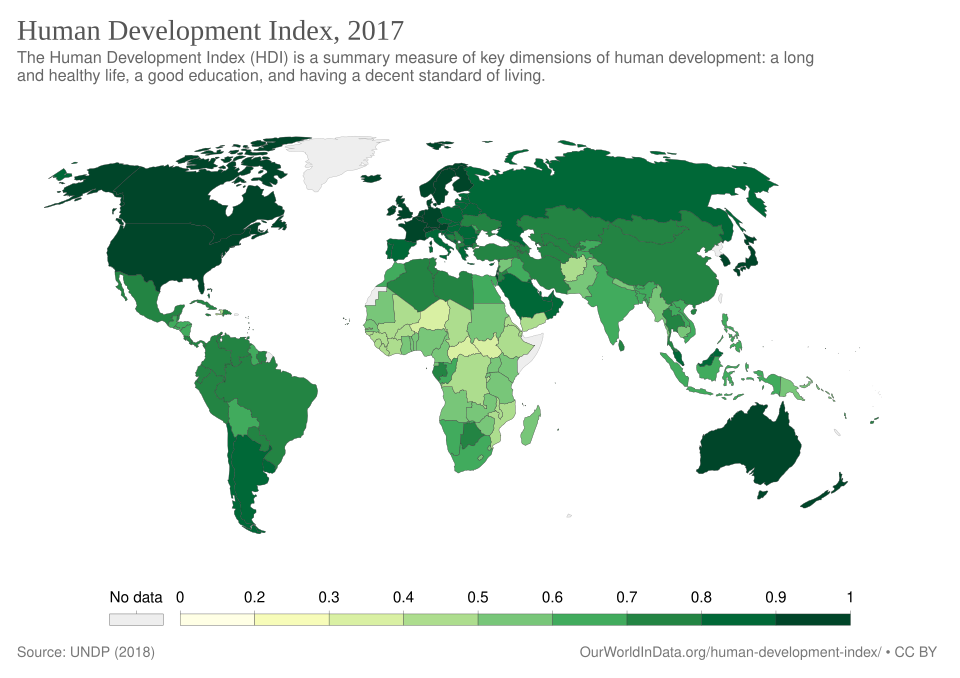 A world map showing HDI rankings (Norway #1, Nepal ~105th). (Image: Our World In Data, CC BY 3.0, via Wikimedia Commons)
Caption: Nepal’s HDI is low due to poverty and poor healthcare access.
A world map showing HDI rankings (Norway #1, Nepal ~105th). (Image: Our World In Data, CC BY 3.0, via Wikimedia Commons)
Caption: Nepal’s HDI is low due to poverty and poor healthcare access.
Models of Development
Sociologists use models to explain how societies develop. Here are three key ones:
1. Rostow’s Stages of Economic Growth (1960)
Rostow argued that all countries go through 5 stages to become modern:
flowchart LR
  A["Traditional Society"] --> B["Preconditions for Take-off"]
  B --> C["Take-off"]
  C --> D["Drive to Maturity"]
  D --> E["Age of High Mass Consumption"]
| Stage | Description | Example |
|---|---|---|
| Traditional Society | Agriculture-based, little technology | Nepal before 1950s |
| Preconditions | Savings, infrastructure, education | Nepal’s Panchayat era reforms |
| Take-off | Industrialization starts | Nepal’s garment factories |
| Drive to Maturity | Diversified economy | Nepal’s IT and tourism growth |
| High Consumption | Affluent society, consumer culture | Not yet reached by Nepal |
Criticism: Ignores colonialism and cultural differences. Many poor countries are stuck in early stages.
2. Wallerstein’s World-Systems Theory
Wallerstein says the world is divided into 3 layers:
mindmap
  root((Global Economy))
    Core Countries
      Wealthy, industrialized
      Example: USA, Germany
    Semi-periphery
      Middle-income, some industry
      Example: Brazil, South Africa
    Periphery
      Poor, exploited for resources
      Example: Nepal, Bangladesh
How it works:
- Core countries control trade and technology.
- Periphery countries supply raw materials (e.g., Nepal’s tea, timber).
- Result: Periphery stays poor while core gets richer.
Example: Nepal exports jute and hydroelectricity but imports machinery and medicine—always at a disadvantage.
3. Giddens’ Reflexive Modernization
Giddens argues that modernization is now self-correcting:
- Societies reflect on the problems caused by modernization (e.g., pollution, inequality).
- They adapt (e.g., green energy, welfare policies).
Example: Nepal’s Community Forest User Groups—local people manage forests sustainably.
Modernization vs. Development: Key Differences
| Aspect | Modernization | Development |
|---|---|---|
| Focus | Industrialization, urbanization | Improving lives (health, education) |
| Goal | Become "modern" like the West | Reduce poverty, increase welfare |
| Approach | Top-down (government-led) | Can be bottom-up (community-led) |
| Criticism | Creates inequality, cultural loss | Can be slow, requires long-term planning |
Example:
- Modernization in Nepal: Building highways (connects cities but ignores rural areas).
- Development in Nepal: Free healthcare camps (helps poor families directly).
Critiques of Modernization and Development
Not everyone agrees that modernization/development is good. Here are key critiques:
1. Dependency Theory (Frank, 1966)
- Claim: Poor countries stay poor because rich countries exploit them.
- How?
- Rich countries control trade (e.g., Nepal sells tea cheaply to India).
- Debt traps: Poor countries borrow money but can’t repay (e.g., Nepal’s loans for infrastructure).
- Example: Nepal’s remittance dependency—workers leave for Gulf countries, sending money home, but the economy still struggles.
2. Cultural Imperialism
- Claim: Modernization erases local cultures.
- Examples:
- Western fast food (McDonald’s in Kathmandu) replaces traditional meals.
- English replaces Nepali in schools, weakening mother-tongue education.
3. Uneven Development
- Claim: Modernization benefits urban elites but harms rural poor.
- Example in Nepal:
- Kathmandu: Skyscrapers, malls, good hospitals.
- Darchula: No electricity, poor roads, limited schools.
Caption: Modernization has created stark contrasts between Nepal’s cities and rural areas.
Nepal’s Development Challenges
Nepal is modernizing but struggling with these issues:
Brain Drain
- Skilled workers (doctors, engineers) leave for Gulf countries or India.
- Result: Nepal has doctor shortages in rural areas.
Cultural Erosion
- Traditional festivals (e.g., Maghe Sankranti) lose participants.
- Youth prefer Western holidays (Valentine’s Day, Halloween).
Environmental Costs
- Deforestation for tourism and agriculture.
- Pollution in Kathmandu (smog, plastic waste).
Regional Inequality
- Eastern Nepal (more developed) vs. Far-Western Nepal (poor infrastructure).
Solved Example: Analyzing Nepal’s Development
Question: "How has modernization affected Nepal’s family structure?" Answer: Modernization has changed Nepal’s families in these ways:
Nuclear Families Increase
- Why? Urban jobs require mobility; extended families are hard to maintain in cities.
- Example: In Kathmandu, young couples live alone instead of with parents.
Delayed Marriages
- Why? Education and career focus delay marriage (average age now 23 for women, up from 18).
- Impact: Fewer early pregnancies, but also loneliness among elderly.
Women’s Roles Shift
- Why? More women work outside home (e.g., in BPOs or teaching).
- Impact: More divorce cases (as women gain independence).
Cultural Conflicts
- Example: Some urban youth reject arranged marriages, causing family disputes.
NEB Board-Style Questions
Short Answer (5 marks)
"Explain Rostow’s stages of economic growth with reference to Nepal." Answer:
- Traditional Society: Nepal before 1950s (agriculture-based, limited tech).
- Preconditions: Panchayat era (1960s–90s)—roads, schools, savings.
- Take-off: 1990s–present (garment industry, hydropower).
- Drive to Maturity: Growth in IT, tourism, but still not fully industrialized.
- Limitation: Nepal is not yet in the "high consumption" stage due to poverty.
"How does Wallerstein’s world-systems theory explain Nepal’s economic position?" Answer:
- Nepal is a periphery country—exports raw materials (tea, timber) to core countries (India, China).
- Dependent: Imports machinery, medicine, and technology.
- Exploited: Gets low prices for exports but high prices for imports.
- Result: Economic inequality between urban and rural Nepal.
Long Answer (10 marks)
"Discuss the social problems caused by modernization in Nepal. Suggest solutions." Answer: Problems:
- Cultural erosion: Festivals like Dashain lose traditional meaning; youth prefer Western holidays.
- Brain drain: Doctors, engineers leave for Gulf countries, causing shortages in Nepal.
- Urban-rural divide: Kathmandu has skyscrapers and malls, while Far-Western Nepal lacks basic services.
- Environmental degradation: Deforestation for tourism and agriculture; Kathmandu’s air pollution.
Solutions:
- Preserve culture: Promote local festivals in schools, teach traditional crafts.
- Stop brain drain: Offer better salaries and incentives for professionals to stay.
- Balanced development: Invest in rural infrastructure (roads, schools) to reduce inequality.
- Sustainable policies: Afforestation programs, promote eco-tourism.
Exam Tip: How to Score Full Marks
Define Key Terms First
- Always start with definitions (e.g., "Modernization is the process of social change...").
- Example: "Development refers to improving human welfare through...".
Use Nepal Examples
- NEB loves local case studies. Always relate theories to Nepal.
- Bad: "Modernization causes inequality."
- Good: "In Nepal, Kathmandu’s GDP is 10x higher than Darchula’s, showing modernization’s inequality."
Compare Models
- If asked about development theories, compare 2 models (e.g., Rostow vs. Wallerstein).
- Use a table (like the one above) for clarity.
Critique Everything
- NEB tests critical thinking. Always mention limitations.
- Example: "While Rostow’s model explains Nepal’s industrial growth, it ignores colonialism’s role in keeping Nepal poor."
Structured Answers
- Use bullet points or paragraph breaks for clarity.
- Example:
*"Modernization affects Nepal in three ways:
- Economic: Growth in IT and tourism...
- Social: Nuclear families replace joint families...
- Cultural: Traditional festivals lose participants..."*
Diagrams Help!
- Draw simple flowcharts (like Rostow’s stages) or mindmaps (like Wallerstein’s layers).
- Example: For dependency theory, sketch:
Core (USA) → Exploits → Periphery (Nepal) → Supplies raw materials
Quick Revision Checklist
Before the exam, ask yourself: ✅ Can I define modernization and development? ✅ Do I know 3 models (Rostow, Wallerstein, Giddens) and their critiques? ✅ Can I analyze Nepal’s case (brain drain, cultural erosion, urban-rural divide)? ✅ Do I remember NEB’s favorite examples (garment industry, remittances, HDI)? ✅ Can I compare Western vs. non-Western development?
Final Thought: Modernization and development are tools, not goals. Nepal must adapt them wisely—balancing progress with culture, equality, and sustainability.
Good luck! 🚀
Based on the NEB +2 Humanities syllabus for Sociology (Soc), unit 9.
Discussion
Loading…