AccountancyUnit 913 min read
Cash Flow Statement: Types, Preparation, Analysis
Unit 9 of Accountancy explains how to prepare and analyze cash flow statements, including operating, investing, and financing activities, using direct and indirect methods, with solved examples and NEB-style questions.
TAKEAWAYS:
- A cash flow statement shows cash inflows and outflows over a period, not profits or losses.
- It is divided into three sections: operating, investing, and financing activities.
- The indirect method starts with net profit and adjusts for non-cash items, while the direct method lists actual cash receipts and payments.
- Working capital changes (current assets and liabilities) affect operating cash flow.
- Investing activities include buying/selling long-term assets, while financing activities involve loans, shares, and dividends.
- Analysis helps assess liquidity, solvency, and financial health.
What is a Cash Flow Statement?
A cash flow statement is a financial report that shows how much cash a business generates and uses during a specific period (e.g., a year). Unlike the income statement, which shows profits (including non-cash items like depreciation), the cash flow statement focuses only on actual cash movements.
Why is it important?
- Helps businesses track liquidity (ability to pay short-term debts).
- Shows where cash is coming from and going.
- Helps investors and lenders assess financial health.
Types of Cash Flows
The cash flow statement is divided into three main activities:
mindmap
  root((Cash Flow Statement))
    Operating Activities
      Cash from sales
      Cash paid to suppliers
      Cash paid to employees
      Cash paid for expenses
    Investing Activities
      Purchase/sale of fixed assets
      Investments in securities
      Loans given to others
    Financing Activities
      Loans taken/repaid
      Issue/repurchase of shares
      Payment of dividends
1. Operating Activities
This section shows cash flows from normal business operations (e.g., selling goods, paying salaries, buying inventory).
How to Calculate Operating Cash Flow (Indirect Method)
Most businesses use the indirect method, which starts with net profit and adjusts for non-cash items.
Formula:
Operating Cash Flow = Net Profit + Non-Cash Expenses – Non-Cash Income + Changes in Working Capital
Key Adjustments:
| Item | Effect on Cash Flow | Reason |
|---|---|---|
| Depreciation | + (Added back) | Non-cash expense |
| Loss on Sale of Asset | + (Added back) | Already recorded as a loss |
| Gain on Sale of Asset | - (Deducted) | Already recorded as income |
| Increase in Current Assets (except Cash) | - (Deducted) | Uses cash (e.g., more inventory) |
| Decrease in Current Assets | + (Added back) | Frees up cash (e.g., less inventory) |
| Increase in Current Liabilities | + (Added back) | Delayed cash payment (e.g., more creditors) |
| Decrease in Current Liabilities | - (Deducted) | Cash paid earlier (e.g., less creditors) |
Example: Calculating Operating Cash Flow (Indirect Method)
Given:
- Net Profit = Rs. 500,000
- Depreciation = Rs. 50,000
- Increase in Inventory = Rs. 30,000
- Increase in Trade Receivables = Rs. 20,000
- Increase in Trade Payables = Rs. 10,000
Solution:
Operating Cash Flow = 500,000 (Net Profit)
                    + 50,000 (Depreciation)
                    - 30,000 (↑ Inventory)
                    - 20,000 (↑ Receivables)
                    + 10,000 (↑ Payables)
                    = **Rs. 510,000**
Explanation:
- Depreciation is added back because it is a non-cash expense.
- Increase in Inventory reduces cash (more stock bought).
- Increase in Receivables means less cash collected from sales.
- Increase in Payables means less cash paid to suppliers (good for cash flow).
2. Investing Activities
This section shows cash flows from buying or selling long-term assets (e.g., machinery, land, investments).
Examples of Investing Cash Flows:
✅ Cash Outflows (Uses of Cash):
- Purchase of machinery
- Purchase of land/buildings
- Purchase of investments (shares, bonds)
❌ Cash Inflows (Sources of Cash):
- Sale of machinery
- Sale of investments
- Repayment of loans given to others
Example: Investing Cash Flow
Transactions:
- Bought machinery for Rs. 200,000 (cash outflow).
- Sold old machinery for Rs. 50,000 (cash inflow).
Investing Cash Flow = -200,000 + 50,000 = -Rs. 150,000 (Net Outflow)
3. Financing Activities
This section shows cash flows from borrowing, repaying loans, issuing shares, and paying dividends.
Examples of Financing Cash Flows:
✅ Cash Inflows (Sources of Cash):
- Loan taken from bank
- Issue of new shares
❌ Cash Outflows (Uses of Cash):
- Repayment of loan
- Payment of dividends
- Buyback of shares
Example: Financing Cash Flow
Transactions:
- Took a loan of Rs. 300,000 (cash inflow).
- Paid Rs. 50,000 as dividends (cash outflow).
Financing Cash Flow = +300,000 - 50,000 = +Rs. 250,000 (Net Inflow)
4. Direct vs. Indirect Method
| Feature | Direct Method | Indirect Method |
|---|---|---|
| Starting Point | Actual cash receipts and payments | Net Profit |
| Adjustments | None (directly lists cash flows) | Adjusts for non-cash items |
| Complexity | More detailed, harder to prepare | Simpler, starts with net profit |
| Used by | Large companies (more transparent) | Most businesses (easier) |
Most NEB questions use the indirect method because it is simpler.
5. Preparation of Cash Flow Statement (Format)
The standard format is:
CASH FLOW STATEMENT For the year ended [Date]
1. Operating Activities: Net Profit (Loss) [X] Add: Non-cash expenses (Depreciation, Amortization) [X] Less: Non-cash income (Gain on sale of assets) [X] Adjustments for working capital changes [X] Total Operating Cash Flow [X]
2. Investing Activities: Purchase of machinery [X] Sale of investments [X] Total Investing Cash Flow [X]
3. Financing Activities: Loan taken [X] Dividends paid [X] Total Financing Cash Flow [X]
Net Increase/(Decrease) in Cash [X] Opening Cash Balance [X] Closing Cash Balance [X]
6. Solved Example: Full Cash Flow Statement
Given Data (for XYZ Ltd.):
- Net Profit (2023): Rs. 800,000
- Depreciation: Rs. 100,000
- Increase in Inventory: Rs. 50,000
- Increase in Trade Receivables: Rs. 30,000
- Increase in Trade Payables: Rs. 20,000
- Purchase of Machinery: Rs. 250,000
- Sale of Old Machinery: Rs. 70,000
- Loan Taken: Rs. 300,000
- Dividends Paid: Rs. 50,000
- Opening Cash Balance (2022): Rs. 150,000
Solution:
1. Operating Activities
Net Profit = 800,000
Add: Depreciation = +100,000
Less: Increase in Inventory = -50,000
Less: Increase in Receivables = -30,000
Add: Increase in Payables = +20,000
**Operating Cash Flow = Rs. 840,000**
2. Investing Activities
Purchase of Machinery = -250,000
Sale of Old Machinery = +70,000
**Investing Cash Flow = -Rs. 180,000**
3. Financing Activities
Loan Taken = +300,000
Dividends Paid = -50,000
**Financing Cash Flow = +Rs. 250,000**
4. Net Change in Cash
Operating (+840,000) + Investing (-180,000) + Financing (+250,000) = **Rs. 910,000**
5. Closing Cash Balance
Opening Cash (150,000) + Net Increase (910,000) = **Rs. 1,060,000**
Final Cash Flow Statement:
CASH FLOW STATEMENT For the year ended 31 Dec 2023
1. Operating Activities: Net Profit = 800,000 Add: Depreciation = 100,000 Less: Increase in Inventory = -50,000 Less: Increase in Receivables = -30,000 Add: Increase in Payables = 20,000 Total Operating Cash Flow = 840,000
2. Investing Activities: Purchase of Machinery = -250,000 Sale of Old Machinery = 70,000 Total Investing Cash Flow = -180,000
3. Financing Activities: Loan Taken = 300,000 Dividends Paid = -50,000 Total Financing Cash Flow = 250,000
Net Increase in Cash = 910,000 Opening Cash Balance = 150,000 Closing Cash Balance = 1,060,000
7. Analysis of Cash Flow Statement
After preparing the cash flow statement, we can analyze:
Key Ratios:
Operating Cash Flow to Net Profit Ratio
- Shows how much cash is generated from operations compared to profit.
- Formula:
- Example: If OCF = 840,000 and Net Profit = 800,000, (Good, as it’s > 100%)
Free Cash Flow (FCF)
- Cash left after paying for operations and investments.
- Formula:
- Example: FCF = 840,000 - 250,000 = Rs. 590,000
Cash Flow per Share
- Helps compare cash generation per share.
- Formula:
8. Common Mistakes to Avoid
❌ Ignoring working capital changes (e.g., increase in inventory reduces cash). ❌ Mixing cash and profit (e.g., depreciation is not cash). ❌ Forgetting to adjust for non-cash items (e.g., gain/loss on asset sale). ❌ Misclassifying transactions (e.g., loan repayment goes under financing, not operating).
9. NEB-Style Questions & Solutions
Question 1 (Short Answer)
"What are the three main activities of a cash flow statement?"
Answer: The three main activities are:
- Operating Activities – Cash from normal business operations.
- Investing Activities – Cash from buying/selling long-term assets.
- Financing Activities – Cash from loans, shares, and dividends.
Question 2 (Numerical – Indirect Method)
"From the following information, prepare the Operating Activities section of the cash flow statement using the indirect method:
- Net Profit: Rs. 600,000
- Depreciation: Rs. 80,000
- Increase in Inventory: Rs. 40,000
- Increase in Trade Payables: Rs. 20,000
- Decrease in Trade Receivables: Rs. 30,000"*
Solution:
Operating Cash Flow:
Net Profit = 600,000
Add: Depreciation = +80,000
Less: Increase in Inventory = -40,000
Add: Increase in Payables = +20,000
Add: Decrease in Receivables = +30,000
**Total Operating Cash Flow = Rs. 690,000**
Question 3 (Long Answer – Full Cash Flow Statement)
"Prepare the cash flow statement for the year ended 31 Dec 2023 from the following data:
- Net Profit: Rs. 500,000
- Depreciation: Rs. 60,000
- Increase in Inventory: Rs. 20,000
- Increase in Trade Receivables: Rs. 10,000
- Purchase of Machinery: Rs. 150,000
- Sale of Investments: Rs. 40,000
- Loan Taken: Rs. 200,000
- Dividends Paid: Rs. 30,000
- Opening Cash Balance: Rs. 100,000"*
Solution: (Follow the same format as the solved example above. Answer should show all three sections and closing cash balance.)
Expected Answer Structure:
- Operating Activities (Indirect Method)
- Investing Activities
- Financing Activities
- Net Change in Cash
- Closing Cash Balance
Exam Tip
✅ For NEB exams:
- Always use the indirect method unless asked otherwise.
- Show all adjustments (depreciation, working capital changes).
- Label each section clearly (Operating, Investing, Financing).
- Calculate net increase/decrease in cash and closing balance.
- Practice numericals where you adjust for non-cash items.
🚫 Common NEB Mistakes:
- Forgetting to add back depreciation.
- Misclassifying loan repayments under operating activities.
- Not adjusting for changes in current assets/liabilities.
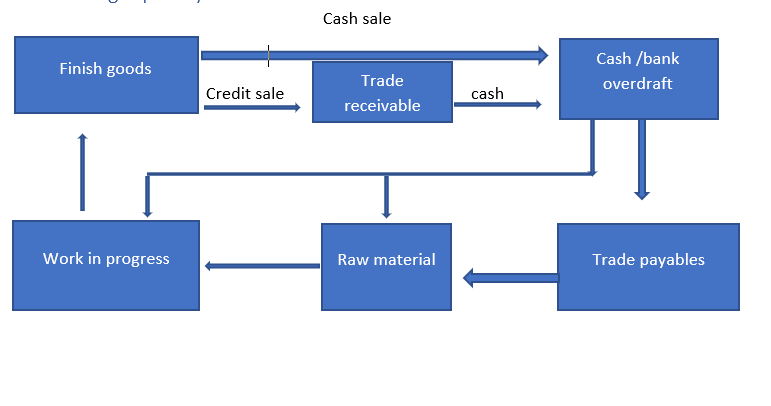 How inventory, receivables, and payables affect cash flow (Image: Saroj Cheema, CC BY-SA 4.0, via Wikimedia Commons)
Based on the NEB +2 Management syllabus for Accountancy (Acc), unit 9.
Discussion
Loading…