Business StudiesUnit 117 min read
Business Environment of Nepal: Components, Types & Impacts
Unit 1 of Business Studies explores Nepal’s business environment, its components (internal/external), types (micro/macro), and how they affect businesses. Learn with real examples, diagrams, and NEB-style questions.
TAKEAWAYS:
- The business environment includes all internal and external factors that influence a business’s operations and strategies.
- Internal factors (company-controlled) include management, employees, and resources, while external factors (uncontrollable) include government policies, technology, and social trends.
- Nepal’s business environment is shaped by economic, political, social, technological, legal, and environmental forces.
- Understanding these factors helps businesses adapt, innovate, and sustain growth in Nepal’s unique context.
- Micro-environment (close factors like customers, competitors) directly impacts daily operations, while macro-environment (broad factors like inflation, laws) shapes long-term strategies.
- NEB exams test definitions, comparisons, real-world applications, and case-based analysis—always link theory to Nepal’s business scenarios.
1. What is the Business Environment?
The business environment refers to all the internal and external forces that influence how a business operates. These forces can be controlled (by the business) or uncontrolled (outside the business’s power).
Why is it important?
- Helps businesses plan and make decisions.
- Helps adapt to changes (e.g., new laws, technology, or customer demands).
- Reduces risks by understanding threats and opportunities.
Visual: Types of Business Environment
2. Internal vs. External Environment
Businesses cannot control all factors. Some are inside the company (internal), while others are outside (external).
A. Internal Environment (Controllable)
These are factors within the business that management can influence.
| Factor | Description | Example in Nepal |
|---|---|---|
| Management | Decisions made by leaders (owners, managers). | A factory owner in Kathmandu decides to hire more workers. |
| Employees | Skills, motivation, and workforce quality. | Trained staff in a hotel improve customer service. |
| Resources | Money, machinery, raw materials, and technology. | A tea factory in Ilam uses modern processing machines. |
| Company Culture | Values, ethics, and work environment. | A bank in Pokhara promotes teamwork and transparency. |
B. External Environment (Uncontrollable)
These are factors outside the business that it must adapt to.
| Type | Factors | Example in Nepal |
|---|---|---|
| Micro | Customers, suppliers, competitors, market conditions. | A bakery in Lalitpur faces competition from new bakeries. |
| Macro | Economic, political, social, technological, legal, and environmental forces. | A new Consumer Protection Act affects how businesses advertise. |
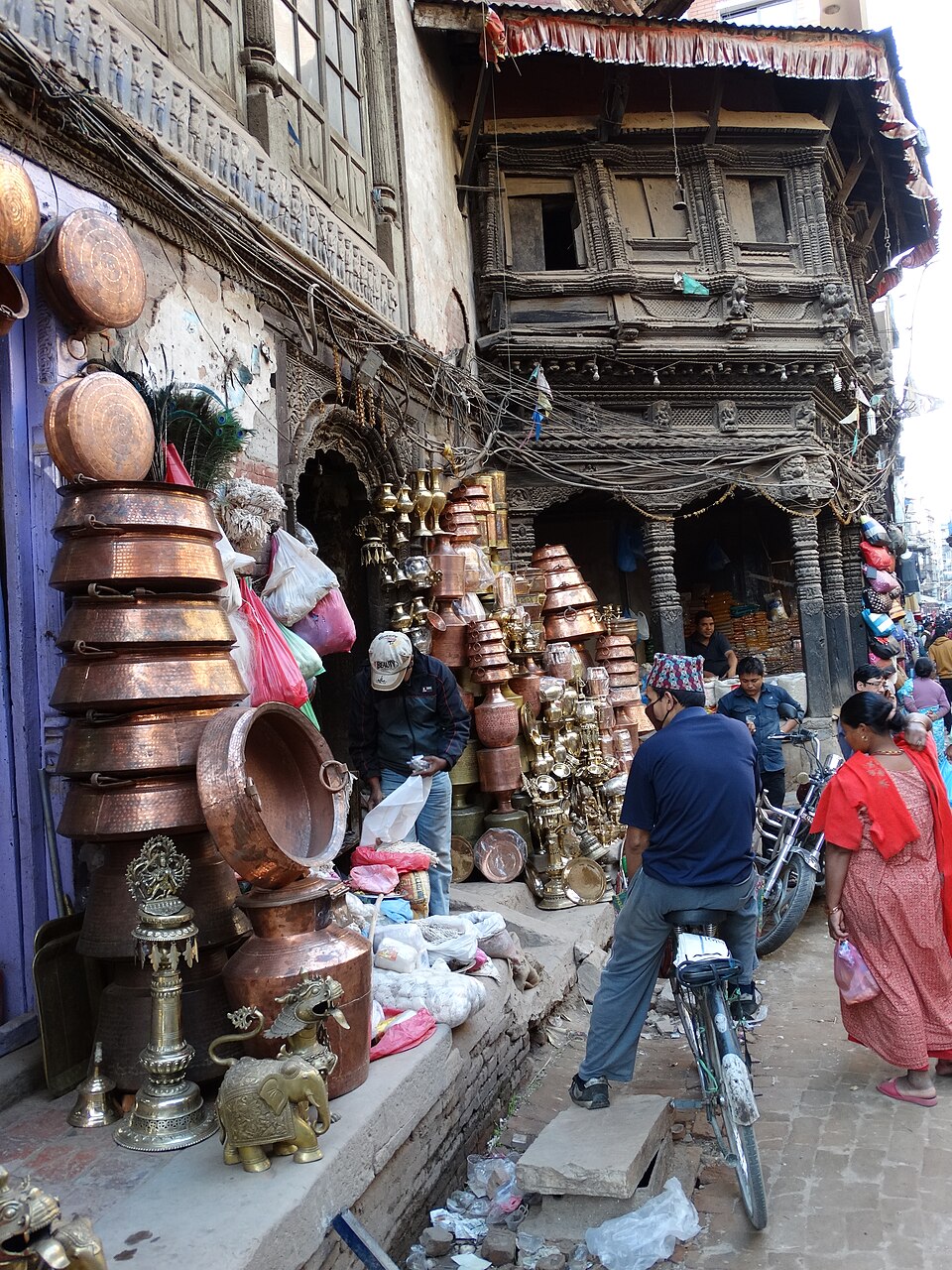 A busy thamel market showing suppliers and customers. (Image: Adam Jones from Kelowna, BC, Canada, CC BY-SA 2.0, via Wikimedia Commons)
3. Micro vs. Macro Environment
The external environment is divided into micro (close factors) and macro (broad factors).
A. Micro Environment (Direct Impact)
These are close and direct influences on a business.
Example:
- A restaurant in Pokhara depends on:
- Customers (tourists, locals).
- Suppliers (vegetable vendors, meat suppliers).
- Competitors (other restaurants in the area).
- Market trends (seasonal demand for momos vs. dal bhat).
B. Macro Environment (Indirect but Broad Impact)
These are wider forces that affect all businesses in a country.
Example:
- A textile factory in Birgunj is affected by:
- Economic: Inflation, exchange rates.
- Political: Government trade policies.
- Social: Changing fashion trends.
- Technological: New weaving machines.
- Legal: Labor laws, environmental regulations.
- Environmental: Water scarcity affecting dyeing processes.
4. Components of the Macro Environment (PESTEL Analysis)
A useful tool to analyze the macro environment is PESTEL (Political, Economic, Social, Technological, Legal, Environmental).
| Factor | Description | Example in Nepal |
|---|---|---|
| Political | Government policies, stability, trade agreements. | New FDI policy allows more foreign investment in hydropower. |
| Economic | Inflation, GDP growth, interest rates, unemployment. | Rising fuel prices increase transport costs for businesses. |
| Social | Population growth, culture, lifestyle changes. | More young consumers prefer digital payments over cash. |
| Technological | Innovation, automation, internet access. | E-commerce growth (e.g., Daraz, Sastodeal) changes retail. |
| Legal | Laws, regulations, consumer rights. | New Consumer Protection Act (2075) bans misleading ads. |
| Environmental | Climate change, pollution, natural resources. | Melting glaciers affect hydropower projects. |
5. How Businesses Adapt to the Environment
Businesses must monitor and respond to changes in their environment to survive and grow.
Strategies for Adaptation
| Strategy | How It Works | Nepalese Example |
|---|---|---|
| Innovation | Introducing new products/services. | A Nepalese bank launches mobile banking (eSewa integration). |
| Diversification | Expanding into new markets/products. | A tea company starts selling organic coffee. |
| Cost Reduction | Cutting expenses to stay competitive. | A hotel reduces energy use with solar panels. |
| Customer Focus | Understanding and meeting customer needs. | A bakery introduces gluten-free options. |
| Compliance with Laws | Following legal requirements to avoid penalties. | A factory installs pollution control systems. |
| Leveraging Technology | Using digital tools for efficiency. | A retailer uses QR codes for inventory management. |
6. Challenges in Nepal’s Business Environment
Nepal’s business environment has unique challenges due to its geography, economy, and policies.
| Challenge | Impact on Businesses | Example |
|---|---|---|
| Political Instability | Frequent government changes affect policies. | Delayed infrastructure projects due to political disputes. |
| Economic Instability | High inflation, currency fluctuations. | Import costs rise, hurting importers. |
| Limited Infrastructure | Poor roads, unreliable electricity. | Supply chain delays for rural businesses. |
| Labor Shortages | Skilled workers migrate abroad. | Hospitals struggle to find trained nurses. |
| Climate Risks | Floods, landslides, droughts. | Agricultural losses affect food businesses. |
| Bureaucracy | Slow approvals for licenses, permits. | New business setup takes months. |
7. Case Study: How a Nepalese Business Adapts
Business: Himalayan Java (a coffee shop chain in Kathmandu) Challenge: Rising competition and changing consumer preferences. Adaptation Strategies:
- Technology: Introduced online ordering via Pathao and Foodmandu.
- Product Innovation: Added vegan and organic options.
- Customer Engagement: Used social media marketing (Instagram, Facebook).
- Cost Control: Switched to locally sourced beans to reduce import costs.
- Legal Compliance: Ensured food safety certifications to build trust.
Result: Increased sales by 30% in 2 years.
8. NEB Exam Tips for This Unit
The NEB exam tests conceptual understanding, real-world application, and analysis. Here’s how to score full marks:
A. Common Question Types
Definitions (2–4 marks)
- "Define business environment and distinguish between internal and external factors."
- Answer: Start with a clear definition, then use a table or bullet points to distinguish.
Short Answers (5–7 marks)
- "Explain the impact of political instability on businesses in Nepal."
- Answer: Use PESTEL analysis (focus on Political factor) + real examples.
Case-Based Questions (8–10 marks)
- "A textile factory in Biratnagar faces rising costs due to inflation. How can it adapt?"
- Answer:
- Identify the problem (economic factor).
- Suggest 3–4 strategies (cost reduction, diversification, technology).
- Use Nepal-specific examples.
Comparison Questions (6–8 marks)
- "Differentiate between micro and macro environment with examples."
- Answer: Use a table (like the one above) with Nepalese examples.
B. How to Write High-Scoring Answers
✅ Use diagrams/tables (PESTEL, micro vs. macro). ✅ Link theory to Nepal (always give local examples). ✅ Structure answers logically:
- Introduction (define key terms).
- Body (explain with examples, pros/cons, or strategies).
- Conclusion (summarize key points). ✅ Avoid vague answers—be specific (e.g., don’t just say "technology helps"; say "e-commerce platforms like Daraz help small businesses reach more customers").
C. Common Mistakes to Avoid
❌ Memorizing without understanding (examiners check application, not just definitions). ❌ Ignoring Nepal’s context (always relate to local businesses, laws, or challenges). ❌ Poor time management (spend more time on case studies—they carry more marks).
9. Solved NEB-Style Questions
Question 1: Define Business Environment. Distinguish between Internal and External Environment with examples.
Answer: Business Environment refers to all the internal and external factors that influence a business’s operations and decision-making.
| Internal Environment | External Environment |
|---|---|
| Definition: Factors within the business that management can control. | Definition: Factors outside the business that it cannot control. |
| Example: A hotel in Pokhara trains its staff to improve customer service. | Example: A bakery in Kathmandu faces rising flour prices due to global inflation. |
| Advantage: Businesses can directly improve these factors. | Disadvantage: Businesses must adapt to changes (e.g., new laws). |
Marking Scheme:
- Definition (2 marks)
- Table with correct classification (3 marks)
- Nepal-specific examples (3 marks)
Question 2: "The business environment of Nepal is highly unstable." Explain this statement with reference to PESTEL factors.
Answer: The statement is true because Nepal’s business environment faces frequent changes due to PESTEL factors:
Political (P):
- Frequent government changes lead to policy shifts (e.g., sudden tax hikes).
- Example: A hydropower company faces delays due to political disputes over land acquisition.
Economic (E):
- High inflation (e.g., fuel price hikes) increases costs.
- Weak currency (NPR depreciation) makes imports expensive.
- Example: A car dealership struggles with rising import duties.
Social (S):
- Urbanization changes demand (e.g., more people want fast food).
- Brain drain (skilled workers leave for jobs abroad).
- Example: A hospital in Dharan loses doctors to foreign jobs.
Technological (T):
- Slow internet in rural areas limits e-commerce.
- Adoption of digital payments (eSewa, Khalti) changes banking.
- Example: A retail shop in Chitwan must go digital to compete.
Legal (L):
- Changing labor laws (e.g., new minimum wage rules).
- Consumer protection laws restrict misleading ads.
- Example: A cosmetics brand must update labels to comply with new regulations.
Environmental (E):
- Climate change (floods, landslides) disrupts supply chains.
- Government pushes for sustainability (e.g., plastic bans).
- Example: A beverage company switches to paper straws to avoid fines.
Conclusion: Nepal’s business environment is unstable due to frequent changes in PESTEL factors, forcing businesses to adapt quickly.
Marking Scheme:
- Introduction (1 mark)
- PESTEL analysis with Nepal examples (5 marks)
- Conclusion (1 mark)
Question 3: How can a small business in Nepal adapt to economic instability? Suggest four strategies with examples.
Answer: Small businesses in Nepal can adapt to economic instability (e.g., inflation, currency fluctuations) using these strategies:
Diversify Products/Services
- Why? Reduces risk if one product fails.
- Example: A stationery shop in Lalitpur starts selling school bags and uniforms alongside notebooks.
Use Local Suppliers
- Why? Reduces dependency on imports (which are expensive due to currency depreciation).
- Example: A bakery in Butwal sources wheat locally instead of importing flour.
Adopt Cost-Effective Technology
- Why? Lowers expenses (e.g., digital accounting instead of hiring more staff).
- Example: A tailoring shop in Biratnagar uses computerized cutting machines to save time.
Offer Credit or Installment Plans
- Why? Helps customers buy even during economic downturns.
- Example: A mobile shop in Kathmandu allows monthly payments for phones.
Marking Scheme:
- Four clear strategies (4 marks)
- Nepal-specific examples (4 marks)
10. Summary & Quick Revision
| Topic | Key Points |
|---|---|
| Business Environment | All internal and external factors affecting a business. |
| Internal vs. External | Internal = controllable (management, employees); External = uncontrollable (customers, laws). |
| Micro vs. Macro | Micro = close factors (customers, competitors); Macro = broad factors (PESTEL). |
| PESTEL Analysis | Political, Economic, Social, Technological, Legal, Environmental forces. |
| Adaptation Strategies | Innovation, diversification, cost reduction, customer focus, compliance. |
| Nepal’s Challenges | Political instability, economic fluctuations, infrastructure issues. |
Final Tip:
- Always relate answers to Nepal (examiners love local examples).
- Use diagrams/tables to make answers clear and structured.
- Practice case studies—they carry the most marks!
Good luck for your NEB exam! 🚀
Based on the NEB +2 Management syllabus for Business Studies (BS), unit 1.
Discussion
Loading…