Business StudiesUnit 910 min read
Marketing Mix: 4Ps – Product, Price, Place, Promotion
Unit 9 of Business Studies explains the marketing mix (4Ps)—how businesses decide what to sell, how much to charge, where to sell, and how to advertise. Learn with real examples, comparisons, and NEB-style questions to ace your exam.
What is Marketing Mix?
The marketing mix is a set of tools a business uses to sell its products or services. It is often called the 4Ps:
- Product (What to sell)
- Price (How much to charge)
- Place (Where to sell)
- Promotion (How to advertise)
These four elements work together to help a business meet customer needs and achieve its goals.
1. Product (What to sell?)
The product is the core of marketing. It includes:
- Physical goods (e.g., clothes, phones)
- Services (e.g., banking, haircuts)
- Ideas (e.g., political campaigns, social messages)
Key Decisions in Product Mix
| Decision Area | Example |
|---|---|
| Product Design | Apple’s sleek iPhone design vs. Samsung’s foldable phones |
| Branding | Coca-Cola’s red logo and slogan "Taste the Feeling" |
| Packaging | Maggi’s colorful, easy-to-open noodle packets |
| Product Life Cycle | Introduction → Growth → Maturity → Decline (e.g., Nokia phones) |
Product Life Cycle (PLC)
- Introduction: High cost, low sales (e.g., new electric cars)
- Growth: Sales increase, competitors enter (e.g., smartphones in 2010s)
- Maturity: Sales peak, competition is fierce (e.g., toothpaste brands)
- Decline: Sales drop, product may be discontinued (e.g., VHS players)
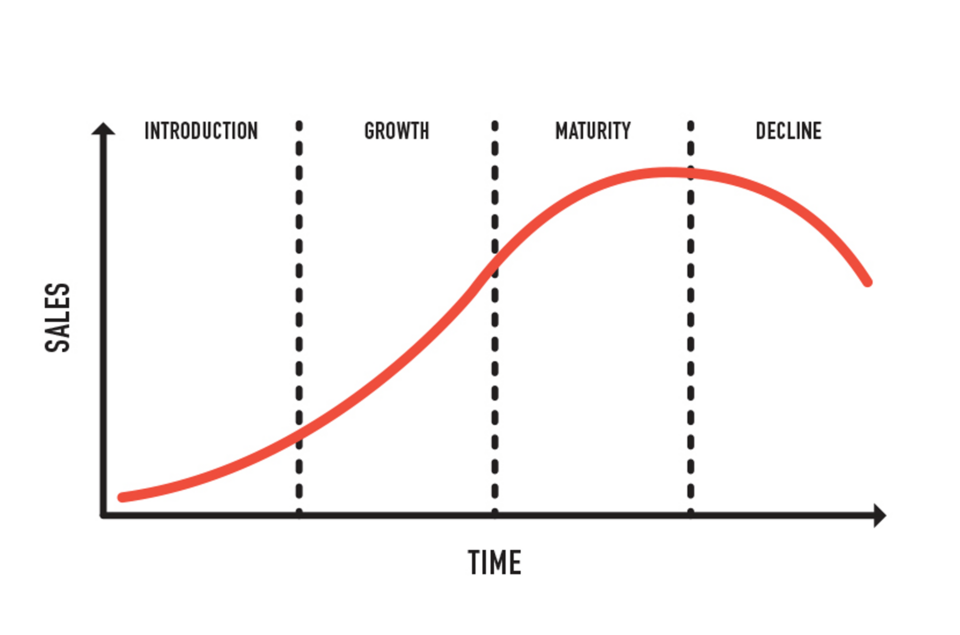 Stages of a product’s life from introduction to decline (Image: Tres West, CC BY-SA 4.0, via Wikimedia Commons)
2. Price (How much to charge?)
Pricing affects profitability, demand, and competition. Businesses use different pricing strategies:
Pricing Strategies
| Strategy | Description | Example |
|---|---|---|
| Cost-Based | Price = Cost + Profit Margin | A shop selling a shirt for Rs. 1,500 (cost Rs. 800 + 100% profit) |
| Demand-Based | Price based on what customers are willing to pay | Luxury watches (Rolex, Rs. 500,000+) |
| Competition-Based | Price similar to competitors’ prices | Mobile companies (Ncell, NTC) pricing |
| Psychological | Pricing to influence perception (e.g., Rs. 999 instead of Rs. 1,000) | "Only Rs. 999 for a premium phone!" |
| Penetration | Low initial price to attract customers, then increase | Netflix’s low-cost entry plan |
| Skimming | High initial price, then lower over time | iPhone launch at Rs. 150,000, then drops |
3. Place (Where to sell?)
Place refers to distribution channels—how products reach customers.
Types of Distribution Channels
| Channel Type | Description | Example |
|---|---|---|
| Direct (Zero-level) | Seller → Customer (no middlemen) | Online stores (Amazon, Daraz) |
| Indirect (One-level) | Seller → Retailer → Customer | Local shops buying from wholesalers |
| Indirect (Two-level) | Seller → Wholesaler → Retailer → Customer | FMCG products (Maggi, Himalaya) |
| Intensive | Product available everywhere (convenience goods) | Coca-Cola in every shop |
| Selective | Product sold in some outlets (specialty goods) | Apple products in authorized stores |
| Exclusive | Product sold in only a few high-end places | Rolex watches in luxury malls |
4. Promotion (How to advertise?)
Promotion is about communicating with customers to increase sales. It includes:
Promotional Mix
| Tool | Description | Example |
|---|---|---|
| Advertising | Paid messages (TV, radio, social media) | Maggi’s "2-minute noodles" ads |
| Sales Promotion | Short-term incentives (discounts, coupons) | "Buy 1, Get 1 Free" offers |
| Personal Selling | Face-to-face interaction (salespeople) | Car dealerships, insurance agents |
| Public Relations | Building a good image (CSR, events) | Nepal Tourism Board’s "Visit Nepal" campaigns |
| Digital Marketing | Online ads (Facebook, Google, YouTube) | Oppo smartphones’ YouTube ads |
Comparing the 4Ps
| 4P | Key Question | Example (Nepal) |
|---|---|---|
| Product | What are we selling? | Himalayan salt, organic coffee |
| Price | How much to charge? | Rs. 500 for a local shirt vs. Rs. 5,000 for a branded one |
| Place | Where to sell? | Online (Daraz), local markets, supermarkets |
| Promotion | How to advertise? | TV ads, social media, word-of-mouth |
Solved Example: Marketing Mix of a Local Business
Business: Thapathali Café (Pokhara)
- Product:
- Serves coffee, snacks, and desserts.
- Unique: Homemade cakes and local Pokhara tea.
- Price:
- Affordable (Rs. 150 for a coffee, Rs. 300 for a burger).
- Uses psychological pricing (Rs. 299 instead of Rs. 300).
- Place:
- Located near Lakeside (tourist area).
- Also delivers via Foodpanda.
- Promotion:
- Social media (Instagram, Facebook).
- "First-time customer gets 20% off" (sales promotion).
Why does this work?
- Product meets tourist needs.
- Price is competitive.
- Place is convenient.
- Promotion attracts new customers.
Advantages and Disadvantages of the 4Ps
| Advantage | Disadvantage |
|---|---|
| Helps businesses target customers effectively | Too much focus on price can hurt quality perception |
| Flexible—can adjust based on market trends | Competitors may copy strategies |
| Measurable results (sales data) | High costs (e.g., TV ads are expensive) |
Exam Tip: How to Score Full Marks in NEB Exams
- Define the 4Ps clearly (1 mark each).
- Example: "Price is the amount of money customers pay for a product."
- Use real examples (Nepal-based if possible).
- Example: "Nepal Telecom uses penetration pricing for new SIM cards."
- Compare strategies (e.g., skimming vs. penetration).
- Explain the product life cycle with a diagram.
- Link to business success (e.g., "Coca-Cola’s branding makes it a global leader.")
NEB-Style Questions & Answers
Short Answer (3-5 marks)
Q: Explain the importance of the product mix in marketing. A:
- Helps businesses meet customer needs.
- Differentiates from competitors (e.g., Maggi vs. other noodles).
- Affects brand image (e.g., Apple’s premium products).
- Increases sales through quality and innovation.
Long Answer (10 marks)
Q: How does pricing strategy affect a business? Discuss with examples. A:
Cost-Based Pricing:
- Ensures profitability.
- Example: A local tailor charges Rs. 500 for a shirt (cost Rs. 300 + Rs. 200 profit).
Demand-Based Pricing:
- Charges more when demand is high (e.g., hotel prices during Dashain).
- Example: Rs. 2,000/night in Kathmandu vs. Rs. 500 in Pokhara.
Competition-Based Pricing:
- Helps stay competitive.
- Example: Ncell and NTC offer similar data plans.
Psychological Pricing:
- Influences buying decisions.
- Example: "Rs. 999 instead of Rs. 1,000" for a phone.
Penetration vs. Skimming:
- Penetration (Low price): Netflix started with cheap plans.
- Skimming (High price): iPhone launches at a premium.
Conclusion: Pricing affects sales, profit, and market position. Businesses must choose wisely based on costs, demand, and competition.
Summary
- The 4Ps (Product, Price, Place, Promotion) are the core of marketing.
- Product = What you sell (quality, branding, packaging).
- Price = How much you charge (cost-based, demand-based).
- Place = Where you sell (online, retail, wholesale).
- Promotion = How you advertise (ads, sales, social media).
- Use real examples (Nepal-based) to score well in exams!
Good luck with your NEB Business Studies exam! 🚀
Based on the NEB +2 Management syllabus for Business Studies (BS), unit 9.
Discussion
Loading…