EconomicsUnit 714 min read
Multiplier & Accelerator: How Spending Creates Jobs & Growth
Unit 7 of Economics explains how small changes in investment or government spending can trigger much larger changes in national income (the multiplier effect) and how business investment depends on expected future sales (the accelerator principle). You’ll learn the math behind these concepts, their real-world applicati
TAKEAWAYS:
- The multiplier shows how an initial injection of spending (like a new road or factory) creates more income through repeated spending cycles, boosting GDP far beyond the original amount.
- The multiplier formula is or , where MPC = Marginal Propensity to Consume, MPS = Marginal Propensity to Save, MPT = Marginal Propensity to Tax, and MPM = Marginal Propensity to Import.
- The accelerator explains why businesses invest more when demand grows faster than before, creating a self-reinforcing cycle of growth (or collapse if demand falls).
- Leakages (savings, taxes, imports) reduce the multiplier’s strength, while injections (investment, government spending, exports) fuel economic expansion.
- Nepal’s economy relies on both: multiplier effects from infrastructure projects (e.g., roads, hydropower) and accelerator-driven private investment in tourism or manufacturing.
- Policymakers use these tools to fight unemployment (via multipliers) or stabilize growth (via accelerators), but over-reliance can cause booms and busts.
1. The Multiplier: How Spending Begets More Spending
What is the Multiplier?
Imagine a farmer gets ₹10,000 to build a new irrigation system. He spends ₹8,000 on tools and labor. The tool seller uses ₹6,000 to pay wages, and those workers spend ₹4,500 on food. The food shop owner spends ₹3,000 on rent... and so on. The multiplier measures how much total income is created from this initial ₹10,000.
Key Idea:
An initial injection of spending (investment, government expenditure, or exports) leads to a larger increase in national income because people spend a portion of their extra income, which others then spend again.
How the Multiplier Works: The Circular Flow
flowchart LR
    A["Initial Injection\n(e.g., ₹10,000 for a factory)"] --> B["Firms hire workers\n(₹8,000 spent on wages)"]
    B --> C["Workers spend wages\n(₹6,000 on goods/services)"]
    C --> D["Sellers hire more workers\n(₹4,500 spent on wages)"]
    D --> E["Cycle repeats...\nTotal income rises by more than ₹10,000"]
    E --> F["Leakages reduce the multiplier:\nSavings, Taxes, Imports"]
The Multiplier Formula
The multiplier (k) depends on how much of extra income people spend (MPC) vs. how much they save/tax/import (leakages).
Simple Multiplier (No Taxes/Imports):
- MPC (Marginal Propensity to Consume): The fraction of extra income spent on goods/services. Example: If MPC = 0.8 (people spend 80% of extra income), then . An initial ₹10,000 injection creates ₹50,000 in total income!
Realistic Multiplier (With Leakages):
- MPS (Marginal Propensity to Save): Fraction saved (not spent).
- MPT (Marginal Propensity to Tax): Fraction paid as taxes.
- MPM (Marginal Propensity to Import): Fraction spent on foreign goods (leaks out of the economy).
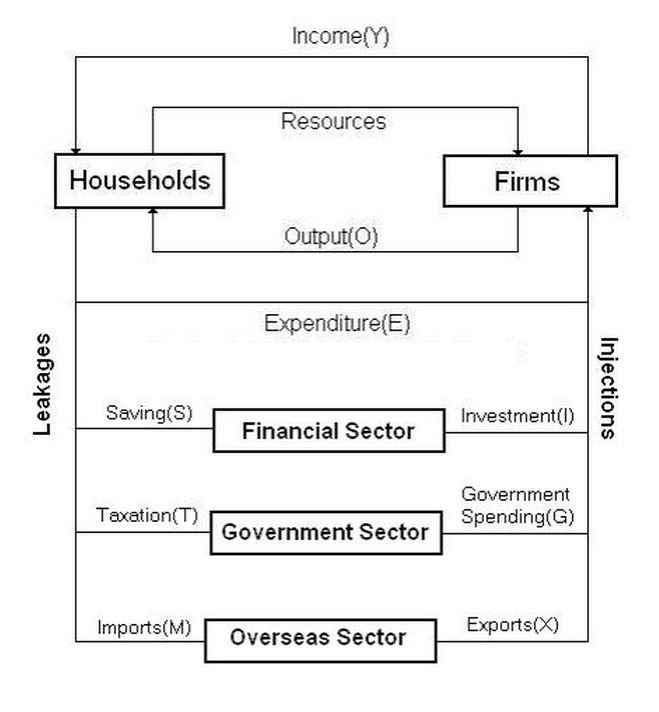 A labelled diagram showing injections (investment, government spending, exports) and leakages (savings, taxes, imports) in a circular flow. (Image: Ari89, CC0, via Wikimedia Commons)
Worked Example: Calculating the Multiplier
Problem: In Nepal, the Marginal Propensity to Consume (MPC) is 0.75, and the Marginal Propensity to Import (MPM) is 0.1. The government builds a new school worth ₹500 million. Calculate the total increase in national income.
Solution:
- First, find MPS (since MPC + MPS = 1): .
- The formula becomes: .
- Total income increase = Initial injection × Multiplier: .
Answer: The national income rises by ₹1,430 million.
2. Types of Multipliers
| Type | Definition | Example in Nepal |
|---|---|---|
| Income Multiplier | Measures how national income changes due to injections (investment, govt. spending). | A new hydropower plant in Pokhara creates jobs, increasing local incomes. |
| Employment Multiplier | Shows how many jobs are created per unit of spending. | ₹1 spent on road construction may create 0.6 jobs in rural areas. |
| Fiscal Multiplier | Focuses on government spending (e.g., subsidies, infrastructure). | The government’s ₹200 billion budget for roads multiplies to ₹600 billion in GDP. |
| Export Multiplier | Measures impact of increased exports (e.g., tourism, remittances). | More Indian tourists visiting Nepal boosts hotel incomes, which are spent locally. |
3. The Accelerator: How Investment Depends on Demand
What is the Accelerator?
The accelerator explains why businesses increase investment when demand grows faster than before. It’s like a car accelerator: the faster you press, the faster the car goes.
Key Idea:
Investment depends on the change in demand, not just the level of demand.
- If demand grows slowly, businesses maintain existing capacity.
- If demand grows rapidly, businesses build new factories, hire more workers, and buy new machines.
The Accelerator Formula
The acceleration coefficient (v) is calculated as: Or more simply:
Example:
- Suppose a factory’s output needs to grow by 20% next year.
- The acceleration coefficient (for every 1% increase in demand, capital stock increases by 2%).
- Required Investment = of current capital stock.
Worked Example: Accelerator in Action
Problem: A toy manufacturer in Kathmandu expects demand to rise from 10,000 toys/year to 15,000 toys/year. The acceleration coefficient is 1.5. Calculate the required investment in new machinery.
Solution:
- Change in Output = 15,000 - 10,000 = 5,000 toys.
- Investment Needed = toys’ worth of machinery. (Assume each toy requires ₹100 of capital, so investment = ₹750,000.)
Answer: The company must invest ₹750,000 to meet the increased demand.
4. Multiplier vs. Accelerator: Key Differences
| Feature | Multiplier | Accelerator |
|---|---|---|
| Focus | How spending creates income through repeated cycles. | How investment responds to changes in demand. |
| Trigger | Injections (investment, govt. spending, exports). | Changes in expected future sales. |
| Effect | Smoothens economic growth (gradual income increase). | Causes boom-and-bust cycles (rapid investment followed by downturns). |
| Example in Nepal | Building a new airport in Pokhara increases incomes for construction workers, who then spend on local goods. | A sudden rise in tourism leads hotels to expand, but if tourism falls, they cut back sharply. |
| Policy Use | Used to stimulate growth (e.g., infrastructure projects). | Helps explain business cycles (why economies grow or shrink rapidly). |
5. Applications in Nepal’s Economy
How Nepal Uses the Multiplier
Infrastructure Projects:
- The Melamchi Drinking Water Project (₹50 billion) created jobs for engineers, laborers, and suppliers, multiplying its economic impact.
- Road construction (e.g., East-West Highway) boosts transport businesses, hotels, and agriculture.
Tourism Multiplier:
- A ₹1 spent by a foreign tourist in Kathmandu generates ₹2–₹3 in total income due to local spending (guides, hotels, shops).
Remittances:
- Nepali migrants send ₹1 trillion/year home. This money is spent on food, housing, and education, creating a multiplier effect.
How Nepal Faces Accelerator Challenges
Boom-Bust Cycles in Agriculture:
- Good monsoons → farmers invest in seeds/fertilizers (accelerator effect).
- Droughts → farmers cut back sharply, leading to unemployment.
Hydropower Investment:
- High global energy prices → Nepal builds new dams (investment accelerates).
- Price drops → projects stall, leading to job losses.
Tourism Fluctuations:
- Earthquake (2015) → tourism collapsed → hotels cut investment.
- Recovery → rapid expansion of new resorts.
6. Limitations and Criticisms
Problems with the Multiplier
- Assumes full employment: If people are unemployed, they may not spend extra income (e.g., during COVID-19 lockdowns).
- Ignores time lags: It takes months for the multiplier to work (e.g., a new factory takes time to hire workers).
- Leakages reduce impact: If people save more or buy imports, the multiplier weakens. Example: Nepalis buying Chinese smartphones instead of local products reduces the domestic multiplier.
Problems with the Accelerator
- Over-investment risks: Businesses may invest too much if they overestimate demand (e.g., ghost factories in China).
- Dependence on expectations: If businesses are pessimistic, they won’t invest even if demand is rising.
- Environmental costs: Rapid investment (e.g., deforestation for roads) can harm long-term growth.
7. Exam Tip: How to Score Full Marks
What NEB Exams Test
Definitions:
- Explain multiplier and accelerator in simple terms (use real-life examples like roads or tourism).
- Define MPC, MPS, MPM, and acceleration coefficient.
Calculations:
- Multiplier problems: Always show steps:
- Find MPS/MPT/MPM if not given.
- Plug into .
- Multiply by initial injection.
- Accelerator problems: Use .
- Multiplier problems: Always show steps:
Diagrams:
- Draw circular flow for multiplier effects.
- Sketch boom-bust cycles for accelerator effects.
Nepal Context:
- Link multipliers to infrastructure, tourism, or remittances.
- Link accelerators to agriculture, hydropower, or tourism.
Advantages/Disadvantages:
- For multipliers: Discuss how they help reduce unemployment but may cause inflation.
- For accelerators: Explain how they drive growth but also create instability.
Common Mistakes to Avoid
- Mixing up MPC and MPS: Remember, MPC is the fraction spent, MPS is the fraction saved.
- Ignoring leakages: Always include taxes/imports in multiplier calculations unless told otherwise.
- Assuming v = 1: The acceleration coefficient is usually greater than 1 (businesses over-invest to meet demand).
- Forgetting units: If initial injection is in ₹, final answer must also be in ₹.
Sample NEB-Style Questions & Answers
Question 1 (Short Answer): "Explain the multiplier effect with an example from Nepal’s economy."
Model Answer: The multiplier effect shows how an initial increase in spending leads to a larger rise in national income. For example, when the government builds a new school in Bhaktapur worth ₹50 million:
- The construction company hires workers and buys materials (₹40 million spent).
- Workers spend their wages on food, transport, and education (₹30 million).
- Shop owners and teachers hire more staff (₹20 million).
- This cycle continues, increasing total income by more than ₹50 million. Formula: . If MPC = 0.8, , so ₹50 million × 5 = ₹250 million increase in GDP.
Question 2 (Calculation): "In Nepal, MPC is 0.6, MPT is 0.1, and MPM is 0.1. If the government increases spending by ₹300 billion, calculate the total increase in national income."
Model Answer:
- Find MPS: .
- Multiplier formula: .
- Total income increase: ₹300 billion × 1.67 = ₹501 billion.
Question 3 (Essay): "How does the accelerator principle explain the fluctuations in Nepal’s hydropower sector?"
Model Answer: The accelerator principle explains hydropower investment cycles in Nepal through:
- Demand Growth: When global energy prices rise (e.g., post-2020 Ukraine war), demand for Nepal’s hydropower increases.
- Investment Surge: Developers accelerate projects (e.g., West Seti, Budhi Gandaki dams) to meet expected demand. The acceleration coefficient is high because hydropower requires large upfront capital.
- Boom Phase: New dams create jobs, boost GDP, and attract foreign investment.
- Bust Risk: If global prices fall or monsoons fail, demand drops sharply. Businesses cut back investment, leading to job losses (e.g., stalled projects in 2015–2017). Conclusion: Nepal’s hydropower sector faces boom-bust cycles due to the accelerator effect, making stable policies crucial.
mindmap
  root((Multiplier & Accelerator))
    Multiplier
      Definition: Spending → More Income → Repeat
      Formula: k = 1/(1-MPC) or 1/(MPS+MPT+MPM)
      Types: Income, Employment, Fiscal, Export
      Nepal Example: Melamchi Project → Local Spending
      Limitations: Leakages, Time Lags, Unemployment
    Accelerator
      Definition: Investment Depends on Demand Growth
      Formula: ΔInvestment = v × ΔOutput
      Nepal Example: Tourism Boom → Hotel Expansion
      Limitations: Overinvestment, Pessimism, Environmental Costs
    Applications
      Policy Tools: Govt. Spending to Fight Unemployment
      Business Cycles: Explains Why Economies Grow/Shrink Rapidly
    Exam Tips
      Calculate Multiplier Step-by-Step
      Draw Circular Flow Diagrams
      Use Nepal Examples (Tourism, Roads, Remittances)
Based on the NEB +2 Management syllabus for Economics (Eco), unit 7.
Discussion
Loading…