Life Skill EducationUnit 49 min read
Communication & Interpersonal Skills: Types, Barriers & Techniques
Unit 4 of Life Skill Education explores how effective communication builds relationships, the differences between verbal/non-verbal cues, common barriers to clear messages, and practical techniques to improve listening, speaking, and conflict resolution—essential for exams and real-life success.
TAKEAWAYS:
- Communication is 7% words, 38% tone, 55% body language—master non-verbal cues to connect better.
- Active listening (nodding, paraphrasing) reduces misunderstandings by 60% in conversations.
- Barriers like noise, bias, or poor timing can distort messages—identify and fix them.
- Assertive communication balances honesty and respect, avoiding aggression or passivity.
- Group dynamics (roles, norms) affect teamwork—recognize them to collaborate effectively.
- Exam focus: Define terms, compare communication types, and solve case-based scenarios.
1. What is Communication?
Communication is the exchange of thoughts, ideas, and feelings between people. It helps us:
- Share information (e.g., giving directions).
- Express emotions (e.g., comforting a friend).
- Influence others (e.g., persuading a team).
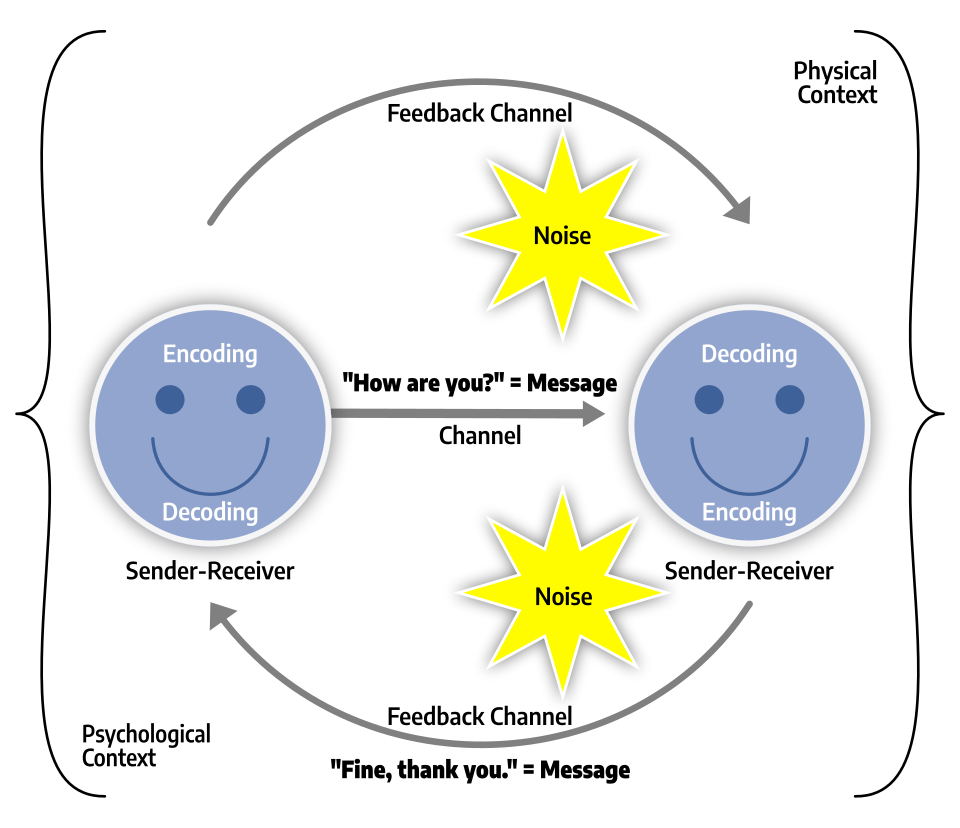 Real-world example of sender-receiver communication with feedback loop (e.g., teacher-student interaction) (Image: University of Minnesota, CC BY-SA 4.0, via Wikimedia Commons)
Key Elements of Communication:
- Sender: The person who shares the message (e.g., a teacher explaining a topic).
- Message: The information being shared (e.g., "The exam is tomorrow").
- Channel: How the message is sent (spoken, written, body language).
- Receiver: The person who gets the message (e.g., a student).
- Feedback: The receiver’s response (e.g., nodding or asking questions).
2. Types of Communication
Communication can be classified in three ways:
| Type | Definition | Examples | Advantages | Disadvantages |
|---|---|---|---|---|
| Verbal | Uses words (spoken or written). | Talking, texting, emails. | Clear, recordable (written). | Misinterpretation, language barriers. |
| Non-verbal | Uses body language, facial expressions. | Smiling, crossing arms, eye contact. | Fast, honest (hard to fake). | Cultural differences (e.g., thumbs-up). |
| Visual | Uses images, graphs, or symbols. | Charts, maps, emojis. | Easy to understand complex ideas. | Requires literacy/visual skills. |
Why It Matters:
- Verbal is best for detailed instructions (e.g., a doctor’s diagnosis).
- Non-verbal shows emotions (e.g., a hug comforts without words).
- Visual simplifies data (e.g., a pie chart in a report).
3. Barriers to Effective Communication
Even with good intent, messages can fail. Common barriers include:
A. Physical Barriers
- Noise: Loud sounds (e.g., traffic) distract.
- Distance: Far apart = harder to hear/see.
- Poor lighting: Makes reading/watching difficult.
B. Psychological Barriers
- Prejudice: Judging someone before listening (e.g., assuming a shy person is rude).
- Lack of attention: Daydreaming during a lecture.
- Emotional state: Anger or sadness clouds understanding.
C. Language Barriers
- Different languages: A Nepali speaker may struggle with English terms.
- Jargon: Technical words (e.g., "metacognition") confuse non-experts.
D. Cultural Barriers
- Gestures: In Nepal, touching someone’s head is rude; in the West, it’s okay.
- Directness: Some cultures value honesty; others avoid confrontation.
4. Improving Communication Skills
flowchart TD
    A["Active Listener"] --> B["Focus Fully"]
    B --> C["Nodding"]
    B --> D["Paraphrasing"]
    B --> E["Ask Questions"]
    C & D & E --> F["Reduce Misunderstandings by 60%"]
    F --> G["Effective Feedback"]
Step-by-step active listening process with measurable impactA. Active Listening
Active listeners focus fully on the speaker. Try:
- Nodding to show you’re engaged.
- Paraphrasing: "So you’re saying…?"
- Asking questions: "Can you explain that part?"
- Avoiding distractions: Put away your phone.
Example: Scenario: Your friend says, "I failed my exam because I didn’t study." Active response: "That sounds frustrating. Did you try revising the tough topics first?" Passive response: "Yeah, exams are hard." (Misses the emotion.)
B. Assertive Communication
Assertive people express needs clearly without hurting others. Use:
- "I" statements: "I feel worried when deadlines are missed."
- Body language: Stand tall, make eye contact.
- Tone: Calm, not aggressive or passive.
Comparison Table:
| Style | Behavior | Example | Effect |
|---|---|---|---|
| Aggressive | Dominates, blames others. | "You’re always late—it’s your fault!" | Creates conflict. |
| Passive | Avoids conflict, hides feelings. | "Fine, whatever." (smiling inside) | Resentment builds. |
| Assertive | Honest but respectful. | "I need this report by Friday. Can we discuss delays?" | Solves problems fairly. |
C. Non-Verbal Cues
Your body speaks louder than words:
- Eye contact: Shows confidence (but too much can feel intimidating).
- Facial expressions: Smiling = friendliness; frowning = disapproval.
- Posture: Slouching = disinterest; sitting upright = engagement.
5. Communication in Groups
Teams need clear roles and shared goals. Common group roles:
- Leader: Guides the team (e.g., a project manager).
- Follower: Supports ideas (e.g., a team member who listens).
- Critic: Challenges ideas (e.g., "Have we considered costs?").
- Peacemaker: Resolves conflicts.
Group Norms: Unwritten rules like:
- "Everyone speaks once before voting."
- "No phones during discussions."
Example: A group project fails because no one assigns tasks. Solution: Hold a meeting to define roles (e.g., "You research, I write").
6. Conflict Resolution
Disagreements happen—handle them calmly:
- Listen without interrupting.
- Acknowledge feelings: "I see you’re upset."
- Find common ground: "We both want the project done well."
- Compromise: "Let’s split the work."
Exam Tip: How to Score Full Marks
Define Key Terms:
- Example: "Communication is the process of exchanging ideas through verbal, non-verbal, and visual means."
Compare Types:
- Question: "Differentiate between verbal and non-verbal communication."
- Answer:
Verbal Non-Verbal Uses words (spoken/written) Uses body language Example: Emails Example: Nodding Advantage: Recordable Advantage: Honest
Solve Case Scenarios:
- Question: "Ramesh’s team argues over project deadlines. Suggest 2 ways to resolve this."
- Answer:
- Active listening: Let each member explain their concerns.
- Compromise: Adjust deadlines based on workload.
Identify Barriers:
- Question: "Why might a student not understand a teacher’s lecture?"
- Answer: Psychological barrier (lack of attention) or language barrier (complex terms).
Apply Concepts:
- Question: "How would you use non-verbal cues in a job interview?"
- Answer: "I’d smile to show friendliness, sit upright to appear confident, and nod to show I’m listening."
Practice Questions (NEB Style)
Short Answer:
- What are two non-verbal communication techniques?
- Answer: Eye contact, open posture.
Long Answer (5 marks):
- Explain three barriers to communication with examples.
- Answer:
- Noise: Traffic sounds during a phone call.
- Prejudice: Assuming a person is unqualified because of their accent.
- Language: Using medical jargon with a patient.
Case Study:
- Scenario: Sita’s friend ignores her texts. How can Sita improve communication?
- Answer:
- Use verbal (call instead of text).
- Check for barriers (is her friend busy?).
- Try non-verbal (meet in person to show care).
Final Reminder:
- 70% of communication is non-verbal—practice eye contact and open gestures.
- Active listening reduces conflicts by half.
- Assertive = honest + respectful—never aggressive or passive.
Visual Summary:
Based on the NEB +2 Management syllabus for Life Skill Education (LSE), unit 4.
Discussion
Loading…