Life Skill EducationUnit 27 min read
Critical & Creative Thinking: Skills, Tools & Applications
Unit 2 of Life Skill Education explores how to think logically (critical thinking) and innovatively (creative thinking), with real-world examples, problem-solving techniques, and NEB-style practice questions to master exam skills.
TAKEAWAYS:
- Critical thinking helps you analyze, evaluate, and solve problems logically using evidence.
- Creative thinking lets you generate new ideas, think outside the box, and innovate.
- Both skills work together: critical thinking filters ideas, creative thinking generates them.
- Common barriers to these skills include fear of failure, lack of practice, and rigid mindsets.
- Tools like mind maps, SWOT analysis, and brainstorming make thinking skills practical.
- NEB exams test these skills through case studies, short-answer questions, and scenario-based problems.
What Are Critical and Creative Thinking?
Critical thinking is thinking carefully and logically to make good decisions. It helps you:
- Question information
- Find problems in arguments
- Make fair judgments
Creative thinking is thinking in new and original ways to solve problems. It helps you:
- Generate fresh ideas
- See problems from different angles
- Come up with unique solutions
Why are both important?
- Critical thinking keeps you from being fooled or making mistakes.
- Creative thinking helps you improve things and find better solutions.
mindmap
  root((Critical & Creative Thinking))
    Critical Thinking
      Definition: Logical analysis of information
      Steps: Question → Analyze → Evaluate → Conclude
      Tools: SWOT, Fishbone Diagram
    Creative Thinking
      Definition: Generating new ideas
      Steps: Brainstorm → Combine → Improve → Evaluate
      Tools: Mind Maps, SCAMPER
    Connection
      Critical Thinking: Filters ideas
      Creative Thinking: Generates ideas
How Critical Thinking Works
Critical thinking is like detective work for your brain. You ask questions, check facts, and decide what is true or false.
Steps of Critical Thinking:
- Question: Ask "Why?" and "How?"
- Analyze: Break the problem into smaller parts.
- Evaluate: Check if the information is reliable.
- Conclude: Make a fair decision based on evidence.
Example: Problem: "All students who study hard get good grades." Critical Thinking Approach:
- Question: Is this always true?
- Analyze: What about students who study hard but are sick on exam day?
- Evaluate: Are there exceptions?
- Conclude: The statement is not always true.
How Creative Thinking Works
Creative thinking is like being an artist with ideas. It helps you see problems in new ways and come up with original solutions.
Steps of Creative Thinking:
- Brainstorm: Write down all possible ideas (no bad ideas!).
- Combine: Mix ideas to create new ones.
- Improve: Make ideas better.
- Evaluate: Pick the best idea.
Example: Problem: "How can we reduce waste in our school?" Creative Thinking Approach:
- Brainstorm: Recycle paper, use reusable water bottles, start a compost.
- Combine: Create a school recycling program with reusable bottles.
- Improve: Add posters to teach students about waste reduction.
- Evaluate: This idea is practical and involves the whole school.
flowchart TD
  A["Problem: Reduce Waste"] --> B["Brainstorm"]
  B --> C["Recycle Paper"]
  B --> D["Reusable Bottles"]
  B --> E["Compost"]
  C --> F["Combine: Recycling Program"]
  D --> F
  E --> F
  F --> G["Improve: Add Posters"]
  G --> H["Evaluate: Best Solution"]
Tools for Critical and Creative Thinking
| Tool | Used For | How to Use It |
|---|---|---|
| Mind Maps | Creative Thinking | Start with a main idea, branch out with related ideas. |
| SWOT Analysis | Critical Thinking | List Strengths, Weaknesses, Opportunities, Threats. |
| Fishbone Diagram | Problem Solving | Identify causes of a problem in categories (e.g., people, process). |
| SCAMPER | Creative Thinking | Ask: Substitute, Combine, Adapt, Modify, Put to another use, Eliminate, Reverse. |
| 5 Whys | Critical Thinking | Keep asking "Why?" until you find the root cause. |
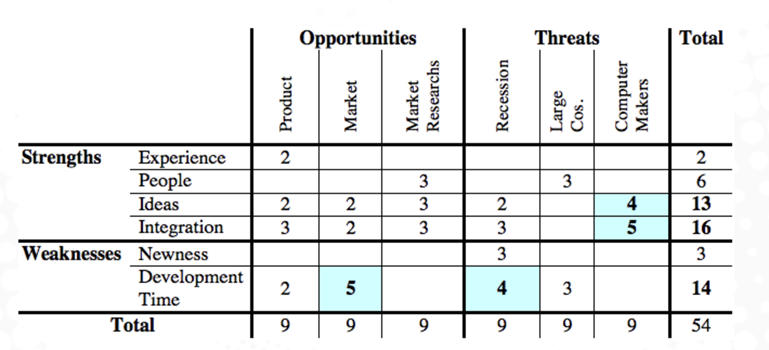 A table showing Strengths, Weaknesses, Opportunities, and Threats for a school project. (Image: Lorijometz, CC BY-SA 4.0, via Wikimedia Commons)
Barriers to Critical and Creative Thinking
Sometimes, our minds get stuck. Here are common barriers:
| Barrier | How It Happens | How to Overcome It |
|---|---|---|
| Fear of Failure | Afraid to try new ideas. | Accept that mistakes are part of learning. |
| Lack of Practice | Not used to thinking deeply. | Practice daily with puzzles or debates. |
| Rigid Mindset | Believing "There’s only one right answer." | Embrace different perspectives. |
| Distractions | Too many thoughts at once. | Focus on one problem at a time. |
How Critical and Creative Thinking Work Together
Critical thinking and creative thinking are like two sides of a coin. They work best when used together.
Example: Problem: "How can we make our school library more interesting?"
- Creative Thinking: Brainstorm ideas like adding bookshelves, hosting book clubs, or using digital books.
- Critical Thinking: Evaluate which ideas are practical (e.g., cost, student interest).
- Combine: Choose the best ideas (e.g., book clubs + digital books) and plan how to implement them.
sequenceDiagram
  participant Creative as Creative Thinking
  participant Critical as Critical Thinking
  Creative->>Critical: Generates ideas (e.g., book clubs)
  Critical->>Critical: Evaluates ideas (e.g., is it affordable?)
  Critical-->>Creative: Filters best ideas
  Creative->>Critical: Refines ideas (e.g., add digital books)
  Critical->>Critical: Plans implementation
Real-Life Applications
School Projects:
- Use creative thinking to design a poster.
- Use critical thinking to check if your facts are correct.
Everyday Decisions:
- Creative: Think of new ways to save money.
- Critical: Compare prices and quality before buying.
Problem Solving:
- Creative: Brainstorm solutions to a fight with a friend.
- Critical: Choose the fairest solution.
NEB-Style Practice Questions
Short Answer Questions:
- What is the difference between critical thinking and creative thinking?
- List two tools for creative thinking and explain how to use them.
- Why is it important to overcome the "fear of failure" in creative thinking?
Scenario-Based Questions:
- Your friend says, "Social media is always bad for students." Use critical thinking to analyze this statement.
- How would you use creative thinking to improve the canteen food in your school?
Case Study:
- A group of students wants to start an environment club. Use SWOT analysis to evaluate their idea.
Exam Tip
For short-answer questions:
- Define the term clearly.
- Give examples to explain your answer.
For scenario-based questions:
- Break the problem into steps.
- Show how you applied critical or creative thinking.
For case studies:
- Use tools like SWOT or mind maps to structure your answer.
- Explain your reasoning clearly.
Practice daily:
- Solve puzzles, debate topics, or brainstorm ideas to sharpen your skills.
Remember: Critical and creative thinking are skills you can improve with practice. The more you use them, the better you’ll get! Good luck in your exams!
Based on the NEB +2 Management syllabus for Life Skill Education (LSE), unit 2.
Discussion
Loading…