BiologyUnit 1113 min read
Animal Kingdom Classification: Phyla, Characteristics & Examples
Unit 11 of Biology covers the classification of the Animal Kingdom into major phyla, their distinguishing features, examples, and evolutionary relationships, with a focus on NEB exam patterns and practical applications.
TAKEAWAYS:
- Animals are classified into 9 major phyla based on body symmetry, tissue organization, and other features.
- Coelom (body cavity) and germ layers (ectoderm, mesoderm, endoderm) are key classification criteria.
- Porifera (sponges) are the simplest animals with no true tissues, while Chordata includes vertebrates.
- NEB-style questions often test identification of phyla from characteristics or examples.
- Evolutionary trends show increasing complexity from Porifera to Chordata.
---

## **Introduction to Animal Kingdom Classification**
The **Animal Kingdom (Kingdom Animalia)** includes over **1.5 million known species**, ranging from simple sponges to complex humans. Unlike plants, animals:
- Are **heterotrophic** (cannot make their own food).
- Are **multicellular** with specialized cells.
- Mostly have **motility** (ability to move at some life stage).
- Reproduce **sexually** (though some can reproduce asexually).

Animals are classified into **9 major phyla** based on:
1. **Body symmetry** (asymmetry, radial, bilateral).
2. **Germ layers** (diploblastic, triploblastic).
3. **Body cavity (coelom)** (acoelomate, pseudocoelomate, coelomate).
4. **Segmentation** (metamerism).
5. **Presence of notochord** (in Chordata).

---
**Key Idea:** Symmetry helps determine an animal’s lifestyle (e.g., radial symmetry in sessile animals like corals).

---

## **Major Phyla of Animal Kingdom**
The **9 major phyla** are grouped based on complexity:

| **Phylum**       | **Germ Layers** | **Body Cavity** | **Symmetry**       | **Examples**               | **Key Features**                          |
|------------------|-----------------|-----------------|--------------------|----------------------------|-------------------------------------------|
| **Porifera**     | None (Cellular) | None            | Asymmetrical       | Sponges                    | No true tissues, porous body, filter feeders |
| **Cnidaria**     | Diploblastic    | None            | Radial             | Hydra, Jellyfish, Coral    | Stinging cells (cnidocytes), polyp/medusa forms |
| **Platyhelminthes** | Triploblastic  | Acoelomate      | Bilateral          | Tapeworm, Planaria         | Flatworms, parasitic or free-living       |
| **Nematoda**     | Triploblastic   | Pseudocoelomate | Bilateral          | Ascaris (roundworm)       | Cylindrical, parasitic or free-living      |
| **Annelida**     | Triploblastic   | Coelomate       | Bilateral          | Earthworm, Leech           | Segmented body, setae (bristles)           |
| **Arthropoda**   | Triploblastic   | Coelomate       | Bilateral          | Insects, Spiders, Crabs    | Jointed legs, exoskeleton, open circulatory system |
| **Mollusca**     | Triploblastic   | Coelomate       | Bilateral          | Snail, Octopus, Oyster     | Soft body, often with shell, muscular foot |
| **Echinodermata**| Triploblastic   | Coelomate       | Radial (larvae bilateral) | Starfish, Sea Urchin      | Spiny skin, water vascular system          |
| **Chordata**     | Triploblastic   | Coelomate       | Bilateral          | Fish, Frog, Human          | Notochord, dorsal nerve cord, pharyngeal slits |

---
### **1. Porifera (Sponges)**
- **Simplest animals** with **no true tissues or organs**.
- **Body structure**:
  - **Porocytes** (tiny pores) for water flow.
  - **Choanocytes** (collar cells) for filter feeding.
  - **Spicules** (skeletal support, made of silica or calcium).
- **Reproduction**:
  - **Asexual**: Budding, gemmule formation.
  - **Sexual**: Release sperm into water for fertilization.
- **Ecological role**: Filter water, provide habitat for marine life.

**Example**: *Sycon* (a calcareous sponge) has a **leuconoid** body type with multiple chambers.

---
### **2. Cnidaria (Hydra, Jellyfish, Coral)**
- **Diploblastic** (2 germ layers: ectoderm and endoderm).
- **Radial symmetry** and **cnidocytes** (stinging cells).
- **Body forms**:
  - **Polyp** (sessile, e.g., Hydra, Coral).
  - **Medusa** (free-swimming, e.g., Jellyfish).
- **Digestive system**: **Gastrovascular cavity** (incomplete digestion).
- **Reproduction**:
  - **Asexual**: Budding (in Hydra).
  - **Sexual**: Medusa releases gametes.

**Example**: *Obelia* shows **alternation of generations** (polyp and medusa stages).

---
### **3. Platyhelminthes (Flatworms)**
- **Triploblastic** (3 germ layers) but **acoelomate** (no body cavity).
- **Bilateral symmetry** and **cephalization** (head region).
- **Examples**:
  - **Free-living**: *Planaria* (regenerates body parts).
  - **Parasitic**: *Taenia* (tapeworm), *Fasciola* (liver fluke).
- **Digestive system**: Incomplete (only one opening).
- **Excretion**: **Protonephridia** (flame cells).

```mermaid
flowchart TD
    A["Flatworm Body Plan"] --> B["Dorsal Surface"]
    A --> C["Ventral Surface"]
    B --> D["Ectoderm"]
    C --> E["Endoderm"]
    D --> F["Mesoderm (no cavity)"]
    E --> F
    F --> G["Parenchyma\n(fills space)"]
    G --> H["Organs\n(No body cavity)"]
    caption: Acoelomate Body Plan (Platyhelminthes)
Example: Taenia solium (pork tapeworm) has a scolex (head) with hooks and suckers.
4. Nematoda (Roundworms)
- Triploblastic and pseudocoelomate (false body cavity).
- Bilateral symmetry, cylindrical body.
- Examples:
- Ascaris (parasitic in humans).
- Caenorhabditis elegans (model organism in genetics).
- Digestive system: Complete (mouth and anus).
- Reproduction: Mostly dioecious (separate sexes).
Example: Wuchereria bancrofti causes elephantiasis (blocked lymphatic system).
5. Annelida (Segmented Worms)
- Triploblastic and coelomate (true body cavity).
- Metamerism (segmented body).
- Examples:
- Pheretima (earthworm, improves soil).
- Hirudinaria (leech, parasitic).
- Circulatory system: Closed (dorsal and ventral blood vessels).
- Respiration: Through moist skin.
flowchart LR
    A["Annelid Body"] --> B["Segment 1"]
    B --> C["Segment 2"]
    C --> D["Segment 3"]
    D --> E["..."]
    E --> F["Segment n"]
    A --> G["Setae\n(Bristles)"]
    A --> H["Coelom\n(Body Cavity)"]
    A --> I["Closed\nCirculatory System"]
caption: Features of Annelida (Earthworm)Example: Earthworm’s clitellum secretes mucus during copulation.
6. Arthropoda (Insects, Spiders, Crabs)
- Largest phylum (~80% of animal species).
- Triploblastic, coelomate, bilateral symmetry.
- Key features:
- Jointed legs (appendages).
- Exoskeleton (chitinous, molting required).
- Open circulatory system.
- Metamorphosis (complete/incomplete).
- Classes:
- Insecta (6 legs, e.g., Apis – honeybee).
- Arachnida (8 legs, e.g., spider).
- Crustacea (e.g., crab, shrimp).
Example: Periplaneta americana (cockroach) has 3 body regions (head, thorax, abdomen).
7. Mollusca (Snails, Octopus, Oyster)
- Triploblastic, coelomate, bilateral symmetry.
- Soft body, often with a shell.
- Classes:
- Gastropoda (snails, slugs).
- Cephalopoda (squid, octopus, cuttlefish).
- Pelecypoda (clams, oysters).
- Key features:
- Muscular foot (locomotion).
- Radula (tongue-like structure for scraping food).
- Open circulatory system (except cephalopods).
Example: Octopus vulgaris has no shell and closed circulatory system.
8. Echinodermata (Starfish, Sea Urchin)
- Triploblastic, coelomate, radial symmetry (as adults).
- Water vascular system (hydraulic system for movement).
- Spiny skin (dermal ossicles).
- Examples:
- Asterias (starfish, regeneration).
- Echinus (sea urchin, tube feet).
Example: Starfish uses tube feet to pry open clams.
9. Chordata (Vertebrates & Closest Relatives)
- Triploblastic, coelomate, bilateral symmetry.
- Key features (present in embryonic stage):
- Notochord (flexible rod for support).
- Dorsal nerve cord (becomes spinal cord).
- Pharyngeal slits (gill pouches).
- Post-anal tail.
- Subphyla:
- Urochordata (tunicates, e.g., Salpa).
- Cephalochordata (lancelets, e.g., Amphioxus).
- Vertebrata (fish, amphibians, reptiles, birds, mammals).
classDiagram
    class Chordata {
        +Notochord
        +Dorsal Nerve Cord
        +Pharyngeal Slits
        +Post-anal Tail
    }
    class Vertebrata {
        +Vertebral Column
        +Skull
    }
    Chordata <|-- Vertebrata
    Vertebrata <|-- Fish
    Vertebrata <|-- Amphibian
    Vertebrata <|-- Reptile
    Vertebrata <|-- Aves
    Vertebrata <|-- Mammalia
caption: Classification of ChordataExample: Peripatus (a "living fossil") shows features of both annelids and arthropods.
Evolutionary Trends in Animal Kingdom
Animals show progressive complexity from Porifera to Chordata:
| Feature | Porifera | Cnidaria | Platyhelminthes | Nematoda | Annelida | Arthropoda | Mollusca | Echinodermata | Chordata |
|---|---|---|---|---|---|---|---|---|---|
| Germ Layers | None | Diploblastic | Triploblastic | Triploblastic | Triploblastic | Triploblastic | Triploblastic | Triploblastic | Triploblastic |
| Body Cavity | None | None | Acoelomate | Pseudocoelomate | Coelomate | Coelomate | Coelomate | Coelomate | Coelomate |
| Symmetry | Asymmetrical | Radial | Bilateral | Bilateral | Bilateral | Bilateral | Bilateral | Radial (adult) | Bilateral |
| Segmentation | No | No | No | No | Yes | Yes | No | No | Partial |
| Notochord | No | No | No | No | No | No | No | No | Yes |
Solved Examples
Example 1: Identifying Phyla from Characteristics
Question: An animal has:
- Radial symmetry.
- Cnidocytes (stinging cells).
- Two body forms: polyp and medusa. Which phylum does it belong to? Solution:
- Radial symmetry + cnidocytes → Cnidaria.
- Polyp and medusa forms are characteristic of Obelia (a hydrozoan).
Example 2: Coelom Types
Question: Match the following animals to their coelom type:
- Earthworm
- Ascaris
- Planaria
- Starfish Solution:
- Earthworm → Coelomate (Annelida).
- Ascaris → Pseudocoelomate (Nematoda).
- Planaria → Acoelomate (Platyhelminthes).
- Starfish → Coelomate (Echinodermata).
Example 3: Evolutionary Relationships
Question: Which phylum shows the transition from pseudocoelomate to coelomate? Solution:
- Nematoda (pseudocoelomate) → Annelida (coelomate).
- This marks a major evolutionary step in body cavity development.
NEB Board-Style Questions
Short Answer Questions (SAQ)
- Define: Coelom, Metamerism, Pseudocoelomate.
- Differentiate between:
- Radial and bilateral symmetry.
- Open and closed circulatory systems.
- Name two animals from each of the following phyla:
- Cnidaria, Platyhelminthes, Arthropoda, Mollusca.
- Why are arthropods the most successful phylum?
Long Answer Questions (LAQ)
- Describe the body organization of Porifera with a labeled diagram.
- Explain the significance of the coelom in animal evolution.
- Compare the digestive systems of:
- Planaria (Platyhelminthes).
- Earthworm (Annelida).
- Cockroach (Arthropoda).
- How do echinoderms demonstrate radial symmetry despite having a bilateral larval stage?
Practical/Application Questions
- If you find an animal with:
- A segmented body.
- Jointed legs.
- An exoskeleton. Identify its phylum and give two examples.
- Why are cnidocytes important in the life of a jellyfish?
Exam Tips
- Memorize key features of each phylum (e.g., Porifera = no tissues, Cnidaria = cnidocytes).
- Practice diagrams:
- Draw body plans (e.g., earthworm segmentation, mollusk anatomy).
- Label symmetry types (radial vs. bilateral).
- Understand evolutionary trends:
- From no coelom (Platyhelminthes) → pseudocoelom (Nematoda) → true coelom (Annelida, Arthropoda).
- Common NEB traps:
- Confusing pseudocoelomate (Ascaris) with acoelomate (Planaria).
- Forgetting Chordata features (notochord, dorsal nerve cord).
- Application questions:
- Relate phyla to ecology (e.g., earthworms in soil health) or medicine (e.g., parasitic flatworms).
- Use mnemonics:
- "Please Come To My Party So You Can Bring Ice Cream" for phyla order (Porifera, Cnidaria, Platyhelminthes, Nematoda, Annelida, Arthropoda, Mollusca, Echinodermata, Chordata).
Summary Table for Quick Revision
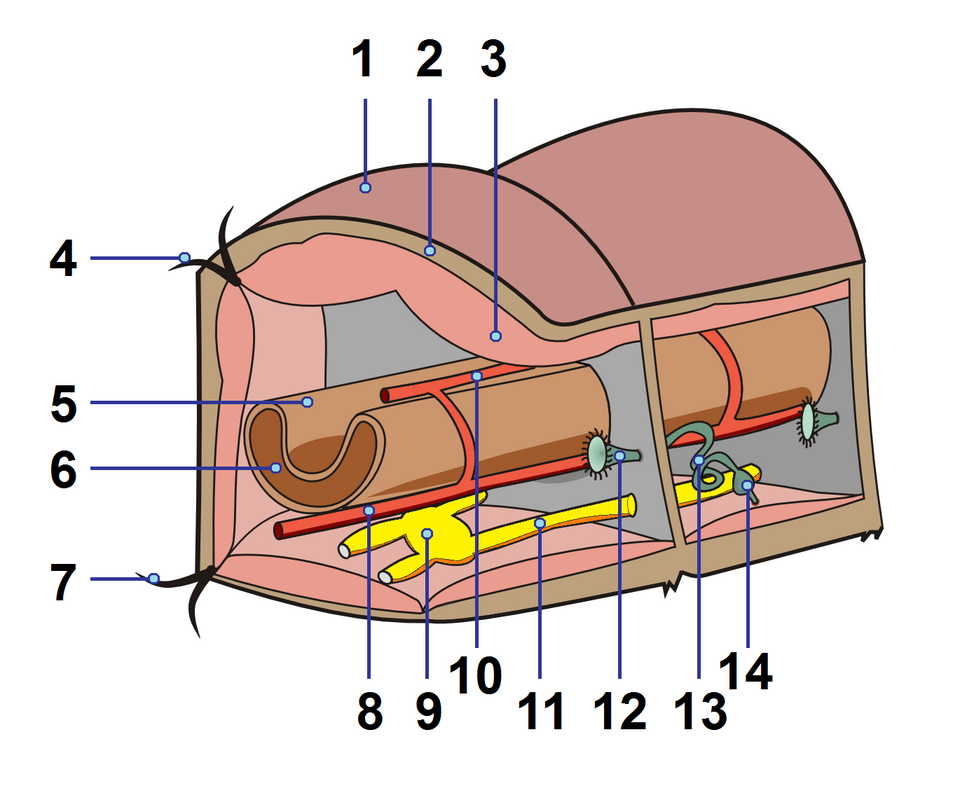 Labelled diagram of an annelid’s segmented body. (Image: Oligochaeta_anatomy.svg: Reytan / *derivative work: B kimmel, Public domain, via Wikimedia Commons)
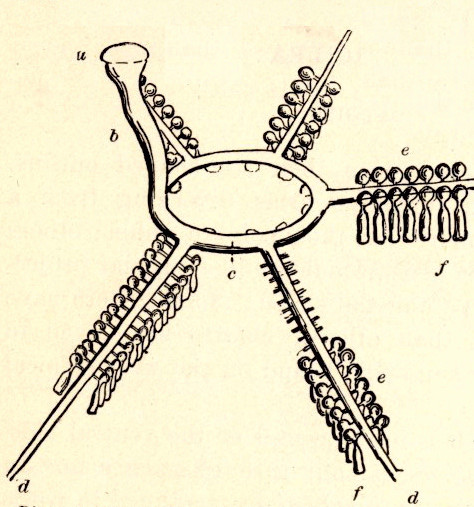 How tube feet work in starfish. (Image: Augusta Foote Arnold, Public domain, via Wikimedia Commons)
Based on the NEB +2 Science syllabus for Biology (Bio), unit 11.
Discussion
Loading…