BiologyUnit 213 min read
Cell Structure, Organelles & Functions
Unit 2 of Biology: Learn the cell theory, eukaryotic vs. prokaryotic cells, organelles (nucleus, mitochondria, chloroplasts, ER, Golgi, lysosomes, vacuoles), cell membrane, cytoplasm, and their functions with diagrams, comparisons, and NEB-style questions.
---

## **Cell Theory: The Foundation of Biology**
Cells are the **basic building blocks of all living things**. Three key ideas make up **cell theory**:
1. **All living things are made of cells** (even viruses use cells to reproduce).
2. **Cells are the smallest unit of life** (they perform all life processes).
3. **Cells come from pre-existing cells** (they do not arise spontaneously).

**Why is this important?**
- Explains how life is organized (from bacteria to humans).
- Helps scientists study diseases (e.g., cancer starts when cells grow uncontrollably).

---

## **Types of Cells: Prokaryotic vs. Eukaryotic**
Cells are divided into **two main types**:

| Feature               | **Prokaryotic Cells** (e.g., bacteria) | **Eukaryotic Cells** (e.g., plants, animals) |
|-----------------------|----------------------------------------|---------------------------------------------|
| **Nucleus**          | No true nucleus (DNA floats freely)    | Has a **nucleus** (DNA enclosed in a membrane) |
| **Size**             | Smaller (0.1–5 µm)                     | Larger (10–100 µm)                          |
| **Organelles**       | Few (ribosomes only)                   | Many (mitochondria, ER, Golgi, etc.)        |
| **Cell Wall**        | Made of **peptidoglycan**              | Made of **cellulose** (plants) or **chitin** (fungi) |
| **Examples**         | Bacteria, blue-green algae             | Animals, plants, fungi, protists           |

```mermaid
classDiagram
    class Prokaryote {
        +No nucleus
        +Small (0.1–5 µm)
        +No membrane-bound organelles
        +Example: Bacteria
    }
    class Eukaryote {
        +Has nucleus
        +Large (10–100 µm)
        +Many organelles
        +Example: Plant/Animal cells
    }
    Prokaryote --> "Lacks" Eukaryote : Organelles
    Eukaryote --> "Contains" Prokaryote : DNA (but in nucleus)
Key Difference:
- Prokaryotes = "Before nucleus" (simple, no organelles).
- Eukaryotes = "True nucleus" (complex, with specialized parts).
Eukaryotic Cell Structure: The Organelles
Each organelle has a specific job in the cell. Let’s explore the most important ones:
1. Nucleus: The "Brain" of the Cell
- Function: Controls all cell activities by storing DNA (genetic material).
- Parts:
- Nuclear membrane (protects DNA).
- Nucleolus (makes ribosomes).
- Chromatin (DNA + proteins, forms chromosomes during cell division).
Fun Fact:
- If the nucleus were a city hall, DNA would be the laws that run the city!
2. Mitochondria: The "Powerhouse"
- Function: Produces energy (ATP) through cellular respiration (using glucose + oxygen).
- Structure:
- Outer membrane (smooth).
- Inner membrane (folded into cristae for more surface area).
- Matrix (contains enzymes for respiration).
Equation of Cellular Respiration:
Glucose (C₆H₁₂O₆) + Oxygen (O₂) → Carbon dioxide (CO₂) + Water (H₂O) + **Energy (ATP)**
Why is ATP important?
- ATP is like a battery that powers all cell activities (muscle movement, nerve signals, etc.).
3. Chloroplasts: The "Solar Panels" (Only in Plant Cells)
- Function: Captures sunlight to make food (glucose) through photosynthesis.
- Structure:
- Chlorophyll (green pigment inside thylakoids).
- Stroma (fluid where Calvin cycle happens).
Equation of Photosynthesis:
Sunlight + Carbon dioxide (CO₂) + Water (H₂O) → Glucose (C₆H₁₂O₆) + Oxygen (O₂)
Why are chloroplasts green?
- Chlorophyll absorbs blue and red light but reflects green light, making plants look green.
4. Endoplasmic Reticulum (ER): The "Factory"
Two types:
- Rough ER (has ribosomes → makes proteins).
- Smooth ER (no ribosomes → makes lipids and detoxifies drugs).
Example:
- If your body takes painkillers, the liver’s smooth ER breaks them down.
5. Golgi Apparatus: The "Post Office"
- Function: Modifies, sorts, and packages proteins/lipids into vesicles for transport.
- Structure: Stack of flattened sacs.
Analogy:
- Like a post office that sorts letters (proteins) and sends them to the right address.
6. Lysosomes: The "Recycling Center"
- Function: Contains digestive enzymes to break down:
- Worn-out organelles (recycling).
- Bacteria (defense).
- Food particles (in white blood cells).
- Only in animal cells (plant cells have vacuoles instead).
Disease Link:
- If lysosomes don’t work, waste builds up → Tay-Sachs disease (fatal in babies).
7. Vacuoles: The "Storage Tank"
- Plant cells have a large central vacuole (stores water, salts, waste).
- Animal cells have small vacuoles (temporary storage).
Why do plants stay upright?
- The central vacuole fills with water, creating turgor pressure (like a water balloon).
8. Cell Membrane: The "Security Gate"
- Function: Controls what enters/exits the cell (selectively permeable).
- Structure:
- Phospholipid bilayer (hydrophilic heads, hydrophobic tails).
- Proteins (channels, pumps, receptors).
- Cholesterol (keeps membrane fluid).
How does it work?
- Small molecules (O₂, CO₂, H₂O) → Diffuse freely.
- Large molecules (glucose, ions) → Need protein channels or energy (active transport).
9. Cytoplasm: The "Jelly-Like Fluid"
- Function: Holds organelles in place and allows chemical reactions to happen.
- Made of:
- Cytosol (watery fluid).
- Cytoskeleton (microfilaments, microtubules → gives shape and helps movement).
Example:
- Amoeba moves using its cytoskeleton (like a skeleton that changes shape).
10. Cell Wall (Only in Plants, Fungi, Bacteria)
- Function: Provides support and protection.
- Composition:
- Plants: Cellulose.
- Fungi: Chitin.
- Bacteria: Peptidoglycan.
Why can’t animals have cell walls?
- Animal cells need to move and change shape (e.g., muscle cells, white blood cells).
Comparison: Plant Cell vs. Animal Cell
| Feature | Plant Cell | Animal Cell |
|---|---|---|
| Cell Wall | Yes (cellulose) | No |
| Chloroplasts | Yes (photosynthesis) | No |
| Large Vacuole | Yes (central vacuole) | No (small vacuoles) |
| Shape | Fixed (rectangular) | Variable (round/irregular) |
| Lysosomes | Few (if any) | Many |
| Centrioles | No | Yes (helps cell division) |
classDiagram
    class PlantCell {
        +Cell wall
        +Chloroplasts
        +Large vacuole
        +Fixed shape
    }
    class AnimalCell {
        +No cell wall
        +No chloroplasts
        +Small vacuoles
        +Variable shape
    }
    PlantCell --> "Has" AnimalCell : Cell wall
    AnimalCell --> "Has" PlantCell : Centrioles
How Substances Move Across the Cell Membrane
Three main ways:
| Method | Description | Example |
|---|---|---|
| Diffusion | Molecules move from high → low concentration (no energy). | O₂ entering cells, CO₂ leaving. |
| Osmosis | Water moves from high → low concentration (no energy). | Plant roots absorbing water. |
| Active Transport | Molecules move against concentration gradient (requires ATP energy). | Sodium-potassium pump in nerve cells. |
Real-Life Example:
- Osmosis in Potatoes:
- Place a potato in saltwater → water leaves → potato shrivels.
- Place in freshwater → water enters → potato swells.
Exam Tip: How to Score Full Marks in NEB Questions
Label Diagrams Properly
- If asked to label a cell organelle, write clear arrows with correct names.
- Example:
→ Nucleus (controls cell activities)
→ Mitochondria (powerhouse)
→ Chloroplast (photosynthesis)
Compare and Contrast
- For plant vs. animal cells, use a table and mention 3 key differences.
Explain Functions with Examples
- Don’t just say "mitochondria produce energy."
- Say: "Mitochondria produce ATP through cellular respiration, which powers muscle contraction in humans and active transport in nerve cells."
Memorize Key Equations
- Photosynthesis:
6CO₂ + 6H₂O → C₆H₁₂O₆ + 6O₂ - Respiration:
C₆H₁₂O₆ + 6O₂ → 6CO₂ + 6H₂O + ATP
- Photosynthesis:
Practical Applications
- Link organelles to diseases (e.g., lysosomes → Tay-Sachs).
- Link to everyday life (e.g., chloroplasts → food production).
NEB-Style Questions & Solutions
Short Answer Questions
Define the term "organelle." Give two examples.
- Answer:
An organelle is a specialized structure within a cell that performs a specific function.
- Examples: Mitochondria (energy production), Golgi apparatus (protein packaging).
- Answer:
An organelle is a specialized structure within a cell that performs a specific function.
Why are mitochondria called the "powerhouse" of the cell?
- Answer: Mitochondria produce ATP (energy currency) through cellular respiration, which powers all cell activities like muscle movement and nerve signals.
Differentiate between rough ER and smooth ER.
Answer:
Rough ER Smooth ER Has ribosomes No ribosomes Makes proteins Makes lipids and detoxifies drugs Found near nucleus Found near cell membrane
Structured Questions
With the help of a labeled diagram, describe the structure and function of a chloroplast.
- Answer:
- Structure:
- Outer membrane (protection).
- Inner membrane (contains thylakoids stacked into grana).
- Stroma (fluid where Calvin cycle makes glucose).
- Function:
- Captures sunlight using chlorophyll.
- Converts CO₂ + H₂O into glucose (food) and O₂ (waste).
- Structure:
- Answer:
Explain the fluid mosaic model of the cell membrane. How does it help in transport?
- Answer:
The fluid mosaic model describes the cell membrane as:
- A flexible "fluid" (phospholipids can move).
- A mosaic of proteins, cholesterol, and carbohydrates.
- Phospholipids form a bilayer (hydrophilic heads face water, hydrophobic tails face inward).
- Proteins act as:
- Channels (let small molecules pass).
- Pumps (use ATP to move molecules against gradient).
- Receptors (detect signals like hormones).
- Cholesterol keeps the membrane fluid and stable.
- Answer:
The fluid mosaic model describes the cell membrane as:
Long Answer Question
- Describe the structure of a mitochondrion with a labeled diagram. How does it produce ATP?
- Answer:
- Structure:
- Outer membrane (smooth, protective).
- Inner membrane (folded into cristae → increases surface area for ATP production).
- Matrix (contains enzymes for Krebs cycle and DNA/ribosomes for protein synthesis).
- ATP Production (Cellular Respiration):
- Glycolysis (cytoplasm): Glucose → Pyruvate (2 ATP).
- Krebs Cycle (matrix): Pyruvate → CO₂ + NADH/FADH₂ (2 ATP).
- Electron Transport Chain (ETC) (inner membrane): NADH/FADH₂ → 32–34 ATP (using oxygen).
- Total ATP: ~36–38 ATP per glucose (most from ETC).
- Structure:
- Answer:
Summary Table: Key Organelles & Functions
| Organelle | Function | Found In |
|---|---|---|
| Nucleus | Controls cell activities (DNA storage) | Eukaryotes |
| Mitochondria | Produces ATP (energy) | Eukaryotes |
| Chloroplast | Photosynthesis (food production) | Plant cells |
| Rough ER | Makes proteins | Eukaryotes |
| Smooth ER | Makes lipids, detoxifies | Eukaryotes |
| Golgi Apparatus | Packages and ships proteins | Eukaryotes |
| Lysosomes | Digests waste | Animal cells |
| Vacuole | Stores water, waste | Plant cells (large) |
| Cell Membrane | Controls entry/exit of substances | All cells |
| Cytoplasm | Holds organelles, site of reactions | All cells |
| Cell Wall | Support and protection | Plants, fungi, bacteria |
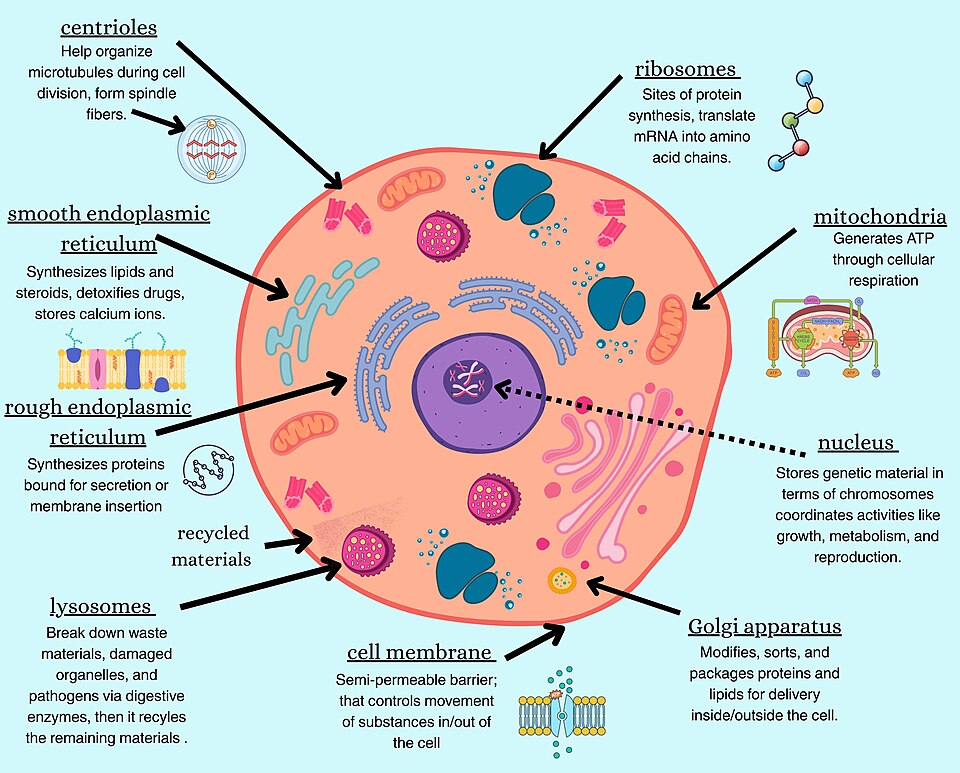 A labeled plant or animal cell showing all major organelles. (Image: Steven Mackenzie, CC BY-SA 4.0, via Wikimedia Commons)
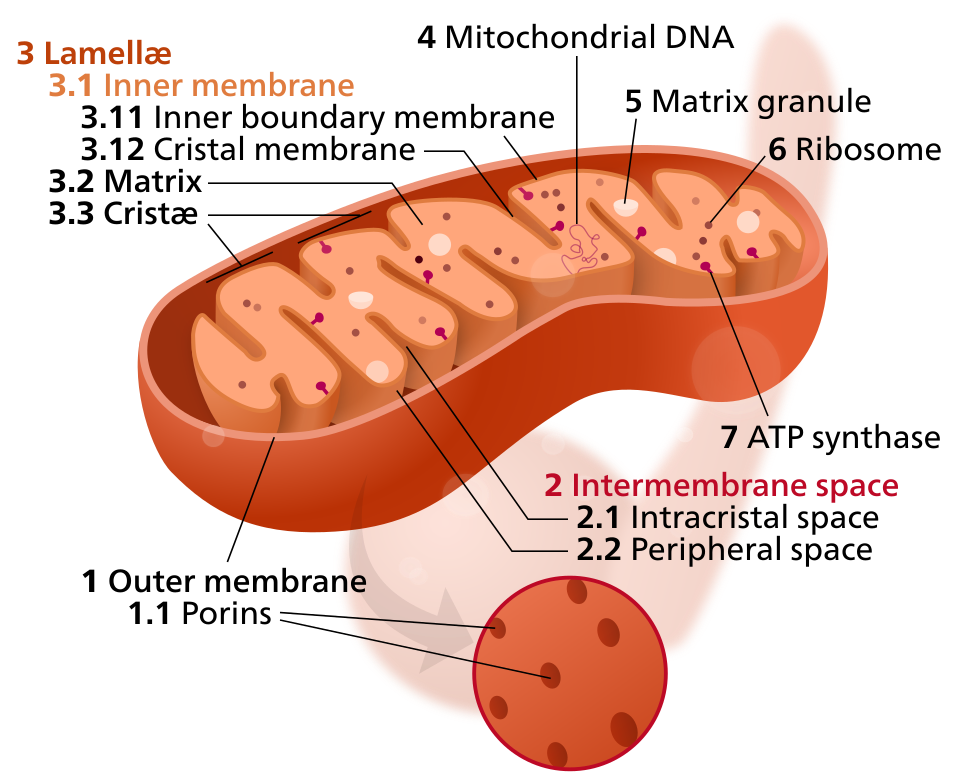 Cross-section of a mitochondrion with cristae and matrix labeled. (Image: Kelvinsong, CC0, via Wikimedia Commons)
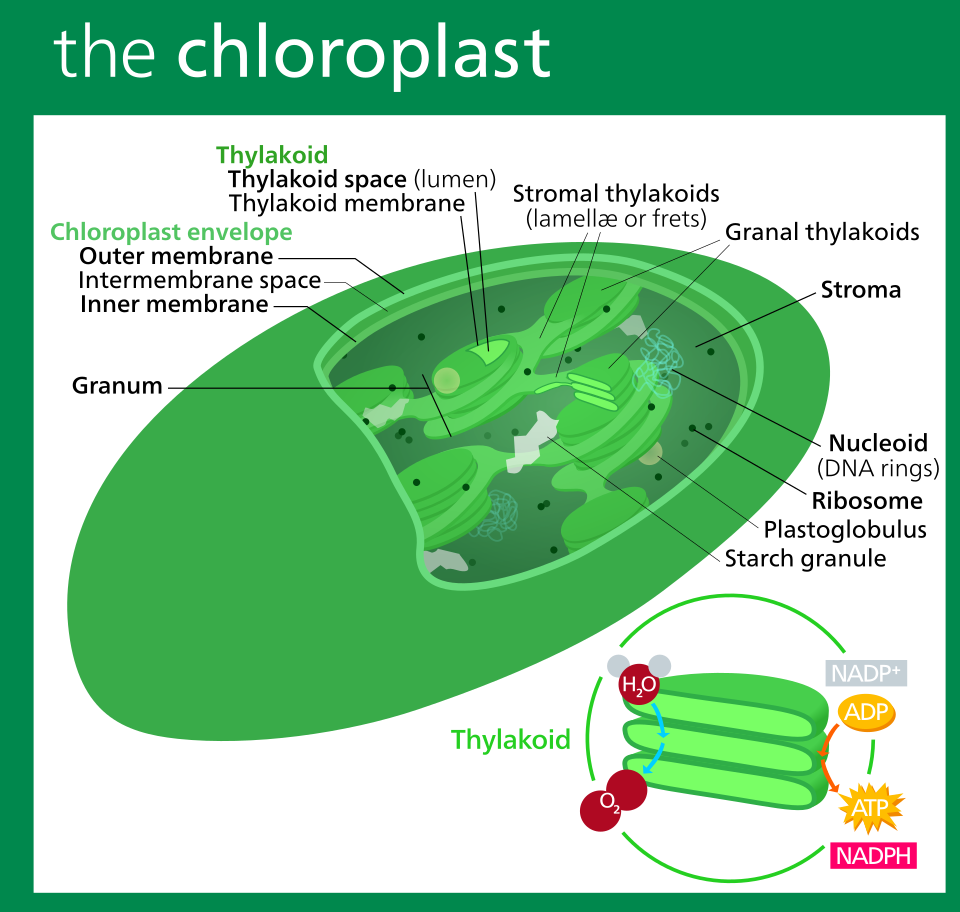 Chloroplast with thylakoids, grana, and stroma labeled. (Image: Kelvinsong, CC BY 3.0, via Wikimedia Commons)
Based on the NEB +2 Science syllabus for Biology (Bio), unit 2.
Discussion
Loading…