BiologyNEB 2076 (old course)
What is the role of enzymes in biological systems? Explain the factors affecting enzyme activity.
5Answer
Role of Enzymes in Biological Systems
Enzymes are biological catalysts that accelerate chemical reactions in living organisms without being permanently altered. Their primary roles include:
Catalysis of Metabolic Reactions
- Enzymes lower the activation energy of reactions, enabling metabolic pathways (e.g., digestion, respiration, photosynthesis) to proceed efficiently.
- Example: Amylase breaks down starch into maltose during digestion.
Regulation of Metabolic Pathways
- Enzymes control reaction rates via allosteric regulation (e.g., feedback inhibition in glycolysis).
- Example: Hexokinase is inhibited by high glucose-6-phosphate levels.
Structural and Organizational Roles
- Some enzymes form multi-enzyme complexes (e.g., pyruvate dehydrogenase complex in mitochondria).
- Others act as chaperones (e.g., heat shock proteins) to stabilize protein folding.
Signaling and Communication
- Enzymes transduce signals (e.g., adenylate cyclase converts ATP to cAMP).
- Protein kinases modify enzymes via phosphorylation, altering activity.
Factors Affecting Enzyme Activity
Enzyme activity depends on physical, chemical, and biological conditions:
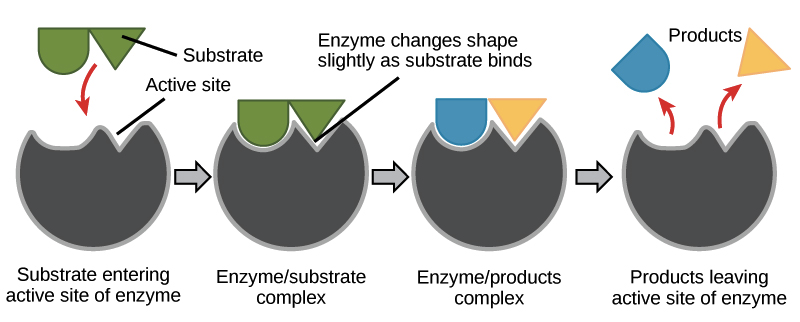 Lock-and-key vs. induced-fit model comparison (real textbook illustration) (Image: Original: OpenStax CollegeDerivative: Khan Academy, CC BY 4.0, via Wikimedia Commons)
| Factor | Effect on Enzyme Activity | Example |
|---|---|---|
| Temperature | Activity increases with temperature up to an optimum (usually 35–40°C for humans), then denatures. | Pepsin (stomach enzyme) works best at 37°C. |
| pH | Enzymes have an optimal pH (e.g., acidic for pepsin, alkaline for trypsin). | Trypsin functions best at pH 8.0 in the small intestine. |
| Substrate Concentration | Activity increases with substrate until the enzyme is saturated (follows Michaelis-Menten kinetics). | Lactase activity plateaus at high lactose levels. |
| Enzyme Concentration | Higher enzyme levels increase reaction rate (until substrate becomes limiting). | Adding more catalase speeds up H₂O₂ breakdown. |
| Inhibitors | Competitive inhibitors (e.g., malonate for succinate dehydrogenase) bind active sites. Non-competitive inhibitors (e.g., heavy metals) alter enzyme shape. | Cyanide inhibits cytochrome oxidase in respiration. |
| Co-factors/Co-enzymes | Required for activity (e.g., Mg²⁺ for ATPases, NAD⁺ for dehydrogenases). | Carbonic anhydrase needs Zn²⁺ to function. |
Key Mechanism: Enzymes bind substrates at their active site, forming an enzyme-substrate complex (ES). The induced-fit model explains how the active site molds to the substrate, facilitating catalysis via:
- Acid-base catalysis (e.g., serine proteases),
- Covalent catalysis (e.g., chymotrypsin),
- Metal ion catalysis (e.g., carbonic anhydrase).
Practical Example: In the digestive system, pepsin (optimum pH 2.0) breaks down proteins in the stomach, while pancreatic amylase (optimum pH 7.0) acts in the small intestine. Temperature deviations (e.g., fever >40°C) can denature enzymes, impairing digestion.
Discussion
Loading…