ChemistryUnit 118 min read
Halogens: Properties, Trends & Uses
Unit 11 of Chemistry explores the halogen group (Group 17), their physical/chemical properties, trends in the periodic table, and real-world applications like disinfectants and refrigerants—essential for NEB exams.
TAKEAWAYS:
- Halogens are Group 17 elements (F₂, Cl₂, Br₂, I₂, At) with 7 valence electrons, forming -1 ions and covalent bonds in compounds.
- Their reactivity decreases down the group (F₂ > Cl₂ > Br₂ > I₂) due to atomic size and bond dissociation energy.
- Disproportionation (e.g., Cl₂ + H₂O → HCl + HClO) and oxidizing power are key reactions.
- Uses: Chlorine in water purification, iodine in antiseptics, and fluorine in Teflon.
- Environmental impact: Ozone depletion by CFCs (chlorofluorocarbons) and toxic halogen gases.
### **1. Introduction to Halogens**
Halogens are **Group 17** elements in the periodic table. They are **highly reactive non-metals** and include:
- **Fluorine (F₂)**
- **Chlorine (Cl₂)**
- **Bromine (Br₂)**
- **Iodine (I₂)**
- **Astatine (At)** (radioactive, rare)

They are called **"salt-formers"** because they react with metals to form **salts** (e.g., NaCl, KCl).

---

### **2. Physical Properties of Halogens**
| **Property**       | **Fluorine (F₂)**       | **Chlorine (Cl₂)**      | **Bromine (Br₂)**       | **Iodine (I₂)**        |
|--------------------|--------------------------|-------------------------|-------------------------|------------------------|
| **State at RT**    | Pale yellow **gas**      | Greenish-yellow **gas** | Reddish-brown **liquid**| Purple-black **solid** |
| **Melting Point**  | -220°C                   | -101°C                  | -7°C                    | 114°C                  |
| **Boiling Point**  | -188°C                   | -34°C                   | 59°C                    | 184°C                  |
| **Density**        | 1.69 g/L (gas)           | 3.21 g/L (gas)          | 3.10 g/mL (liquid)      | 4.93 g/cm³ (solid)     |
| **Color**          | Pale yellow              | Greenish-yellow         | Reddish-brown           | Shiny purple-black     |

```figure
{"type":"layers","layers":["Fluorine (F₂)","Chlorine (Cl₂)","Bromine (Br₂)","Iodine (I₂)","Astatine (At)"],"arrow":"Increasing atomic size","highlight":["Fluorine (F₂)","Chlorine (Cl₂)","Bromine (Br₂)","Iodine (I₂)"],"caption":"Trend in atomic size and physical state down Group 17"}
Trend: As we go down the group, melting and boiling points increase due to increasing van der Waals forces between larger molecules.
3. Chemical Properties of Halogens
A. Reactivity
- Halogens are highly reactive because they need only 1 electron to complete their octet.
- Reactivity decreases down the group because:
- Atomic size increases → nuclear attraction decreases → harder to gain an electron.
- Bond dissociation energy decreases (e.g., F-F bond is weak due to lone pair repulsion).
B. Reaction with Metals (Formation of Salts)
Halogens react with metals to form ionic compounds (salts):
2Na + Cl₂ → 2NaCl (Sodium Chloride)
Ca + Br₂ → CaBr₂ (Calcium Bromide)
- Fluorine is the most reactive → forms ionic bonds even with less reactive metals.
- Iodine is the least reactive → may form covalent bonds (e.g., with hydrogen).
C. Reaction with Hydrogen (Hydrogen Halides)
Halogens react with hydrogen to form hydrogen halides (HX):
H₂ + X₂ → 2HX (where X = F, Cl, Br, I)
- HF is a weak acid (used in toothpaste).
- HCl is a strong acid (used in stomach acid).
- HI is the strongest reducing agent among hydrogen halides.
D. Disproportionation Reactions
Some halogens oxidize and reduce themselves in the same reaction:
Cl₂ + H₂O → HCl + HClO (Chlorine water)
- Chlorine acts as both oxidizing and reducing agent.
- Bromine and iodine also show disproportionation in alkaline medium:
3Br₂ + 6OH⁻ → 5Br⁻ + BrO₃⁻ + 3H₂O
E. Oxidizing Power
- Fluorine is the strongest oxidizing agent (can oxidize even noble gases like Xe).
- Oxidizing power decreases down the group:
F₂ > Cl₂ > Br₂ > I₂
4. Uses of Halogens
| Halogen | Uses |
|---|---|
| Fluorine (F₂) | - Used in Teflon (PTFE) coating for non-stick pans. <br> - Toothpaste (NaF) to prevent cavities. <br> - Uranium enrichment (UF₆) in nuclear reactors. |
| Chlorine (Cl₂) | - Water purification (bleach, HClO). <br> - Disinfectant in swimming pools. <br> - Manufacture of PVC, CFCs, and solvents. |
| Bromine (Br₂) | - Fire retardants (e.g., in plastics). <br> - Photographic films (AgBr). <br> - Sedatives and pesticides. |
| Iodine (I₂) | - Antiseptic (tincture of iodine). <br> - Deficiency disease prevention (iodized salt). <br> - Detecting starch (blue-black color). |
5. Environmental Impact of Halogens
A. Ozone Depletion by CFCs (Chlorofluorocarbons)
- CFCs (e.g., CFCl₃) were used in refrigerators and aerosols.
- Chlorine atoms from CFCs destroy ozone (O₃) in the stratosphere:
Cl + O₃ → ClO + O₂ ClO + O → Cl + O₂ - Result: Ozone layer depletion → increased UV radiation → skin cancer, global warming.
B. Toxicity of Halogens
- Chlorine gas (Cl₂) is poisonous (used in WWI as a chemical weapon).
- Iodine vapors are harmful if inhaled.
- Fluorine is extremely corrosive (attacks glass, metals, and even water).
6. Solved Examples
Example 1: Reaction of Chlorine with Cold & Hot NaOH
Reaction with cold NaOH:
Cl₂ + 2NaOH → NaCl + NaOCl + H₂O
Reaction with hot NaOH:
3Cl₂ + 6NaOH → 5NaCl + NaClO₃ + 3H₂O
Explanation:
- In cold NaOH, chlorine forms sodium hypochlorite (NaOCl) (bleaching agent).
- In hot NaOH, it forms sodium chlorate (NaClO₃) (oxidizing agent).
Example 2: Disproportionation of Bromine in Alkaline Medium
3Br₂ + 6OH⁻ → 5Br⁻ + BrO₃⁻ + 3H₂O
Balancing Steps:
- Oxidation half: Br₂ → BrO₃⁻ (Br goes from 0 to +5, loses 5e⁻).
- Reduction half: Br₂ → Br⁻ (Br goes from 0 to -1, gains 1e⁻).
- Balance electrons: Multiply oxidation by 1, reduction by 5.
- Add OH⁻ and H₂O to balance O and H.
7. NEB Board-Style Questions
Short Answer Questions (SAQ)
Why does reactivity decrease down Group 17?
- Answer: Due to increasing atomic size and decreasing bond dissociation energy.
Write the reaction of chlorine with cold and hot NaOH.
- Answer:
- Cold:
Cl₂ + 2NaOH → NaCl + NaOCl + H₂O - Hot:
3Cl₂ + 6NaOH → 5NaCl + NaClO₃ + 3H₂O
- Cold:
- Answer:
What is disproportionation? Give an example.
- Answer: A reaction where the same element is oxidized and reduced.
- Example:
Cl₂ + H₂O → HCl + HClO
Long Answer Questions (LAQ)
Describe the preparation, properties, and uses of chlorine.
- Preparation:
- From NaCl (electrolysis):
2NaCl (l) → 2Na (l) + Cl₂ (g)
- From NaCl (electrolysis):
- Properties:
- Greenish-yellow gas, oxidizing agent, reacts with metals/non-metals.
- Uses:
- Water purification (bleach), PVC manufacture, disinfectant.
- Preparation:
Explain the environmental impact of CFCs on the ozone layer.
- Answer:
- CFCs release Cl atoms in the stratosphere.
- Cl acts as a catalyst, breaking O₃ into O₂.
- Result: Ozone depletion → increased UV radiation.
- Answer:
Exam Tip
✅ Key Focus Areas for NEB Exam:
- Trends in Group 17 (reactivity, physical properties, oxidizing power).
- Disproportionation reactions (chlorine in cold/hot NaOH).
- Uses of halogens (chlorine in bleach, iodine in antiseptics).
- Environmental impact (CFCs and ozone depletion).
- Balancing redox reactions (e.g., bromine in alkaline medium).
❌ Common Mistakes to Avoid:
- Forgetting that fluorine is the most reactive (not chlorine).
- Mixing up cold vs. hot NaOH reactions of chlorine.
- Not balancing disproportionation reactions properly.
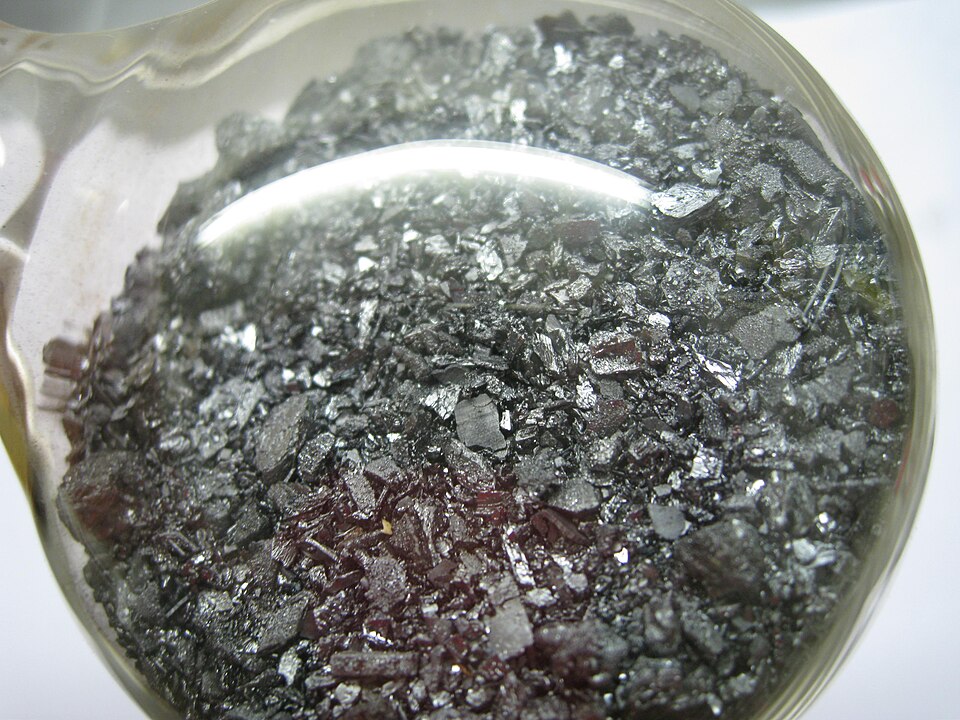 Purple-black solid in a test tube (Image: Dnn87, CC BY 3.0, via Wikimedia Commons)
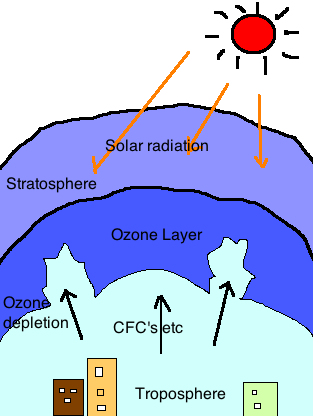 Stratosphere with O₃ breakdown (Image: Mrfoogles, CC BY-SA 4.0, via Wikimedia Commons)
Based on the NEB +2 Science syllabus for Chemistry (Chem), unit 11.
Discussion
Loading…