ChemistryUnit 1310 min read
Phosphorus: Allotropes, Compounds, and Uses
Unit 13 of Chemistry explores phosphorus—its allotropes (white, red, black), key compounds (oxides, acids, salts), extraction from phosphate rock, and industrial applications like fertilizers, matches, and detergents.
TAKEAWAYS:
- Phosphorus exists in three allotropes (white, red, black) with distinct properties and uses.
- Phosphorus oxides (P₄O₆, P₄O₁₀) react with water to form phosphoric and phosphorous acids, crucial in fertilizers and food additives.
- Phosphate rock (Ca₅(PO₄)₃(OH)) is the primary source of phosphorus, processed via the electric furnace method.
- Phosphorus compounds (e.g., PCl₅, Ca₃(PO₄)₂) are used in detergents, matches, and pesticides.
- Environmental impact: Excess phosphorus causes eutrophication (water pollution).
- NEB exam focus: Allotrope properties, reactions of P₄O₁₀, and industrial extraction.
---

### **1. Introduction to Phosphorus**
Phosphorus is a **non-metal** (Group 15, Period 3) that **never occurs free in nature**—it is always found in **compounds**, mainly in **phosphate rocks** (e.g., Ca₅(PO₄)₃(OH)). It is **highly reactive** and forms **three allotropes** (different forms of the same element). Phosphorus is **essential for life** (found in DNA, ATP, and bones) and has **industrial uses** in fertilizers, matches, and detergents.

---

### **2. Allotropes of Phosphorus**
Allotropes are **different structural forms of the same element**. Phosphorus has **three main allotropes**:

```figure
{"type":"cylinder","r":"1.5 cm","h":"2 cm","caption":"Tetrahedral structure of white phosphorus (P₄)"}
A. White Phosphorus (P₄)
- Structure: Tetrahedral (4 P atoms bonded in a pyramid).
- Appearance: Waxy, translucent solid (glows in the dark due to oxidation).
- Reactivity: Highly reactive—ignites spontaneously in air (used in smoke screens and incendiary bombs).
- Toxicity: Poisonous (causes "phossy jaw" in workers).
- Storage: Kept under water to prevent oxidation.
B. Red Phosphorus
- Structure: Polymeric chains (long chains of P atoms).
- Appearance: Reddish-brown powder.
- Reactivity: Less reactive than white phosphorus (does not ignite in air).
- Uses:
- Matchbox strikers (mixed with glass powder).
- Flare pistols (in military applications).
- Semiconductors (in solar cells).
C. Black Phosphorus
- Structure: Layered sheets (like graphite).
- Appearance: Black, metallic luster.
- Reactivity: Least reactive.
- Uses:
- Semiconductor industry (better than silicon in some cases).
- Lubricants (due to its layered structure).
| Allotrope | Structure | Color | Reactivity | Uses |
|---|---|---|---|---|
| White (P₄) | Tetrahedral | Waxy, translucent | Very high | Smoke screens, incendiary bombs |
| Red | Polymeric chains | Reddish-brown | Moderate | Matches, flares |
| Black | Layered sheets | Black, metallic | Low | Semiconductors, lubricants |
3. Extraction of Phosphorus
Phosphorus is extracted from phosphate rock (Ca₅(PO₄)₃(OH)) using the electric furnace method:
Step-by-Step Process
- Mix phosphate rock with sand (SiO₂) and coke (C).
- Heat in an electric furnace (1400–1500°C).
- Reactions:
- Ca₅(PO₄)₃(OH) + 3 SiO₂ → 3 Ca₃(PO₄)₂ + CaSiO₃ (slag)
- Ca₃(PO₄)₂ + 5 C + 3 SiO₂ → 3 CaSiO₃ + 5 CO + 2 P (gaseous)
- Gaseous P₄ is collected and cooled to form white phosphorus.
flowchart TD
    A["Phosphate Rock<br/>Ca₅(PO₄)₃(OH)"] -->|"+ SiO₂, C"| B["Electric Furnace<br/>1400°C"]
    B --> C["Ca₃(PO₄)₂ + CaSiO₃<br/>(slag)"]
    B --> D["5 CO + 2 P₄<br/>(gas)"]
    D --> E["Cool P₄<br/>→ White Phosphorus"]
Why Sand (SiO₂) is Added?
- Removes calcium as calcium silicate (CaSiO₃), preventing reformation of phosphate.
4. Phosphorus Oxides
Phosphorus burns in air to form two oxides:
A. Phosphorus(III) Oxide (P₄O₆)
- Formation: P₄ + 3 O₂ → P₄O₆
- Reaction with water: P₄O₆ + 6 H₂O → 4 H₃PO₃ (phosphorous acid)
- Uses: Rubber industry, food preservatives.
B. Phosphorus(V) Oxide (P₄O₁₀)
- Formation: P₄ + 5 O₂ → P₄O₁₀
- Reaction with water: P₄O₁₀ + 6 H₂O → 4 H₃PO₄ (phosphoric acid)
- Uses:
- Fertilizers (superphosphate).
- Food industry (acidulant in sodas).
- Detergents (as sodium phosphate).
5. Phosphoric and Phosphorous Acids
| Acid | Formula | Formation | Uses |
|---|---|---|---|
| Phosphoric Acid | H₃PO₄ | P₄O₁₀ + 6 H₂O → 4 H₃PO₄ | Fertilizers, sodas, detergents |
| Phosphorous Acid | H₃PO₃ | P₄O₆ + 6 H₂O → 4 H₃PO₃ | Food preservatives, rubber industry |
Properties of Phosphoric Acid (H₃PO₄)
- Triprotic acid (can donate 3 H⁺ ions).
- Weak acid (does not dissociate completely).
- Uses:
- Phosphate fertilizers (e.g., superphosphate).
- Cola drinks (acidulant).
- Cleaning agents.
6. Phosphorus Halides
Phosphorus reacts with halogens (F₂, Cl₂, Br₂) to form phosphorus halides:
| Halide | Formula | Preparation | Uses |
|---|---|---|---|
| Phosphorus Trichloride | PCl₃ | P₄ + 6 Cl₂ → 4 PCl₃ | Organic synthesis, pesticides |
| Phosphorus Pentachloride | PCl₅ | PCl₃ + Cl₂ → PCl₅ | Chlorinating agent, lab reagent |
Reaction of PCl₅ with Water
PCl₅ + 4 H₂O → H₃PO₄ + 5 HCl
- Used to generate HCl gas in labs.
7. Phosphorus in Fertilizers
Phosphorus is a key nutrient for plants (along with N, K). The main phosphorus fertilizers are:
Superphosphate (Ca(H₂PO₄)₂)
- Prepared by treating phosphate rock with sulfuric acid (H₂SO₄).
- Reaction: Ca₃(PO₄)₂ + 2 H₂SO₄ → Ca(H₂PO₄)₂ + 2 CaSO₄
- Advantage: Highly soluble, readily absorbed by plants.
- Disadvantage: Can acidify soil over time.
Basic Slag (Ca₃(PO₄)₂)
- Prepared by heating phosphate rock with silica and coke.
- Advantage: Less acidic than superphosphate.
- Disadvantage: Less soluble, slower release.
8. Environmental Impact of Phosphorus
- Eutrophication: Excess phosphorus in water bodies causes algal blooms, leading to oxygen depletion and fish kills.
- Soil pollution: Overuse of phosphorus fertilizers can reduce soil fertility over time.
- Biological role: Essential for DNA, ATP, and cell membranes.
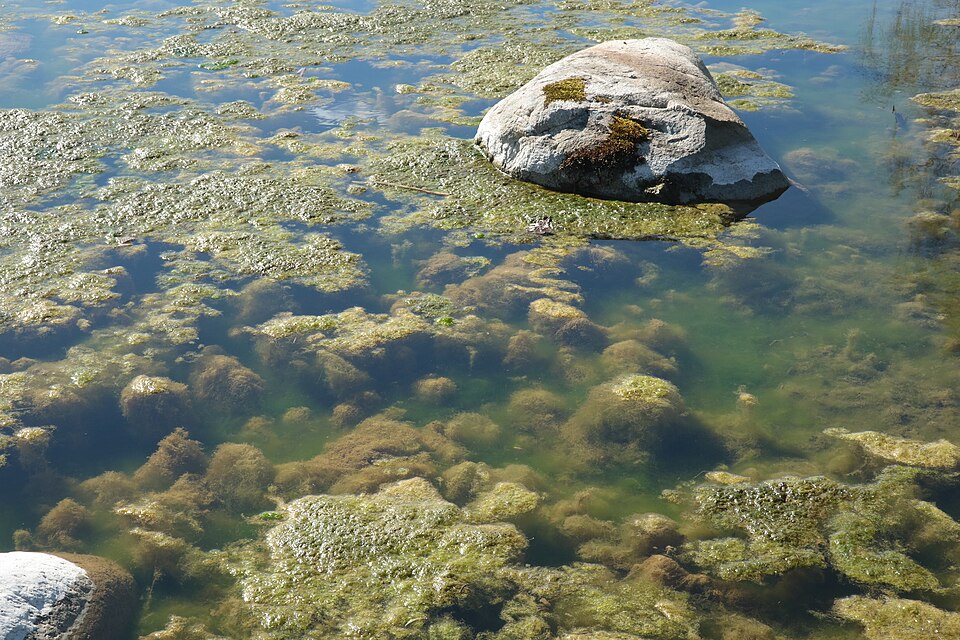 Excess phosphorus causing algal bloom in a lake. (Image: Goran_tek-en, CC BY-SA 4.0, via Wikimedia Commons)
9. Industrial Applications of Phosphorus
| Compound | Use |
|---|---|
| White Phosphorus (P₄) | Smoke screens, incendiary bombs |
| Red Phosphorus | Matchbox strikers, flares |
| Phosphoric Acid (H₃PO₄) | Fertilizers, sodas, detergents |
| Phosphorus Pentachloride (PCl₅) | Chlorinating agent |
| Calcium Phosphate (Ca₃(PO₄)₂) | Bone ash, fertilizers |
Exam Tip: How to Score Full Marks in NEB Exams
Allotropes Comparison:
- Always compare structure, reactivity, and uses of white, red, and black phosphorus.
- Example: "White phosphorus is highly reactive and stored under water, while red phosphorus is used in matchboxes."
Extraction Process:
- Memorize the electric furnace method steps and role of sand (SiO₂).
- Example: "Sand removes calcium as calcium silicate, preventing reformation of phosphate."
Reactions of Phosphorus Oxides:
- Know how P₄O₆ → H₃PO₃ and P₄O₁₀ → H₃PO₄.
- Example: "P₄O₁₀ reacts with water to form phosphoric acid, used in fertilizers."
Fertilizer Preparation:
- Differentiate between superphosphate (H₂SO₄) and basic slag (heat + coke).
- Example: "Superphosphate is prepared by treating phosphate rock with sulfuric acid."
Environmental Impact:
- Always mention eutrophication when discussing phosphorus pollution.
NEB Board-Style Questions (Practice)
Short Answer (3 marks each)
- Describe the structure and uses of white and red phosphorus.
- How is phosphoric acid prepared from phosphorus? Give one use.
- What is eutrophication? How does phosphorus contribute to it?
Long Answer (5 marks)
- Explain the electric furnace method for extracting phosphorus from phosphate rock. Why is sand added in this process?
- Compare P₄O₆ and P₄O₁₀ in terms of:
- Formation
- Reaction with water
- Uses
Numerical (2 marks)
- Calculate the mass of P₄O₁₀ formed when 124 g of phosphorus (P₄) burns completely in excess oxygen. (Atomic mass: P = 31, O = 16)
Solutions to NEB-Style Questions
1. Structure and Uses of White & Red Phosphorus
- White Phosphorus:
- Structure: Tetrahedral (P₄ molecules).
- Uses: Smoke screens, incendiary bombs (highly reactive).
- Red Phosphorus:
- Structure: Polymeric chains.
- Uses: Matchbox strikers, flares (less reactive).
4. Electric Furnace Method
- Steps:
- Mix phosphate rock (Ca₅(PO₄)₃(OH)) + sand (SiO₂) + coke (C).
- Heat in electric furnace (1400–1500°C).
- P₄ gas is collected and cooled to form white phosphorus.
- Role of Sand: Removes calcium as CaSiO₃, preventing reformation of phosphate.
6. Mass of P₄O₁₀ Calculation
- Given: 124 g P₄ → Molar mass of P₄ = 4 × 31 = 124 g/mol.
- Moles of P₄ = 124 g / 124 g/mol = 1 mol.
- Reaction: P₄ + 5 O₂ → P₄O₁₀.
- Moles of P₄O₁₀ = 1 mol (1:1 ratio).
- Molar mass of P₄O₁₀ = 4 × 31 + 10 × 16 = 284 g/mol.
- Mass of P₄O₁₀ = 1 mol × 284 g/mol = 284 g.
Final Notes for NEB Exam
✅ Memorize allotropes (structure, reactivity, uses). ✅ Know extraction steps (electric furnace, role of sand). ✅ Reactions of P₄O₆ and P₄O₁₀ with water. ✅ Fertilizer preparation (superphosphate vs. basic slag). ✅ Environmental impact (eutrophication).
Good luck! 🚀
Based on the NEB +2 Science syllabus for Chemistry (Chem), unit 13.
Discussion
Loading…