MathematicsUnit 219 min read
Derivatives: Definition, Rules, Applications & Graphs
Unit 21 of Mathematics explains how to find derivatives (instantaneous rates of change) using first principles, differentiation rules, and applications in real-world problems like optimization and curve sketching.
TAKEAWAYS:
- Derivatives measure how fast a function changes at any point (slope of the tangent line).
- Basic rules (power, product, quotient, chain) simplify differentiation without using first principles.
- Graphs help visualize where functions increase/decrease, have maxima/minima, or change concavity.
- Applications include finding tangents, rates of change, and optimizing quantities (e.g., profit, area).
- Common mistakes: Forgetting the chain rule for composite functions or misapplying power rules to negative exponents.
1. Introduction to Derivatives
A derivative tells us how fast a quantity changes at a specific point. For example:
- If is the position of a car at time , then is its instantaneous speed.
- If is the profit of a company based on sales , then tells us how profit changes with each additional sale.
1.1 Definition: Derivative as a Limit
The derivative of a function at a point is defined as: This is called the limit definition or first principles.
1.2 Geometric Meaning
The derivative is the slope of the tangent line to the curve at .
1.3 Example: Find for using first principles
Step 1: Write the limit definition: Step 2: Expand and simplify: Step 3: Take the limit:
2. Basic Differentiation Rules
Instead of using first principles every time, we use shortcut rules:
| Rule | Formula | Example |
|---|---|---|
| Power Rule | ||
| Constant Rule | ||
| Constant Multiple | ||
| Sum/Difference | ||
| Product Rule | ||
| Quotient Rule | ||
| Chain Rule |
2.1 Example: Differentiate
Using the power rule and sum rule:
2.2 Example: Differentiate (Product Rule)
Let , . Then: Using the product rule: Simplify:
2.3 Example: Differentiate (Quotient Rule)
Let , . Then: Using the quotient rule:
2.4 Example: Differentiate (Chain Rule)
Let , . Then: Using the chain rule:
3. Derivatives of Common Functions
Here’s a quick reference table:
| Function | Derivative |
|---|---|
4. Applications of Derivatives
Derivatives help solve real-world problems:
4.1 Finding Tangents
Find the equation of the tangent line to at . Step 1: Find . At , slope . Step 2: Point is . Use point-slope form:
4.2 Rates of Change
If is the area of a square at time , find how fast the area changes at . So, the area increases at 8 square units per second at .
4.3 Optimization (Maxima/Minima)
Find the maximum profit if . Step 1: Find . Step 2: Set : Step 3: Check concavity with (negative, so maximum). Maximum profit at :
4.4 Increasing/Decreasing Functions
A function is:
- Increasing where .
- Decreasing where .
For :
- Increasing when or .
- Decreasing when .
5. Higher-Order Derivatives
The second derivative tells us about concavity:
- If , the curve is concave up (like ).
- If , the curve is concave down (like ).
For :
- Concave up when .
- Concave down when .
6. Exam Tips
- Memorize basic rules: Power, product, quotient, and chain rules are frequently tested.
- Practice first principles: Even though rules are faster, NEB sometimes asks for the limit definition.
- Check for critical points: Always set to find maxima/minima.
- Graph interpretation: Sketch the graph and label increasing/decreasing intervals and concavity.
- Units matter: In applied problems, always include units (e.g., "meters per second").
- Common mistakes:
- Forgetting the chain rule for composite functions (e.g., → ).
- Misapplying the quotient rule (denominator must be squared).
- Ignoring domain restrictions (e.g., is undefined at ).
NEB Board-Style Questions
Short Answer (5 marks each)
- Find the derivative of using the quotient rule.
- Differentiate using the product rule and chain rule.
- Find the equation of the tangent line to at .
- Determine where is increasing and decreasing.
- If is the position of a particle, find its velocity at .
Long Answer (10 marks each)
- A company’s profit function is , where is the number of units sold.
- Find the number of units that maximizes profit.
- Calculate the maximum profit.
- Sketch the graph of and label the critical point.
- Differentiate from first principles and simplify.
- For :
- Find and .
- Determine where the function is concave up/down.
- Find all critical points and classify them as maxima/minima.
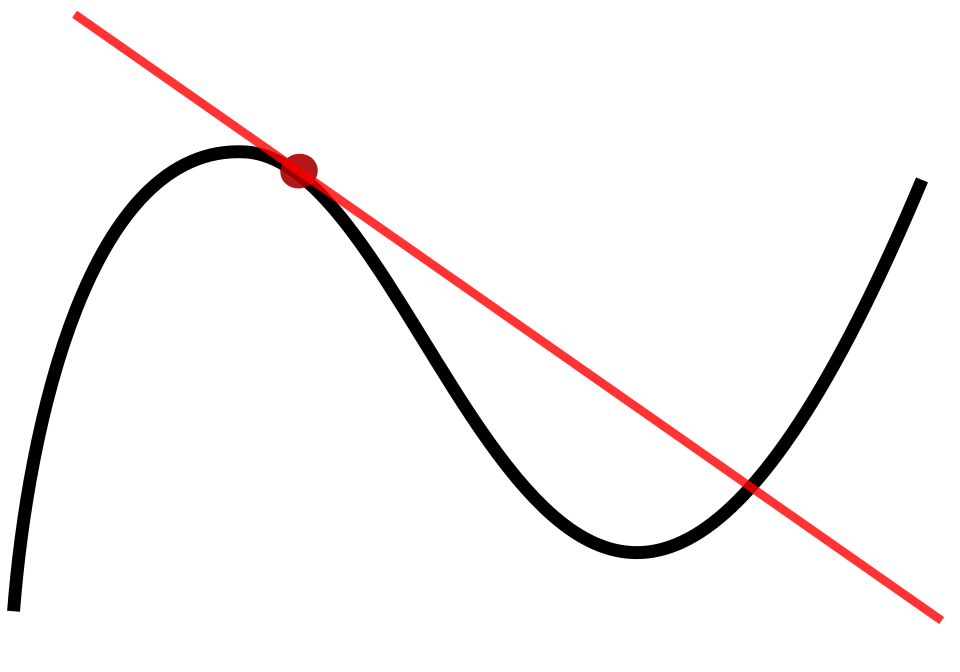 A tangent line touches the curve at exactly one point and has the same slope as the curve there. (Image: Jacj at English Wikipedia / Later versions were uploaded by , Public domain, via Wikimedia Commons)
Based on the NEB +2 Science syllabus for Mathematics (Maths), unit 21.
Discussion
Loading…