PhysicsUnit 1310 min read
Ideal Gas: Laws, PVT Graphs, Kinetic Theory & Applications
Unit 13 of Physics explains the behavior of ideal gases using Boyle’s, Charles’s, Gay-Lussac’s laws, the combined gas law, and the kinetic theory of gases. It covers PVT graphs, real vs. ideal gases, and applications like gas thermometers and the derivation of pressure from molecular collisions.
---

## What is an Ideal Gas?
An **ideal gas** is a theoretical gas that follows these rules perfectly:
1. Its molecules have **no volume** (they are point masses).
2. There are **no forces** between its molecules (except during collisions).
3. The molecules move **randomly** and **collide elastically** (no energy loss).

Real gases (like oxygen, nitrogen, or helium) behave like ideal gases **only at low pressures and high temperatures**.


---

## Gas Laws: How Pressure, Volume, and Temperature Relate

### 1. Boyle’s Law (Pressure-Volume Relationship)
**Statement:**
At **constant temperature**, the **pressure (P)** of a gas is **inversely proportional** to its **volume (V)**.
Mathematically:
\[ P \propto \frac{1}{V} \quad \text{or} \quad P_1 V_1 = P_2 V_2 \]

**Example:**
A gas occupies 2 L at 3 atm. What is its volume at 1 atm (same temperature)?
**Solution:**
\[ P_1 V_1 = P_2 V_2 \]
\[ 3 \, \text{atm} \times 2 \, \text{L} = 1 \, \text{atm} \times V_2 \]
\[ V_2 = 6 \, \text{L} \]

```figure
{"type":"graph","fns":[{"expr":"4/x","label":"P (atm)","color":"blue"},{"expr":"x","label":"V (L)","color":"red"}],"x":[0.5,8],"points":[{"x":2,"y":2,"label":"(2 L, 2 atm)"}],"xlabel":"Volume (L)","ylabel":"Pressure (atm)","caption":"Boyle’s Law: P vs. V (T constant)"}
2. Charles’s Law (Volume-Temperature Relationship)
Statement: At constant pressure, the volume (V) of a gas is directly proportional to its absolute temperature (T) in Kelvin. Mathematically: [ V \propto T \quad \text{or} \quad \frac{V_1}{T_1} = \frac{V_2}{T_2} ]
Example: A gas at 27°C (300 K) occupies 500 mL. What is its volume at 127°C (400 K)? Solution: [ \frac{V_1}{T_1} = \frac{V_2}{T_2} ] [ \frac{500 , \text{mL}}{300 , \text{K}} = \frac{V_2}{400 , \text{K}} ] [ V_2 = 666.67 , \text{mL} ]
3. Gay-Lussac’s Law (Pressure-Temperature Relationship)
Statement: At constant volume, the pressure (P) of a gas is directly proportional to its absolute temperature (T). Mathematically: [ P \propto T \quad \text{or} \quad \frac{P_1}{T_1} = \frac{P_2}{T_2} ]
Example: A gas at 25°C (298 K) has a pressure of 1.5 atm. What is its pressure at 125°C (400 K)? Solution: [ \frac{P_1}{T_1} = \frac{P_2}{T_2} ] [ \frac{1.5 , \text{atm}}{298 , \text{K}} = \frac{P_2}{400 , \text{K}} ] [ P_2 = 2 , \text{atm} ]
4. Combined Gas Law
If pressure, volume, and temperature all change, we combine the three laws: [ \frac{P_1 V_1}{T_1} = \frac{P_2 V_2}{T_2} ]
Example: A gas at 1 atm, 300 K, and 2 L is compressed to 0.5 L and heated to 600 K. What is the new pressure? Solution: [ \frac{1 \times 2}{300} = \frac{P_2 \times 0.5}{600} ] [ P_2 = 8 , \text{atm} ]
Kinetic Theory of Gases
This theory explains why gas laws work by studying the motion of gas molecules.
Key Assumptions:
- Gases are made of tiny particles in constant random motion.
- Collisions between molecules and the container walls are elastic (no energy loss).
- The average kinetic energy of gas molecules depends only on temperature.
Derivation of Pressure:
Pressure arises from molecular collisions with the container walls. The pressure (P) of an ideal gas is given by: [ P = \frac{1}{3} \frac{N}{V} m \overline{v^2} ] Where:
- ( N ) = number of molecules
- ( V ) = volume
- ( m ) = mass of one molecule
- ( \overline{v^2} ) = mean square speed of molecules
Example: If a gas has ( N = 10^{23} ) molecules, each with mass ( 10^{-26} , \text{kg} ), moving at an average speed of ( 500 , \text{m/s} ) in a 1 m³ container, what is the pressure? Solution: [ P = \frac{1}{3} \times \frac{10^{23}}{1} \times 10^{-26} \times (500)^2 ] [ P = 8.33 \times 10^3 , \text{Pa} ]
Ideal Gas Equation (Universal Gas Law)
Combining Boyle’s, Charles’s, and Avogadro’s laws gives the ideal gas equation: [ PV = nRT ] Where:
- ( P ) = pressure (Pa or atm)
- ( V ) = volume (m³ or L)
- ( n ) = number of moles
- ( R ) = universal gas constant (( 8.314 , \text{J/(mol·K)} ) or ( 0.0821 , \text{L·atm/(mol·K)} ))
- ( T ) = absolute temperature (K)
Example: How many moles of gas occupy 22.4 L at STP (1 atm, 273 K)? Solution: [ PV = nRT ] [ 1 \times 22.4 = n \times 0.0821 \times 273 ] [ n = 1 , \text{mole} ]
PVT Graphs (Pressure-Volume-Temperature Diagrams)
These graphs show how P, V, and T change together for a gas.
Types of PVT Graphs:
Isobaric Process (Constant Pressure):
- Volume changes with temperature.
- Example: Heating a gas in a piston with a fixed weight.
Isochoric Process (Constant Volume):
- Pressure changes with temperature.
- Example: Heating a gas in a sealed rigid container.
Isothermal Process (Constant Temperature):
- Pressure and volume are inversely related.
- Example: Compressing a gas slowly to keep temperature constant.
Adiabatic Process (No Heat Exchange):
- ( PV^\gamma = \text{constant} ), where ( \gamma = \frac{C_p}{C_v} ).
flowchart LR
    A["Isobaric\n(P constant)"] -->|"V ∝ T"| B["Charles's Law"]
    C["Isochoric\n(V constant)"] -->|"P ∝ T"| D["Gay-Lussac's Law"]
    E["Isothermal\n(T constant)"] -->|"P ∝ 1/V"| F["Boyle's Law"]
    G["Adiabatic\n(Q = 0)"] -->|"PV^γ = const"| H["No Heat Exchange"]
Real Gases vs. Ideal Gases
| Feature | Ideal Gas | Real Gas |
|---|---|---|
| Molecule Size | Point masses (no volume) | Have finite volume |
| Intermolecular Forces | None | Attractive/repulsive forces exist |
| Behavior | Follows perfectly | Deviates at high P, low T |
| Examples | Theoretical model | O₂, N₂, CO₂, H₂O vapor |
When do real gases behave like ideal gases?
- At low pressures (molecules far apart).
- At high temperatures (molecular motion dominates forces).
Van der Waals Equation (for real gases): Where:
- = measures attraction between molecules.
- = volume excluded by a mole of molecules.
Applications of Ideal Gas Laws
Gas Thermometers:
- Use the constant-volume gas thermometer to measure temperature accurately.
- Based on Gay-Lussac’s Law ().
Balloon and Aircraft Design:
- Hot air balloons rise because heating air increases its volume (Charles’s Law), reducing density.
Car Engines:
- The Otto cycle (in petrol engines) uses adiabatic and isochoric processes.
SCUBA Diving:
- Divers must account for Boyle’s Law to avoid "the bends" (nitrogen bubbles forming in blood due to pressure changes).
Weather Prediction:
- Changes in atmospheric pressure (due to temperature and volume changes) help forecast weather.
Solved Problems (NEB-Style)
Problem 1:
A gas at 27°C and 1 atm occupies 4 L. What is its volume at –3°C and 0.5 atm? Solution: Convert temperatures to Kelvin:
Use the combined gas law:
Problem 2:
A cylinder contains 2 moles of an ideal gas at 300 K and 2 atm. What is its volume? Solution: Use the ideal gas equation:
Problem 3:
A gas expands from 1 L to 3 L at constant temperature. If the initial pressure is 4 atm, what is the final pressure? Solution: Use Boyle’s Law:
Common Mistakes to Avoid
Forgetting to convert Celsius to Kelvin:
- Always use .
Mixing up direct and inverse proportions:
- Boyle’s Law is inverse ().
- Charles’s and Gay-Lussac’s Laws are direct (, ).
Ignoring units:
- Ensure pressure is in atm or Pa, volume in L or m³, and temperature in K.
Assuming real gases are ideal:
- Only use for ideal gases or at low P/high T.
Exam Tip: How to Score Full Marks
Always write the gas law equation before solving numerical problems.
- Example: For a problem involving pressure and volume, start with .
Show all steps clearly:
- NEB examiners reward step-by-step solutions. Never jump to the final answer.
Label units properly:
- Write units for every quantity (e.g., , ).
Draw PV diagrams for conceptual questions:
- If asked about isothermal or adiabatic processes, sketch the graph.
Memorize key values:
- STP: , .
- Molar volume at STP: .
- Universal gas constant: or .
Practice numerical problems:
- The NEB exam often includes 3-4 numerical questions from this unit. Solve at least 10 past papers.
Explain real-world applications:
- Questions may ask how gas laws apply to balloons, engines, or diving. Be ready to connect theory to real life.
Summary Table: Gas Laws at a Glance
| Law | Conditions | Equation | Graph Type |
|---|---|---|---|
| Boyle’s Law | Constant T | P vs. V (hyperbola) | |
| Charles’s Law | Constant P | V vs. T (straight line) | |
| Gay-Lussac’s Law | Constant V | P vs. T (straight line) | |
| Combined Gas Law | Varies | PVT diagram | |
| Ideal Gas Law | Any conditions | None |
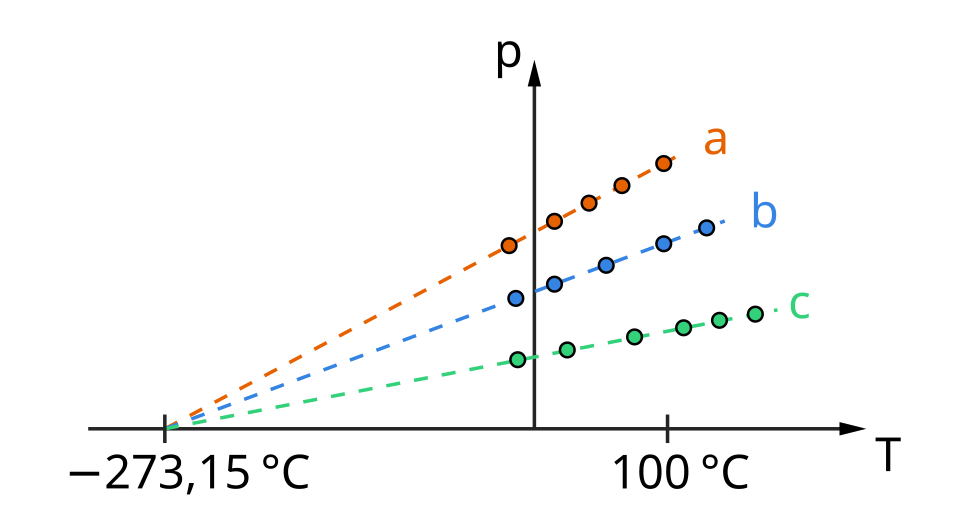 Illustrates how a constant-volume gas thermometer works. (Image: MikeRun, CC BY-SA 4.0, via Wikimedia Commons)
Based on the NEB +2 Science syllabus for Physics (Phy), unit 13.
Discussion
Loading…