PhysicsUnit 106 min read
Thermal Expansion: Solids, Liquids, Gases & Applications
Unit 10 of Physics explains why objects expand when heated—how solids, liquids, and gases change size with temperature, their formulas, real-world uses, and how to solve problems step-by-step.
TAKEAWAYS:
- Thermal expansion means objects grow bigger when heated and shrink when cooled.
- Solids expand linearly (length) or volumetrically (volume), with coefficients α (linear) and γ (volume).
- Liquids expand only in volume, measured by γ, and their expansion depends on the container.
- Gases expand freely, following Charles’s Law (V ∝ T at constant pressure).
- Applications include bridges, railway tracks, thermostats, and liquid-in-glass thermometers.
- Problems use the formula ΔL = αL₀ΔT, ΔV = γV₀ΔT, or V/T = constant for gases.
1. What is Thermal Expansion?
When an object is heated, its particles gain kinetic energy and move faster. This increased motion pushes particles apart, making the object expand. Conversely, cooling makes it contract.
Key Idea:
- Linear expansion = change in length (ΔL).
- Area expansion = change in surface area (ΔA).
- Volume expansion = change in volume (ΔV).
2. Thermal Expansion in Solids
Solids expand in all three dimensions when heated. The change depends on:
- Original length (L₀) or volume (V₀).
- Temperature change (ΔT).
- Material property: Coefficient of linear expansion (α) or volume expansion (γ).
Formulas:
Linear Expansion:
- ΔL = change in length (m)
- α = coefficient of linear expansion (K⁻¹ or °C⁻¹)
- L₀ = original length (m)
- ΔT = temperature change (K or °C)
Area Expansion: (Area expansion is twice the linear expansion.)
Volume Expansion:
- γ = coefficient of volume expansion (K⁻¹ or °C⁻¹)
- V₀ = original volume (m³)
Example 1: Railway Track Expansion
A steel railway track is 100 m long at 20°C. If the temperature rises to 40°C, how much does it expand? (Given: α for steel = 12 × 10⁻⁶ K⁻¹)
Solution:
- ΔT = 40°C − 20°C = 20°C
- ΔL = αL₀ΔT = (12 × 10⁻⁶)(100)(20) = 0.024 m = 2.4 cm
Answer: The track expands by 2.4 cm.
3. Thermal Expansion in Liquids
Liquids only expand in volume (no fixed shape). Their expansion depends on:
- The liquid’s coefficient of volume expansion (γ).
- The container’s expansion (since liquids take the container’s shape).
Apparent vs. Real Expansion:
- Real expansion (γ): Expansion if the container did not expand.
- Apparent expansion (γ_app): Observed expansion because the container also expands.
Formula:
Example 2: Mercury Thermometer
A mercury thermometer has a bulb volume of 0.5 cm³ at 0°C. If γ for mercury = 182 × 10⁻⁶ K⁻¹, how much does it expand when heated to 100°C?
Solution:
- ΔT = 100°C − 0°C = 100°C
- ΔV = γV₀ΔT = (182 × 10⁻⁶)(0.5)(100) = 0.0091 cm³
Answer: Mercury expands by 0.0091 cm³.
4. Thermal Expansion in Gases
Gases expand freely in all directions. Their behavior follows Charles’s Law (at constant pressure):
- V = volume (m³)
- T = temperature in Kelvin (K) (not °C!)
Example 3: Balloon in a Hot Air Balloon
A gas balloon has a volume of 500 L at 300 K. If heated to 350 K, what is its new volume?
Solution:
Answer: The balloon expands to 583.33 L.
flowchart TD
    A["Gas Heated"] -->|"Volume Increases"| B["Charles's Law: V ∝ T"]
    B --> C["If P is constant, V/T = constant"]
    C --> D["Example: Balloon expands"]
5. Applications of Thermal Expansion
| Application | How It Works | Example |
|---|---|---|
| Bimetallic Strip | Two metals with different α expand at different rates, causing bending. | Electric iron, thermostats. |
| Railway Tracks | Gaps (expansion joints) prevent buckling. | Steel tracks with space between rails. |
| Liquid-in-Glass Thermometer | Liquid (mercury/alcohol) expands in a thin tube. | Clinical thermometers. |
| Bridges | Expansion joints allow movement. | Suspension bridges. |
| Glass Stopper in Bottles | Glass expands less than liquid, creating a vacuum seal. | Medicine bottles. |
6. Problems and Solutions
Problem 1 (NEB-style):
A brass rod is 2 m long at 20°C. If heated to 120°C, how much does it expand? (α for brass = 19 × 10⁻⁶ K⁻¹)
Solution:
- ΔT = 120°C − 20°C = 100°C
- ΔL = αL₀ΔT = (19 × 10⁻⁶)(2)(100) = 0.0038 m = 3.8 mm
Answer: 3.8 mm
Problem 2 (NEB-style):
A mercury thermometer reads 0°C when the bulb volume is 0.1 cm³. At 100°C, the volume is 0.1091 cm³. Find γ for mercury.
Solution:
- ΔV = 0.1091 − 0.1 = 0.0091 cm³
- γ = ΔV / (V₀ΔT) = 0.0091 / (0.1 × 100) = 0.00091 K⁻¹ = 910 × 10⁻⁶ K⁻¹
Answer: γ = 910 × 10⁻⁶ K⁻¹
Exam Tip
Memorize formulas:
- ΔL = αL₀ΔT
- ΔV = γV₀ΔT (γ = 3α for solids)
- V₁/T₁ = V₂/T₂ (gases)
Units matter!
- Always use Kelvin (K) for gas problems.
- ΔT in °C or K works the same (since it’s a difference).
Real vs. apparent expansion:
- For liquids, subtract the container’s expansion if asked.
Common mistakes:
- Forgetting to convert °C to K for gases.
- Using α instead of γ for volume problems.
NEB loves:
- Railway track/bridge expansion.
- Thermometer problems (mercury/alcohol).
- Bimetallic strip applications.
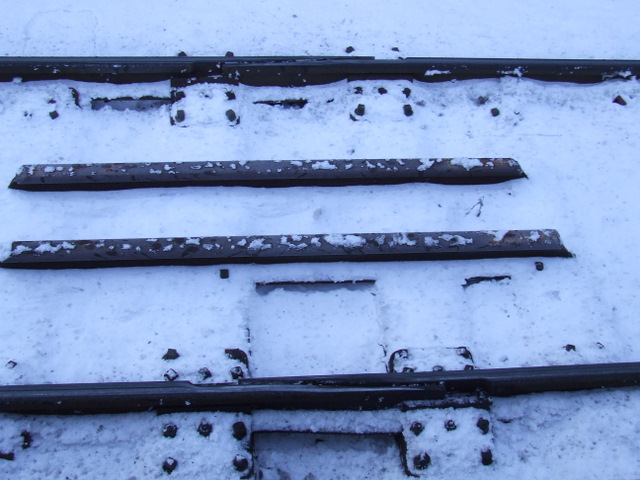 Gaps in railway tracks prevent buckling due to thermal expansion. (Image: Thomas Nugent, CC BY-SA 2.0, via Wikimedia Commons)
Based on the NEB +2 Science syllabus for Physics (Phy), unit 10.
Discussion
Loading…