ChemistryUnit 1111 min read
Phenols: Structure, Properties, Reactions & Uses
Unit 11 of Chemistry explores phenols—hydroxybenzene derivatives—covering their structure, acidity, reactions (electrophilic substitution, oxidation, coupling), preparation methods, and industrial applications like disinfectants and pharmaceuticals, with solved examples and NEB-style questions.
What are Phenols?
Phenols are organic compounds containing a hydroxyl group (–OH) directly attached to an aromatic benzene ring. They are represented by the general formula C₆H₅OH (for the simplest phenol) or Ar–OH (where Ar = aryl group).
Structure of Phenols
The hydroxyl group is bonded directly to the benzene ring, not through a carbon chain. This makes phenols more reactive than alcohols but less acidic than carboxylic acids.
graph LR
    A["Benzene Ring (C6H5)"] --> B["Hydroxyl Group (OH)"]
    B -->|"Direct Bond"| C["Phenol (C6H5OH)"]
Key Features:
- The benzene ring is planar and stable.
- The –OH group is attached to sp²-hybridized carbon (not sp³ like in alcohols).
- The lone pair of electrons on oxygen participates in resonance with the benzene ring, increasing electron density at ortho and para positions.
Physical Properties of Phenols
Phenols are white crystalline solids (except some substituted phenols) with a distinctive smell (like carbolic soap). Their properties depend on the –OH group and benzene ring.
| Property | Details |
|---|---|
| Melting Point | Higher than alcohols of similar mass (due to hydrogen bonding). |
| Solubility | Soluble in organic solvents (ethanol, ether) and slightly soluble in water (due to H-bonding). |
| Boiling Point | Higher than hydrocarbons but lower than carboxylic acids (intermediate H-bonding). |
| Acidity | Weakly acidic (pKa ~10) due to resonance stabilization of phenoxide ion. |
Preparation of Phenols
1. From Chlorobenzene (Dow’s Process)
- Reagent: Sodium hydroxide (NaOH) at high temperature (623 K) and pressure (300 atm).
- Reaction:
C₆H₅Cl + NaOH → C₆H₅ONa + HCl C₆H₅ONa + HCl → C₆H₅OH + NaCl - Conditions: High temperature and pressure favor nucleophilic substitution (SN2).
2. From Diazonium Salts (Hydrolysis)
- Reagent: Water or dilute acid (H₃O⁺) at low temperature (273–283 K).
- Reaction:
C₆H₅N₂⁺Cl⁻ + H₂O → C₆H₅OH + N₂ + HCl - Used in: Industrial synthesis of phenols from aniline.
3. From Cumene (Hock Process – Industrial Method)
- Steps:
- Oxidation of cumene (isopropylbenzene) with O₂ → cumene hydroperoxide.
- Acid-catalyzed rearrangement → phenol + acetone.
- Equation:
(CH₃)₂CH–C₆H₅ + O₂ → (CH₃)₂C(OH)–C₆H₅ → C₆H₅OH + (CH₃)₂CO
- Advantage: Produces two valuable products (phenol and acetone).
Chemical Properties of Phenols
Phenols undergo electrophilic aromatic substitution (EAS) and oxidation reactions due to the activating effect of –OH group.
1. Acidity of Phenols
- Phenols are more acidic than alcohols but less acidic than carboxylic acids.
- Reason: The phenoxide ion (C₆H₅O⁻) is stabilized by resonance (negative charge delocalized over benzene ring).
- pKa Values:
- Phenol: ~10
- Ethanol: ~16
- Carboxylic acid: ~4–5
Example:
C₆H₅OH + Na → C₆H₅ONa + ½H₂ (Phenol reacts with sodium to give hydrogen gas)
2. Electrophilic Aromatic Substitution (EAS)
The –OH group is strongly activating and ortho/para directing due to:
- +M effect (mesomeric effect): Increases electron density at ortho and para positions.
- –I effect (inductive effect): Weakly withdraws electrons (but resonance dominates).
a) Bromination (No Catalyst Needed!)
- Phenol reacts with Br₂ water to give 2,4,6-tribromophenol (white precipitate).
- Reaction:
C₆H₅OH + 3Br₂ → C₆H₂Br₃OH + 3HBr - Test for Phenols: If a white precipitate forms with Br₂ water, the compound is likely a phenol.
b) Nitration (Dilute HNO₃)
- Gives ortho and para nitrophenols (mix of products).
- Reaction:
C₆H₅OH + HNO₃ → o-nitrophenol + p-nitrophenol
c) Sulfonation (Fuming H₂SO₄)
- Gives p-hydroxybenzenesulfonic acid (para product dominates).
3. Oxidation Reactions
Phenols are easily oxidized to quinones (colored compounds).
- Example: Oxidation with Na₂Cr₂O₇/H₂SO₄ or KMnO₄ gives p-benzoquinone.
- Reaction:
C₆H₅OH + [O] → C₆H₄O₂ (quinone) + H₂O - Application: Used in dyes and antiseptics.
4. Reimer-Tiemann Reaction (Formylation)
- Phenol reacts with chloroform (CHCl₃) and NaOH to give salicylaldehyde (ortho-hydroxybenzaldehyde).
- Reaction:
C₆H₅OH + CHCl₃ + 3NaOH → o-HOC₆H₄CHO + 3NaCl + 2H₂O
- Mechanism: Involves dichlorocarbene (:CCl₂) as an electrophile.
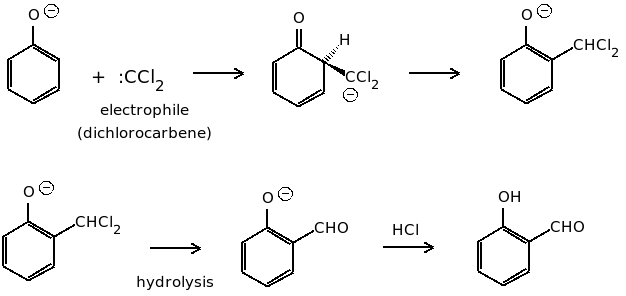 Formation of salicylaldehyde from phenol (Image: CC BY-SA 3.0, via Wikimedia Commons)
5. Coupling Reactions (Azo Dye Formation)
- Phenol reacts with diazonium salts to form azo dyes (colored compounds).
- Example:
C₆H₅OH + C₆H₅N₂⁺Cl⁻ → p-HOC₆H₄N=NC₆H₅ (p-hydroxyazobenzene, orange dye) - Application: Used in textile dyes and food coloring.
Uses of Phenols
| Application | Example Compounds | Why? |
|---|---|---|
| Disinfectants & Antiseptics | Phenol (carbolic acid), Cresol | Kills bacteria (used in soaps, Listerine). |
| Pharmaceuticals | Aspirin (from salicylic acid), Paracetamol | Analgesic and anti-inflammatory. |
| Pesticides | Pentachlorophenol | Fungicide and wood preservative. |
| Plastics & Polymers | Phenol-formaldehyde resin (Bakelite) | Heat-resistant plastic. |
| Dyes & Indicators | Phenolphthalein (pH indicator) | Color change in basic medium. |
| Perfumes & Flavors | Thymol (in mouthwash), Eugenol (clove oil) | Aromatic properties. |
Comparison: Phenols vs. Alcohols vs. Carboxylic Acids
| Property | Phenols (Ar–OH) | Alcohols (R–OH) | Carboxylic Acids (R–COOH) |
|---|---|---|---|
| Acidity (pKa) | ~10 (weak acid) | ~16 (very weak) | ~4–5 (strong acid) |
| Reactivity | High (EAS, oxidation) | Moderate (oxidation to aldehydes/ketones) | High (nucleophilic acyl substitution) |
| Solubility | Slightly soluble in water | Miscible in water | Highly soluble in water |
| Test with Na | Gives H₂ gas | Gives H₂ gas | No reaction |
| Test with Br₂ | White ppt (2,4,6-tribromophenol) | No reaction (unless allylic/benzylic) | No reaction |
Solved Examples
Example 1: Identifying a Phenol
Question: A compound X gives a white precipitate with Br₂ water and reacts with Na to evolve H₂. What is X? Solution:
- White ppt with Br₂ → Phenol or enol.
- Reacts with Na → Alcohol or phenol.
- Conclusion: X is a phenol (most likely C₆H₅OH).
Example 2: Reimer-Tiemann Reaction
Question: What is the product when phenol is treated with CHCl₃ and NaOH? Solution:
- Reimer-Tiemann reaction introduces –CHO at ortho position.
- Product: Salicylaldehyde (o-hydroxybenzaldehyde).
Example 3: Acidity Comparison
Question: Arrange in order of increasing acidity: Phenol, Ethanol, Benzoic Acid. Solution:
- Ethanol (pKa ~16) < Phenol (pKa ~10) < Benzoic Acid (pKa ~4).
- Reason: Stability of conjugate base (resonance in phenoxide > carboxylate).
NEB Board-Style Questions
Short Answer Questions (2–5 marks)
Why is phenol more acidic than ethanol but less acidic than carboxylic acids?
- Answer: Phenol’s conjugate base (phenoxide ion) is stabilized by resonance, making it more acidic than ethanol. However, carboxylic acids have two resonance structures and a more stable carboxylate ion, making them stronger acids.
Write the reaction of phenol with bromine water. What is its use in identification?
- Answer:
C₆H₅OH + 3Br₂ → C₆H₂Br₃OH (white ppt) + 3HBr - Use: Confirms the presence of phenol (white ppt test).
- Answer:
What is the Reimer-Tiemann reaction? Give one application.
- Answer: Phenol reacts with CHCl₃ and NaOH to form salicylaldehyde (ortho-hydroxybenzaldehyde).
- Application: Used in synthesis of aspirin.
Long Answer Questions (10–15 marks)
Describe the preparation of phenol from cumene. Explain the mechanism of its reaction with bromine water.
- Answer:
- Preparation:
- Cumene + O₂ → Cumene hydroperoxide.
- Acid-catalyzed rearrangement → Phenol + Acetone.
- Mechanism with Br₂:
- –OH group activates benzene ring (ortho/para directing).
- Br₂ polarizes in presence of phenol, leading to electrophilic substitution at ortho/para positions.
- Final product: 2,4,6-tribromophenol (white ppt).
- Preparation:
- Answer:
How do phenols differ from alcohols in terms of acidity and reactivity? Give chemical tests to distinguish them.
- Answer:
Property Phenols Alcohols Acidity More acidic (pKa ~10) Less acidic (pKa ~16) Reactivity Undergoes EAS, oxidation to quinones Oxidation to aldehydes/ketones Test with Br₂ White ppt (2,4,6-tribromophenol) No reaction (unless allylic) Test with FeCl₃ Purple/violet color No color change
- Answer:
Exam Tip
✅ Key Points for NEB Exam:
- Structure: Remember –OH directly attached to benzene ring (not through a carbon chain).
- Acidity: Phenol is more acidic than alcohols due to resonance stabilization.
- Bromination Test: White ppt with Br₂ water is a must-know test for phenols.
- Reimer-Tiemann Reaction: Always gives ortho product (salicylaldehyde).
- Uses: Phenol is used in disinfectants, dyes, and plastics (Bakelite).
- Comparison: Know how phenols differ from alcohols and carboxylic acids in acidity and reactions.
❌ Common Mistakes to Avoid:
- Confusing phenols with alcohols (e.g., thinking both give white ppt with Br₂).
- Forgetting that phenol is ortho/para directing in EAS.
- Not remembering that phenol is weakly acidic (does not react with Na₂CO₃ but reacts with Na).
Good luck with your NEB exam! Practice drawing mechanisms and remembering key reactions. 🚀
Based on the NEB +2 Science syllabus for Chemistry (Chem), unit 11.
Discussion
Loading…