Life Skill EducationUnit 310 min read
Decision Making & Problem Solving: Models, Steps & Real-Life Skills
Unit 3 of Life Skill Education explains how to make smart choices and solve problems using clear steps, tools, and strategies—essential for school, career, and daily life.
TAKEAWAYS:
- Decision making is a step-by-step process (identify → explore → choose → act → review) that anyone can learn.
- Problem solving uses techniques like brainstorming, SWOT analysis, and the 5 Whys to find root causes.
- Decision-making models (e.g., rational, intuitive, satisficing) help pick the best approach for different situations.
- Barriers (fear, bias, lack of info) can ruin choices—learn to spot and overcome them.
- Ethics and values must guide decisions to avoid harm or unfairness.
- Practice with real-life scenarios (e.g., career, health, conflicts) builds confidence for exams and life.
What Is Decision Making?
Decision making is choosing the best option from available alternatives to solve a problem or reach a goal. It’s not just about picking randomly—it’s a skill you can improve.
Key Parts of Decision Making
Problem Identification
- Ask: What exactly is the issue?
- Example: "I keep failing my exams because I don’t study on time."
- Visual:
flowchart TD
  A["Problem"] --> B["Is it clear?"]
  B -->|"Yes"| C["Define it"]
  B -->|"No"| D["Ask: Why? How?"]
  C --> E["Move to next step"]
Gathering Information
- Collect facts, opinions, and data.
- Example: "I check my past exam papers to see where I lost marks."
Weighing Options
- List pros and cons of each choice.
- Example:
Option Pros Cons Study at home Quiet, no distractions Hard to focus Library Structured time, fewer distractions Fixed hours, crowded
Making the Choice
- Use a model (see below) to decide.
- Example: "I’ll study at the library for 2 hours daily."
Taking Action
- Put the plan into action.
- Example: "I set a timer and stick to the schedule."
Reviewing the Outcome
- Did it work? If not, adjust.
- Example: "If I still fail, I’ll try a study group."
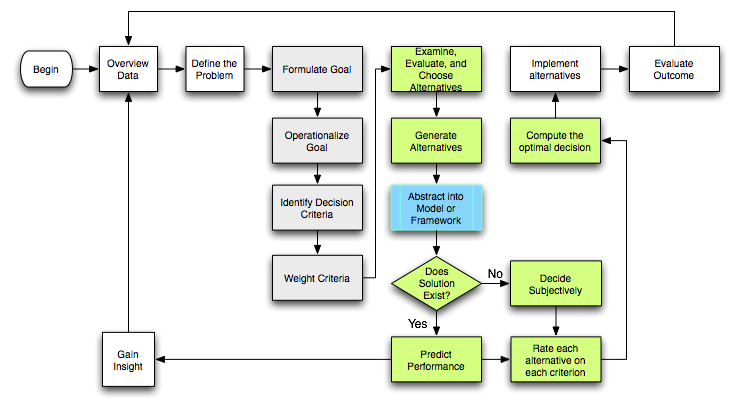 Steps to make a smart choice (Image: DavidLevinson, CC BY-SA 3.0, via Wikimedia Commons)
Decision-Making Models
Different situations need different approaches. Here are 3 common models:
1. Rational Model (Step-by-Step)
- How it works: Logical, fact-based, no emotions.
- Steps:
- Define the problem.
- List all possible solutions.
- Evaluate each (pros/cons).
- Pick the best one.
- Act and review.
- Best for: Important choices (e.g., career, health).
- Example:
- Problem: "Should I join college in Kathmandu or Pokhara?"
- Solution:
- Option 1: Kathmandu → More job options, but expensive.
- Option 2: Pokhara → Cheaper, but fewer opportunities.
- Choice: "I’ll go to Pokhara and look for part-time jobs."
2. Intuitive Model (Gut Feeling)
- How it works: Rely on experience and instincts.
- When to use: Quick decisions (e.g., avoiding a risky friend).
- Example:
- "My friend suggests skipping class to watch a movie. My gut says ‘no’—I trust it."
3. Satisficing Model (Good Enough)
- How it works: Pick the first acceptable option (not necessarily the best).
- When to use: When time is limited (e.g., buying groceries).
- Example:
- "I need a notebook. The first one I see that fits my budget is good enough."
TABLE: Decision-Making Models Compared
| Model | Best For | Speed | Emotion Involved? | Example |
|---|---|---|---|---|
| Rational | Big life choices | Slow | No | Choosing a career |
| Intuitive | Quick judgments | Fast | Yes | Trusting a friend’s advice |
| Satisficing | Everyday tasks | Fast | Sometimes | Buying a snack |
What Is Problem Solving?
Problem solving is finding a solution to a challenge. It’s different from decision making because:
- Decision making = choosing between options.
- Problem solving = figuring out how to fix something.
Steps to Solve Problems
Define the Problem
- Ask: "What exactly is wrong?"
- Example: "My phone battery drains too fast."
Find the Root Cause
- Use tools like:
- 5 Whys: Ask "Why?" 5 times to find the real issue.
- Example:
- Why? → "Battery drains fast."
- Why? → "Too many apps open."
- Why? → "I don’t close background apps."
- Solution: "Turn off unused apps."
- Example:
- SWOT Analysis: Strengths, Weaknesses, Opportunities, Threats.
- Example:
S (Strengths) W (Weaknesses) Good study habits Procrastinate O (Opportunities) T (Threats) Scholarship available Distractions at home
- Example:
- 5 Whys: Ask "Why?" 5 times to find the real issue.
- Use tools like:
Brainstorm Solutions
- List all possible fixes, even silly ones.
- Example for "I’m always late":
- Set 2 alarms.
- Leave earlier.
- Use a planner.
Pick the Best Solution
- Test which one works best.
- Example: "I’ll try leaving 15 minutes early for a week."
Implement and Check
- Did it work? If not, try another solution.
Common Barriers to Good Decisions
Even smart people make bad choices because of:
- Fear of Failure
- "What if I try and fail?"
- Fix: Remember—failure teaches you.
Bias (Prejudice)
- Favoring one option because of personal feelings.
- Example: "I’ll only study what I like, not what’s important."
Lack of Information
- Not knowing all the facts.
- Fix: Research before deciding.
Peer Pressure
- Doing what friends say, not what’s best for you.
- Example: "Everyone smokes, so I’ll try it."
Overconfidence
- Thinking "I don’t need to plan—I’ll figure it out."
- Fix: Always have a backup plan.
Ethics in Decision Making
Some decisions affect others. Ask:
- Is it fair?
- Is it honest?
- Does it help or harm someone?
Example:
- Situation: "My friend copied my homework. Should I tell the teacher?"
- Ethical Choice: "Yes, because it’s unfair to others."
- Unethical Choice: "No, because I don’t want to get in trouble."
Real-Life Examples
Example 1: Career Choice
- Problem: "Should I study medicine or engineering?"
- Steps:
- Research: Talk to professionals, check job markets.
- Pros/Cons:
Medicine Engineering Helps people High salary Long hours More job options - Decision: "I’ll try both fields in college and decide later."
Example 2: Handling Conflict
- Problem: "My friend and I keep arguing over study plans."
- Solution:
- Listen to both sides.
- Compromise: "Let’s study together but take breaks separately."
- Review: "Does this work better?"
NEB Exam Tips
Understand the Difference
- Decision making = Choosing between options.
- Problem solving = Fixing an issue.
- Exam question: "Distinguish between decision making and problem solving." → Use the table above!
Practice Step-by-Step Answers
- For short questions, write all steps (e.g., 5 Whys, SWOT).
- Example:
"How would you solve the problem of ‘not having enough time to study’?" Answer:
- Problem: "I waste time on social media."
- 5 Whys:
- Why? → "I scroll mindlessly."
- Why? → "No study schedule."
- Solution: "Use a timer app to block social media."
Watch for Barriers
- Questions may ask: "What are the barriers to good decision making?"
- Answer: Fear, bias, lack of info, peer pressure, overconfidence.
Ethics Questions
- If a scenario is given, always ask:
- Is it fair?
- Is it honest?
- Example:
"Your friend asks you to lie to the teacher. What will you do?" Answer: "I’ll refuse because lying is unethical and can harm others."
- If a scenario is given, always ask:
Use Diagrams in Long Answers
- Draw flowcharts (like the decision-making steps) to score extra marks.
Quick Revision Checklist
✅ Can you list the 6 steps of decision making? ✅ Do you know the 3 decision-making models (rational, intuitive, satisficing)? ✅ Can you apply the 5 Whys to a real problem? ✅ What are 5 barriers to good decisions? ✅ How do you make an ethical choice?
Final Thought: "Every big success starts with a small, smart decision. Practice these skills now, and you’ll handle life’s challenges like a pro!" 🚀
Based on the NEB +2 Science syllabus for Life Skill Education (LSE), unit 3.
Discussion
Loading…