MathematicsUnit 159 min read
Definite Integrals & Area: Calculating Areas Under Curves & Between Functions
Unit 15 of Mathematics teaches how to compute exact areas under curves using definite integrals, compare Riemann sums, and find areas between functions—essential for physics, engineering, and economics problems.
TAKEAWAYS:
- Definite integrals compute exact areas under curves, unlike approximations from Riemann sums.
- The Fundamental Theorem of Calculus connects integrals and derivatives to evaluate areas efficiently.
- Areas between curves require subtracting integrals of the upper and lower functions.
- Symmetry (even/odd functions) can simplify calculations.
- Applications include physics (work, pressure), economics (profit), and biology (growth rates).
- NEB exams test both computation and conceptual understanding of area interpretation.
1. Definite Integrals: The Area Under a Curve
What is a Definite Integral?
A definite integral calculates the signed area between a curve and the x-axis from to . It is written as:
- If is above the x-axis, the area is positive.
- If is below the x-axis, the area is negative.
- The total area (always positive) requires taking the absolute value or splitting the integral where the curve crosses the x-axis.
How is it Calculated?
The Fundamental Theorem of Calculus (FTC) connects integrals and derivatives: where is the antiderivative of .
Worked Example 1: Basic Definite Integral
Problem: Find the area under from to .
Solution:
- Find the antiderivative :
- Apply the FTC:
- Interpretation: The area under from to is 26 square units.
2. Riemann Sums vs. Definite Integrals
Riemann Sums: Approximating Areas
Before calculus, mathematicians used Riemann sums to approximate areas by dividing the region into rectangles.
- Left Riemann Sum: Uses the left endpoint of each subinterval.
- Right Riemann Sum: Uses the right endpoint.
- Midpoint Riemann Sum: Uses the midpoint of each subinterval.
As the number of rectangles () increases, the approximation becomes more accurate.
Comparison Table
| Method | Formula | Accuracy | Use Case |
|---|---|---|---|
| Left Riemann Sum | Approximate | Quick estimates | |
| Right Riemann Sum | Approximate | Quick estimates | |
| Definite Integral | Exact | Precise calculations |
Worked Example 2: Riemann Sum Approximation
Problem: Approximate the area under from to using 4 equal subintervals (Left Riemann Sum).
Solution:
- Divide into 4 subintervals: .
- Evaluate at left endpoints: .
- Compute the sum:
- Exact area (using integral): Observation: The Left Riemann Sum overestimates because is increasing.
3. Areas Between Two Curves
To find the area between two curves (upper) and (lower) from to , use:
Key Steps:
- Sketch the graphs to identify which function is upper and which is lower.
- Find points of intersection (if any) to determine limits.
- Set up the integral as .
Worked Example 3: Area Between Curves
Problem: Find the area between and from to .
Solution:
- Sketch the graphs (see below).
- Check which is upper/lower:
- At , , . So, is upper.
- Set up the integral:
- Compute the integral:
4. Special Cases: When Curves Cross
If the curves intersect, split the integral at the points of intersection.
Worked Example 4: Curves Crossing
Problem: Find the area between and .
Solution:
- Find intersection points:
- Determine upper/lower:
- For , . So, is upper.
- Set up the integral:
- Compute:
5. Symmetry in Definite Integrals
Even and Odd Functions
- Even function: (symmetric about y-axis).
- Odd function: (symmetric about origin).
Worked Example 5: Using Symmetry
Problem: Evaluate .
Solution:
- Split the integral:
- Analyze each part:
- is odd → integral = 0.
- is even → .
- Compute:
6. Applications of Definite Integrals
Definite integrals are used in:
- Physics:
- Work done by a variable force: .
- Pressure in fluids: .
- Economics:
- Consumer surplus = .
- Biology:
- Population growth under varying rates.
Worked Example 6: Physics Application
Problem: A force acts on an object from to . Find the work done.
Solution:
7. Common Mistakes to Avoid
- Forgetting absolute value when area is entirely below the x-axis.
- Mixing upper/lower functions in area-between-curves problems.
- Incorrect limits when curves intersect.
- Ignoring units (area should be in square units).
- Misapplying symmetry (check if function is even/odd first).
Exam Tip: How NEB Tests This Unit
NEB exams on Definite Integrals and Area typically include:
- Direct computation of definite integrals (3–5 marks).
- Area under a single curve (3–5 marks).
- Area between two curves (5–7 marks).
- Application-based problems (physics/economics, 5–8 marks).
- Riemann sum approximations (3–5 marks).
NEB-Style Questions
Question 1 (Direct Integral)
Evaluate:
Question 2 (Area Under Curve)
Find the area bounded by , the x-axis, and the lines and .
Question 3 (Area Between Curves)
Find the area enclosed by and .
Question 4 (Application)
A tank has a cross-sectional area at height . Find the volume if the tank is 5 units tall.
Question 5 (Riemann Sum)
Approximate using 3 equal subintervals (Right Riemann Sum).
Final Advice:
- Always sketch graphs before setting up integrals.
- Double-check upper/lower functions in area problems.
- Practice symmetry shortcuts to save time.
- Memorize the Fundamental Theorem of Calculus—it’s the key to solving integrals!
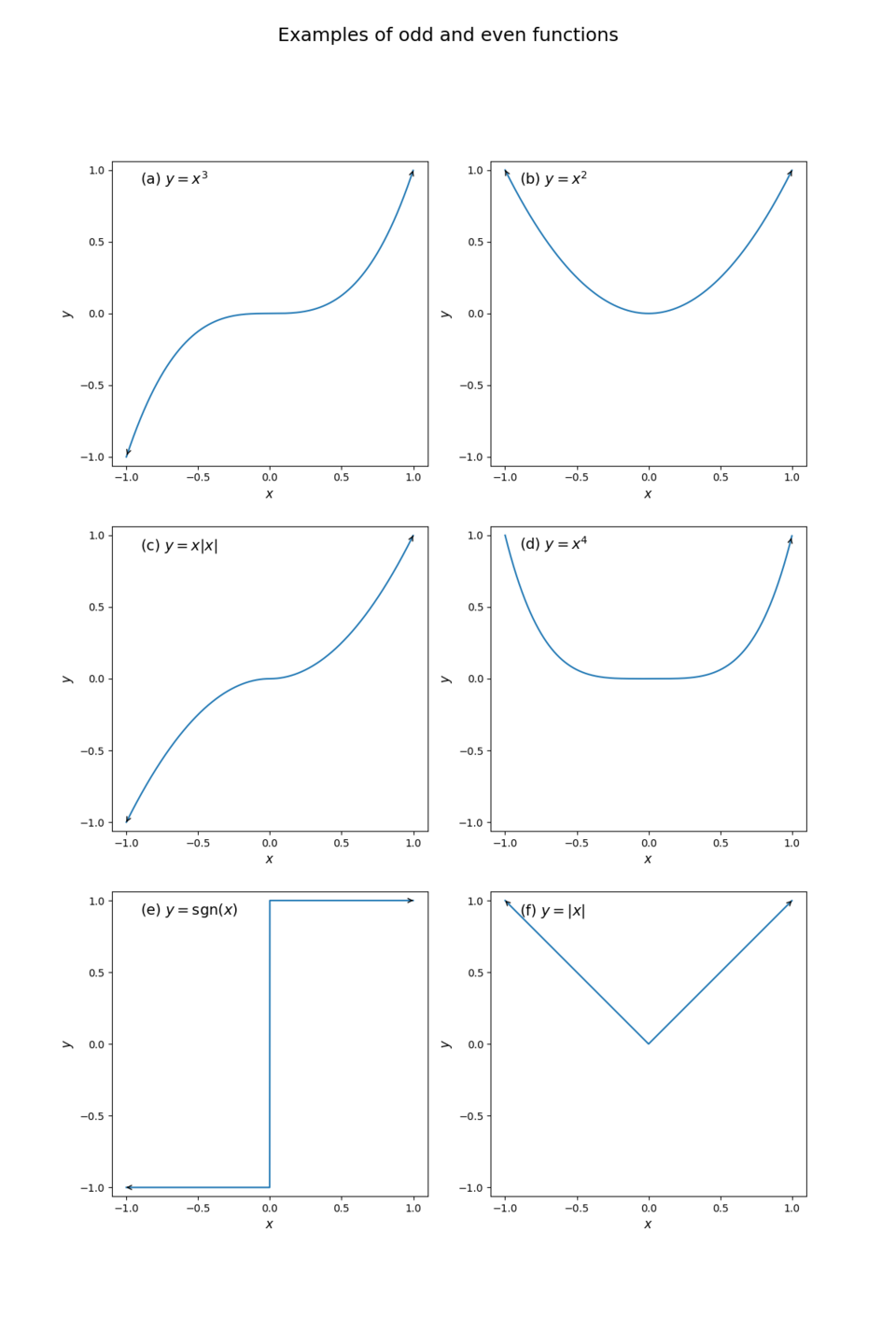 Graphs of f(x) = x² (even) and f(x) = x³ (odd) (Image: Saracena9000, CC0, via Wikimedia Commons)
Based on the NEB +2 Science syllabus for Mathematics (Maths), unit 15.
Discussion
Loading…