MathematicsUnit 510 min read
Sequence and Series: Sum of Finite Series – Types, Formulas & Applications
Unit 5 of Mathematics covers arithmetic and geometric sequences/series, their sums, and real-world applications like finance, physics, and engineering. Learn formulas, proofs, and problem-solving techniques for NEB exams.
TAKEAWAYS:
- Understand arithmetic sequences (common difference) and geometric sequences (common ratio) to find their sums.
- Memorize sum formulas: (arithmetic) and (geometric).
- Recognize mixed sequences (alternating arithmetic/geometric) and use telescoping series for simplification.
- Apply sums to real problems like loan repayments, projectile motion, and population growth.
- Avoid common mistakes: misapplying formulas, ignoring convergence, or skipping step-by-step calculations.
- Practice NEB-style questions with multiple-choice, short-answer, and long-answer formats.
1. What Are Sequences and Series?
A sequence is an ordered list of numbers following a rule. A series is the sum of its terms.
Types of Sequences
Arithmetic Sequence (AP)
- Each term increases/decreases by a constant difference .
- Example: (here, ).
Geometric Sequence (GP)
- Each term is multiplied by a constant ratio .
- Example: (here, ).
Mixed Sequences
- Combine AP and GP rules (e.g., is quadratic, not AP/GP).
Visual: Arithmetic vs. Geometric Sequence
2. Sum of Finite Arithmetic Series
The sum of the first terms of an AP is: where:
- = first term,
- = common difference,
- = number of terms.
Derivation (Why This Formula Works)
- Write the series forward and backward:
- Add both equations:
- The last term . Substitute:
Worked Example 1: Sum of an AP
Problem: Find the sum of the first 10 terms of the AP: .
Solution:
- , , .
- Plug into the formula:
Answer: The sum is 230.
3. Sum of Finite Geometric Series
The sum of the first terms of a GP is: where:
- = first term,
- = common ratio,
- = number of terms.
Derivation (Why This Formula Works)
- Write the series:
- Multiply by :
- Subtract the two equations:
- Solve for :
Worked Example 2: Sum of a GP
Problem: Find the sum of the first 5 terms of the GP: .
Solution:
- , , .
- Plug into the formula:
Answer: The sum is 93.
Special Case: Infinite GP ()
If , the series converges, and: Example: For , :
4. Mixed Sequences and Telescoping Series
Mixed Sequences
Some sequences combine AP and GP rules. Identify the pattern first! Example: Find the sum of .
- Differences between terms: (AP of differences).
- This is a quadratic sequence. Use the general term formula: Solve for using given terms, then sum.
Telescoping Series
A series where most terms cancel out when expanded. Example: Sum .
- Expand:
- Most terms cancel, leaving:
5. Applications of Sum of Series
Real-World Problems
Finance:
- Loan repayments: If you repay ₹1000 monthly with 10% interest, the total repayment is a GP sum.
- Savings: Calculate total savings after years with monthly deposits.
Physics:
- Projectile motion: Sum of distances traveled in each second (AP).
- Wave interference: Sum of amplitudes (GP if decaying).
Engineering:
- Signal processing: Sum of decaying signals (GP).
- Structural analysis: Sum of forces (AP/GP).
Worked Example 3: Loan Repayment (GP Application)
Problem: A person takes a loan of ₹50,000 to be repaid in 5 equal annual installments of ₹12,000 each, with 10% interest. What is the total amount repaid?
Solution:
- Each installment is a GP where the first term and (10% interest).
- Total repayment .
- Calculate .
- .
Answer: Total repayment is ₹73,260.
6. Common Mistakes to Avoid
| Mistake | Why It’s Wrong | How to Fix |
|---|---|---|
| Forgetting in GP sum formula | Formula breaks if (use instead). | Check if ; adjust formula. |
| Misidentifying sequence type | Assuming a quadratic sequence is AP/GP. | Calculate differences/ratios to confirm. |
| Incorrect or | Wrong term count or starting value. | Double-check given values. |
| Skipping convergence check | Using infinite GP sum when . | Verify for infinite sums. |
7. NEB Exam Tips
What to Expect in Exams
Multiple-Choice Questions (MCQ):
- Identify sequence type (AP/GP/mixed).
- Calculate sums or missing terms.
- Example:
The sum of the first 8 terms of an AP is 120, and the 5th term is 15. Find the common difference. Options: (A) 2 (B) 3 (C) 4 (D) 5 Answer: (B) 3
Short-Answer Questions:
- Derive sum formulas from first principles.
- Solve for or given .
- Example:
If the sum of the first terms of a GP is , find the first term and common ratio.
Long-Answer Questions:
- Real-world applications (loans, physics, etc.).
- Prove a series telescopes or identify its type.
- Example:
A ball is dropped from a height of 10 m. It rebounds to 60% of its previous height each time. Find the total distance traveled when it hits the ground for the 4th time.
Marking Scheme Insights
- Step marks: Show all steps (e.g., identifying , substituting into formulas).
- Formula marks: Write the correct formula before substituting values.
- Unit consistency: Ensure terms like "years," "meters," or "rupees" are consistent.
8. Practice Questions (NEB Style)
Section A: Multiple Choice
The sum of the first 10 terms of the AP is: (A) 120 (B) 130 (C) 140 (D) 150 Answer: (B) 130
For a GP with and , the sum of the first 4 terms is: (A) 45 (B) 48 (C) 42 (D) 36 Answer: (B) 48
Section B: Short Answer
Find the sum of the series . Answer: 150
The sum of the first terms of a GP is . Find the common ratio. Answer:
Section C: Long Answer
- A farmer plants 100 trees in a row. Each subsequent row has 5 more trees than the previous. If there are 20 rows, find: (a) The number of trees in the 20th row. (b) The total number of trees planted. Answer: (a) 190 trees (b) 2,100 trees
9. Summary Table: AP vs. GP Sum Formulas
| Feature | Arithmetic Series (AP) | Geometric Series (GP) |
|---|---|---|
| Common Difference/Ratio | (constant difference) | (constant ratio) |
| Sum Formula | (if ) | |
| Special Case | If , . | If , . |
| Example | (sum of first 5 terms = 70) | (sum of first 4 terms = 27) |
| Applications | Loan repayments (equal installments), physics. | Compound interest, signal decay, population growth. |
Exam Tip
- Memorize formulas but understand derivations—examiners test both!
- Draw diagrams for real-world problems (e.g., loan repayment tables, projectile motion graphs).
- Check units in word problems (e.g., years vs. months in finance).
- Practice mixed sequences—they often appear in higher-mark questions.
- Time management: Spend 1–2 minutes per MCQ, 5–10 minutes per short answer, and 15–20 minutes per long answer.
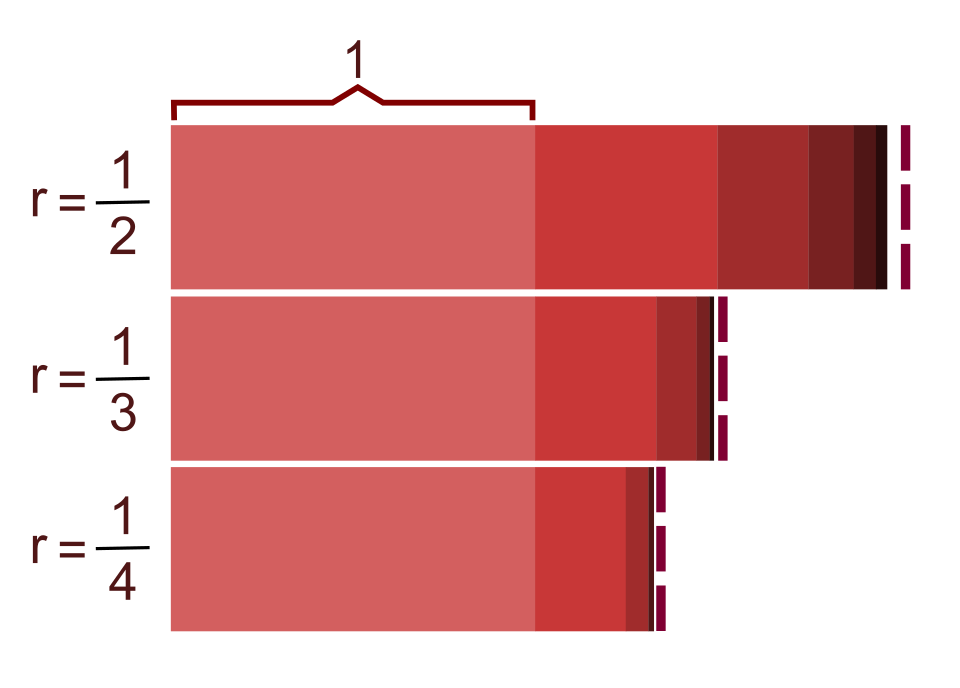 A labelled diagram showing a GP with terms and arrows indicating common ratio . (Image: Resident Mario (talk), CC BY-SA 3.0, via Wikimedia Commons)
Based on the NEB +2 Science syllabus for Mathematics (Maths), unit 5.
Discussion
Loading…