PhysicsUnit 186 min read
Magnetic Field: Sources, Forces, Fields & Applications
Unit 18 of Physics covers magnetic fields from currents, moving charges, and permanent magnets, including force laws, field patterns, and real-world applications like electric motors and mass spectrometers.
TAKEAWAYS:
- A magnetic field is a region where a magnetic force acts on moving charges or magnetic materials.
- Right-hand rules (for currents and moving charges) help visualize field directions.
- Biot-Savart Law and Ampère’s Law calculate magnetic fields from currents.
- Magnetic force on a current-carrying wire is .
- Earth’s magnetic field protects us from solar radiation and helps in navigation.
- Applications include electric motors, generators, and medical imaging (MRI).
1. Introduction to Magnetic Fields
Magnetic fields are invisible forces that act on moving charges, currents, and magnetic materials. They are produced by:
- Moving electric charges (currents or electrons in motion).
- Permanent magnets (like bar magnets or Earth’s magnetic field).
Key Observations:
- A compass needle aligns with Earth’s magnetic field (points north).
- Like poles repel; unlike poles attract.
- Magnetic fields are represented by field lines (imaginary lines showing direction and strength).
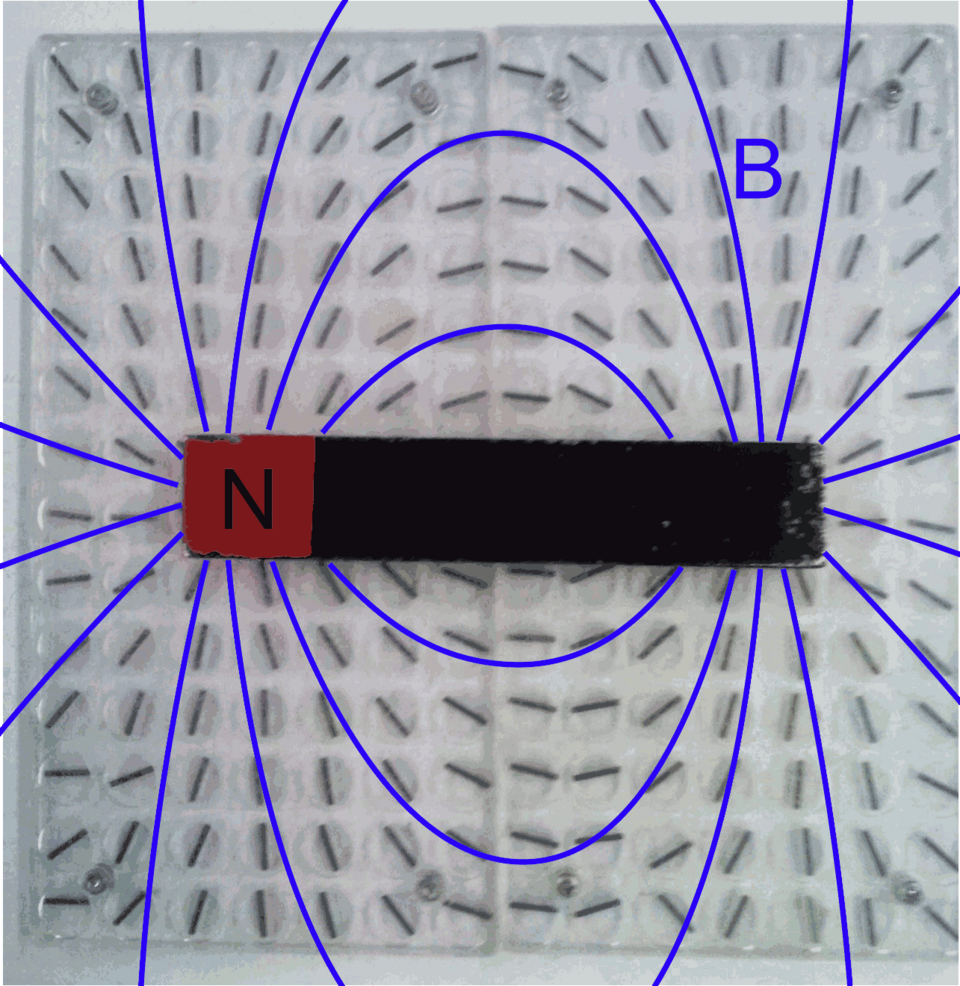 Magnetic field lines emerge from the North pole and enter the South pole. (Image: Original version:Yzarc-pan This version:Chetvorno, CC BY-SA 4.0, via Wikimedia Commons)
2. Magnetic Field Due to a Current-Carrying Wire
When current flows through a wire, it creates a magnetic field around it. The direction is given by the Right-Hand Thumb Rule:
- Thumb points in the direction of current.
- Fingers curl in the direction of the magnetic field.
Field Strength (Biot-Savart Law):
For a long straight wire, the magnetic field at a distance is: where:
- (permeability of free space).
- = current in amperes.
- = radial distance from the wire.
Example: A wire carries 5 A of current. Find the magnetic field at 10 cm from it.
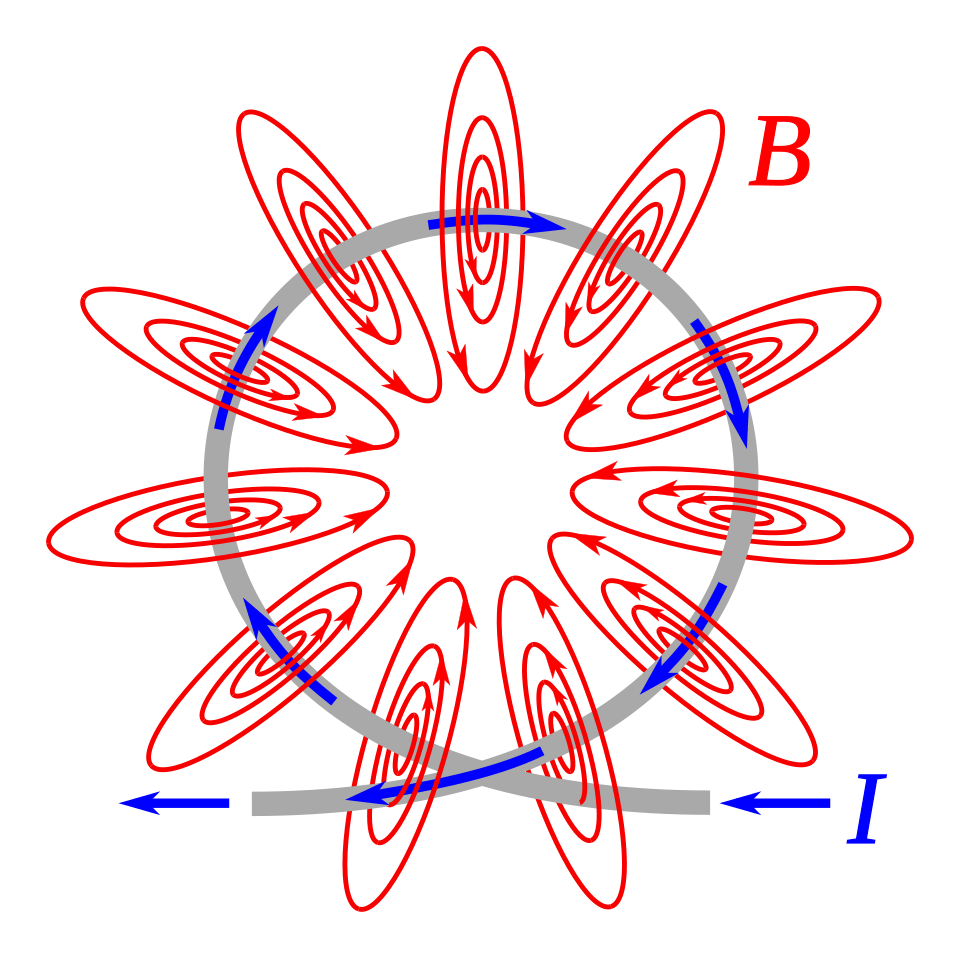 Field lines form concentric circles around the wire. (Image: Chetvorno, CC0, via Wikimedia Commons)
3. Magnetic Field Due to a Current Loop
A circular loop of current produces a magnetic field similar to a bar magnet:
Field at the center: where = radius of the loop.
Field along the axis (at a distance from the center):
Example: A circular loop of radius 0.1 m carries 2 A. Find the field at its center.
4. Force on a Current-Carrying Wire
A wire in a magnetic field experiences a force if it carries current. The force is: where:
- = current.
- = length of wire.
- = magnetic field strength.
- = angle between wire and field.
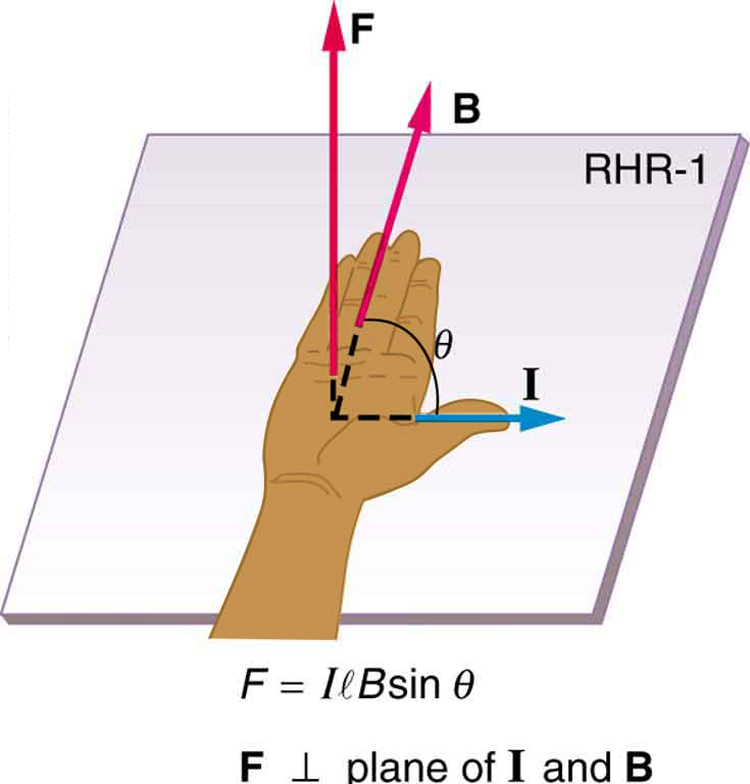 Right-hand rule: Force direction on a wire (F = ILB sinθ) in a magnetic field. (Image: OpenStax, CC BY 4.0, via Wikimedia Commons)
Direction: Given by Fleming’s Left-Hand Rule (thumb = force, index = field, middle = current).
Example: A 0.5 m wire carries 3 A at 30° to a 0.2 T field. Find the force.
5. Force on a Moving Charge
A charged particle moving in a magnetic field experiences a force: where:
- = charge.
- = velocity.
- = angle between velocity and field.
Direction: Given by Right-Hand Rule (for positive charges; reverse for negative).
Example: An electron moves at perpendicular to a 0.5 T field. Find the force.
6. Earth’s Magnetic Field
Earth acts like a giant bar magnet with:
- Magnetic North Pole (near geographic South Pole).
- Magnetic South Pole (near geographic North Pole).
- Inclination: Angle between field and Earth’s surface (varies by location).
Applications:
- Compass navigation (aligns with magnetic field).
- Protection from solar winds (deflects harmful radiation).
7. Applications of Magnetic Fields
| Application | Working Principle | Example |
|---|---|---|
| Electric Motor | Force on current-carrying coil in a field. | Fans, drills, electric cars. |
| Generator | Mechanical rotation → changing magnetic flux. | Power plants, bicycles. |
| Mass Spectrometer | Deflection of charged particles in a field. | Chemistry, medicine. |
| MRI (Magnetic Resonance Imaging) | Protons align with a strong field. | Medical imaging. |
| Electric Bell | Electromagnet attracts a metal armature. | School bells, doorbells. |
8. Solved Problems (NEB Style)
Problem 1: A wire of length 0.2 m carries 4 A at 90° to a 0.3 T field. Find the force. Solution:
Problem 2: Find the magnetic field at the center of a 10 cm loop carrying 5 A. Solution:
9. Exam Tips
- Memorize Right-Hand Rules (for currents and moving charges).
- Practice Biot-Savart and Ampère’s Law for field calculations.
- Understand Fleming’s Left-Hand Rule for motor action.
- Relate theory to real devices (motors, generators, MRI).
- Watch for units (Tesla, Ampere, meters).
- Draw field lines for loops, wires, and bar magnets in exams.
Final Note: Magnetic fields are fundamental to modern technology. Master the rules, formulas, and applications to score well in NEB exams! 🚀
Based on the NEB +2 Science syllabus for Physics (Phy), unit 18.
Discussion
Loading…