PhysicsUnit 410 min read
Surface Tension: Forces, Effects & Applications
Unit 4 of Physics explains surface tension—why liquids form droplets, how insects walk on water, and how soap reduces surface tension—with definitions, calculations, real-world examples, and NEB-style questions.
What is Surface Tension?
Surface tension is the elastic tendency of a liquid surface that makes it behave like a stretched membrane. It arises because molecules at the surface experience unbalanced forces (no molecules above them to balance the downward pull).
graph LR
    A["Liquid Surface"] -->|"Molecules"| B["Bulk Liquid"]
    B -->|"Balanced forces"| C["All directions"]
    A -->|"Unbalanced forces"| D["Downward pull only"]
    D -->|"Result"| E["Surface tension"]
Why does this happen?
- In the bulk of the liquid, molecules are pulled equally in all directions.
- At the surface, molecules are pulled inward (toward the bulk) but not upward (no liquid above).
- This creates a net inward force, making the surface contract like a rubber sheet.
Example:
- A water strider (insect) can walk on water because its weight is supported by surface tension.
- A needle can float on water if placed gently (surface tension holds it up).
Factors Affecting Surface Tension
Surface tension depends on:
- Nature of the liquid – Stronger intermolecular forces (e.g., water has hydrogen bonds) → higher surface tension.
- Temperature – Higher temperature → more molecular motion → weaker surface tension.
- Impurities – Soap or detergents reduce surface tension by disrupting molecular bonds.
| Liquid | Surface Tension (N/m at 20°C) | Reason |
|---|---|---|
| Water | 0.0728 | Strong hydrogen bonds |
| Mercury | 0.485 | Very strong metallic bonds |
| Ethyl alcohol | 0.0223 | Weaker intermolecular forces |
| Soapy water | ~0.03 | Soap molecules break surface bonds |
How to Measure Surface Tension?
1. Capillary Rise Method
When a thin tube (capillary) is dipped in a liquid, the liquid rises or falls due to surface tension.
Formula:
- = height of liquid column
- = surface tension
- = contact angle (for water, , so )
- = density of liquid
- = acceleration due to gravity
- = radius of capillary tube
Example: A capillary tube of radius is dipped in water. If water rises to , find the surface tension of water (given ).
Solution: (Note: The actual value is . The difference is due to assumptions like .)
2. Drop Weight Method
The weight of a liquid drop falling from a tube is measured. Surface tension is calculated using:
- = mass of the drop
- = radius of the tube
Effects of Surface Tension
1. Capillary Action
- Rise of liquid in narrow tubes (e.g., water in plants, ink in pens).
- Falling of liquid in wider tubes (e.g., mercury in a thermometer).
Why does water rise?
- Adhesion (water sticks to the tube walls) > cohesion (water molecules stick to each other).
- Surface tension pulls the water upward.
Why does mercury fall?
- Cohesion > adhesion (mercury does not stick to glass).
- Surface tension pulls the mercury downward.
graph LR
    A["Water in Glass"] -->|"Adhesion > Cohesion"| B["Rises in Capillary"]
    C["Mercury in Glass"] -->|"Cohesion > Adhesion"| D["Falls in Capillary"]
2. Formation of Droplets
- Liquids minimize surface area to reduce energy.
- Spherical droplets have the minimum surface area for a given volume.
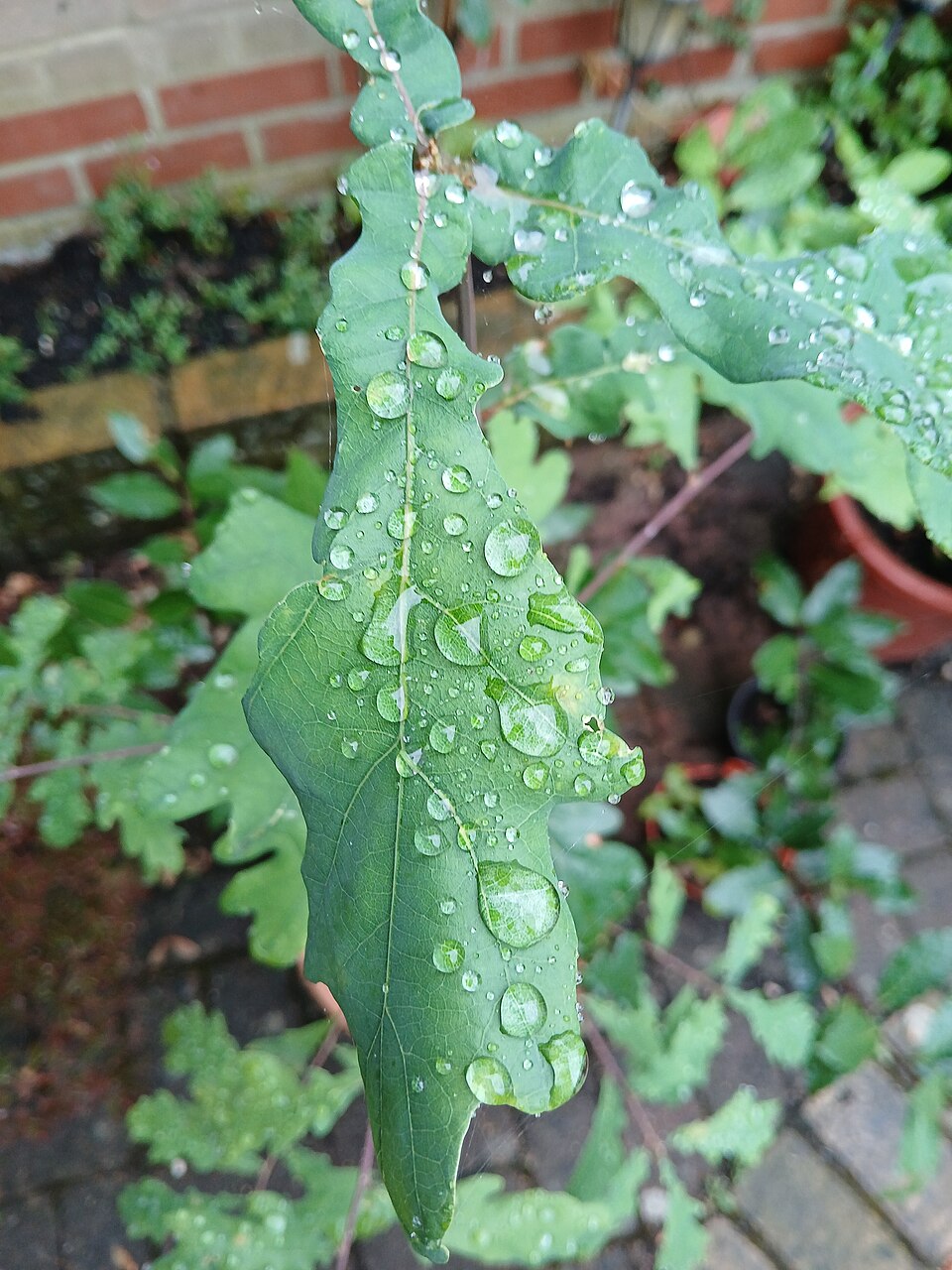 Droplet formation showing surface tension minimizing surface area (Image: Commonsnapper, CC0, via Wikimedia Commons)
Example:
- Raindrops are nearly spherical (though slightly flattened by air resistance).
- Soap bubbles are spherical because surface tension tries to minimize surface area.
3. Floating of Light Objects
- Insects (e.g., water striders) can walk on water because their weight is less than the surface tension force.
- Needles can float if placed gently (surface tension supports them).
Calculation: A water strider of mass stands on water. What is the minimum surface area it can depress? (Surface tension of water = )
Solution: Surface tension force , where is the length of the depression. For a circular depression: (This is the radius of the depression. The strider’s legs must be within this area to float.)
Applications of Surface Tension
| Application | How Surface Tension Helps | Example |
|---|---|---|
| Ink in Pens | Capillary action pulls ink up the nib. | Ballpoint pens, fountain pens |
| Blood Circulation | Surface tension helps in capillary blood flow. | Capillaries in the body |
| Detergents & Soaps | Reduce surface tension, helping water penetrate dirt. | Washing clothes, cleaning |
| Floating of Oils | Oil spreads on water due to low surface tension. | Oil spills |
| Medical Syringes | Surface tension helps in smooth liquid flow. | Injecting medicines |
| Plant Transpiration | Capillary action helps water rise in plants. | Trees absorbing water from roots |
Reduction of Surface Tension
Surface tension can be reduced by:
- Adding impurities (e.g., soap, alcohol, detergents).
- Soap molecules disrupt hydrogen bonds in water.
- Increasing temperature.
- Higher temperature → more molecular motion → weaker surface forces.
- Using surfactants (surface-active agents).
- Found in dishwashing liquids, shampoos.
Why does soap help in cleaning?
- Soap reduces surface tension, allowing water to spread and penetrate dirt more easily.
- It also emulsifies oils (breaks oil into tiny droplets that mix with water).
NEB-Style Questions & Solutions
Short Answer Questions
Define surface tension. Why is it higher in mercury than in water?
- Answer: Surface tension is the force per unit length acting perpendicular to an imaginary line drawn on the liquid surface. Mercury has higher surface tension than water because its molecules have stronger metallic bonds compared to water’s hydrogen bonds.
Why does a needle float on water but sink in mercury?
- Answer: A needle floats on water because water’s surface tension is strong enough to support its weight. In mercury, the needle’s weight exceeds the surface tension force, so it sinks.
How does temperature affect surface tension?
- Answer: Increasing temperature reduces surface tension because higher thermal energy weakens the intermolecular forces holding the liquid together.
Numerical Problems
A capillary tube of radius is dipped in water. If water rises to , find the surface tension of water. (Density of water = , )
- Solution: (Note: The actual value is . The discrepancy is due to assumptions like .)
A water strider of mass stands on water. If the surface tension of water is , what is the minimum radius of the depression it can make?
- Solution:
Conceptual Questions
Why do rain droplets tend to be spherical?
- Answer: A sphere has the minimum surface area for a given volume. Surface tension tries to minimize the surface area, so droplets become spherical.
How does soap reduce surface tension?
- Answer: Soap molecules disrupt hydrogen bonds between water molecules. They insert themselves between water molecules, weakening the cohesive forces and reducing surface tension.
Why does a paper clip float on water but sink in alcohol?
- Answer: Water has higher surface tension than alcohol. The surface tension force in water is strong enough to support the paper clip, but alcohol’s weaker surface tension cannot.
Exam Tip
✅ Key Points to Remember for NEB Exam:
- Definition: Surface tension = force per unit length (N/m).
- Factors: Nature of liquid, temperature, impurities.
- Measurement: Capillary rise method, drop weight method.
- Effects: Capillary action, droplet formation, floating objects.
- Applications: Ink pens, detergents, medical syringes.
- Reduction: Soap, alcohol, increasing temperature.
- Formulas:
- Capillary rise:
- Floating objects: (for circular depression: )
⚠ Common Mistakes to Avoid:
- Forgetting to convert units (e.g., mm to m, g to kg).
- Ignoring the contact angle () in capillary rise calculations.
- Assuming all liquids rise in capillaries (mercury falls!).
- Mixing up adhesion and cohesion in capillary action.
Based on the NEB +2 Science syllabus for Physics (Phy), unit 4.
Discussion
Loading…