Fundamentals of SociologyUnit 916 min read
Nepalese Society: Structure, Diversity, Challenges & Global Links
Unit 9 of Fundamentals of Sociology explores Nepal’s unique social fabric—its caste system, ethnic diversity, rural-urban divide, gender roles, and modern transformations (e.g., digital economy, migration, and political reforms)—while linking sociological theories to real-world issues like tourism, remittances, and cli
TAKEAWAYS:
- Nepal’s caste system persists despite legal bans, shaping access to education, jobs, and political power, with Dalits facing systemic discrimination.
- Ethnic federalism (75% of seats reserved for marginalized groups) reflects Nepal’s 125+ ethnic groups, but implementation struggles with corruption and elite capture.
- Rural-urban migration (e.g., Kathmandu’s 3M+ population) drives labor shortages in agriculture while overburdening urban infrastructure like water and transport.
- Gender roles are rigid: women hold 30% of parliament seats but face higher unpaid labor burdens and lower property rights than men.
- Digital divide (e.g., eSewa for payments, Pathao for rides) benefits urban youth but excludes 40% of rural households without smartphones or electricity.
- Climate migration (e.g., 100,000+ displaced by melting glaciers) creates "environmental refugees" with no legal protection, testing Nepal’s social cohesion.
1. Nepal’s Social Structure: Caste, Ethnicity, and Class
Nepal’s society is a layered hierarchy where caste, ethnicity, and class intersect to determine opportunities. Unlike India’s varna system, Nepal’s jati (sub-caste) system has 3,000+ groups, each with distinct occupations, endogamy rules, and social status. The 2011 census identified 125 ethnic groups, but Brahmin/Chhetri (15%) dominate politics and business, while Dalits (Kami, Damai, etc.) (13%) face untouchability despite the 2008 constitution banning discrimination.
How Caste Works in Nepal Today
- Occupational segregation: Brahmins traditionally handle rituals; Kami (blacksmiths) and Damai (leatherworkers) are "polluted" castes.
- Marriage endogamy: 90% of Nepalis marry within their jati; inter-caste marriages risk social ostracization (e.g., a Chhetri-Brahmin man marrying a Dalit woman may lose family support).
- Political representation: The 2015 federal elections reserved 40% of seats for women, Dalits, and indigenous groups, but Brahmin/Chhetri elites still control key ministries.
classDiagram
    class Caste {
        +Name: Brahmin, Chhetri, Dalit, etc.
        +Occupation: Priest, Farmer, Laborer
        +Status: High/Medium/Low
        +Marriage: Endogamous
    }
    class Ethnicity {
        +Group: Newar, Tharu, Magar, etc.
        +Region: Kathmandu Valley, Terai, Himalayas
        +Language: Nepali, Maithili, Tamang
    }
    class Class {
        +Economic Tier: Upper, Middle, Lower
        +Education: Elite (TU), Mass (NEB), None
        +Urban/Rural: Kathmandu vs. Sindhupalchok
    }
    Caste --> Ethnicity : "Influences but not identical"
    Ethnicity --> Class : "Determines access to jobs"
    Class --> Caste : "Reinforces hierarchy"
Worked Example: A Dalit Student’s Struggle
Consider Ramesh, a Damai caste student from Kavrepalanchok:
- School: His teacher ignores his questions because his caste is "low."
- College: He scores first in NEB exams but is denied a scholarship because the college principal (a Chhetri) favors "upper-caste" students.
- Job: He applies for a bank clerk position at Nabil Bank but is rejected despite qualifications because the HR manager assumes Dalits are "untrustworthy."
- Solution: He files a complaint under the 2015 Social Inclusion Act, but the case drags for 2 years due to corruption.
Why this matters: Nepal’s 2018 Social Inclusion Index ranks it 145th/189 in the world—worse than Afghanistan and Yemen—showing how deep-rooted caste discrimination remains.
2. Ethnic Diversity and Federalism: A Fragile Balance
Nepal’s federal structure (2015 constitution) created 7 provinces to address ethnic marginalization. However, implementation has failed due to:
- Elite capture: Provincial governors and CMs are often Brahmin/Chhetri despite quotas.
- Resource mismanagement: The Terai region (home to 40% of Nepalis) gets only 22% of national budget, worsening poverty.
- Language politics: Maithili, Tharu, and Newari are official languages, but Nepali dominates media and bureaucracy.
Comparison: Ethnic Groups in Nepal vs. India
| Feature | Nepal | India |
|---|---|---|
| Major Groups | Brahmin/Chhetri (31%), Dalit (13%), Janajati (45%) | Upper caste (30%), Dalit (20%), Adivasi (8%) |
| Federalism | 7 provinces, ethnic quotas | 28 states, no strict quotas |
| Language | 123 languages, Nepali dominant | 22 scheduled languages |
| Conflict Risk | Maoist insurgency (1996–2006) | Caste riots (e.g., 2006 Gujarat) |
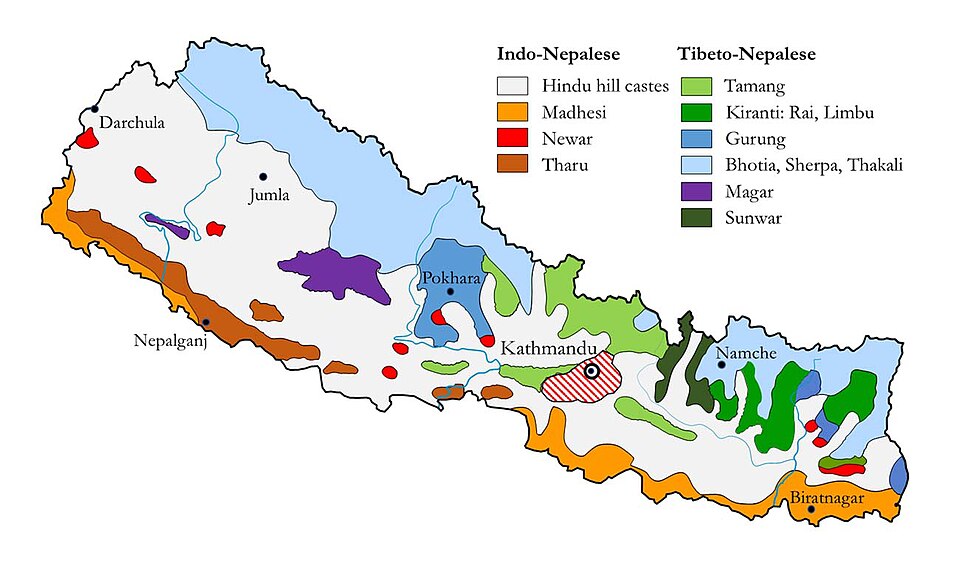 Shows the geographic distribution of Newar (Kathmandu Valley), Tharu (Terai), Magar (Western hills), and Rai/Limbu (Eastern Nepal). (Image: mapsland, CC BY-SA 3.0, via Wikimedia Commons)
Real-World Example: Tharu Land Rights in the Terai
- Problem: The Terai region (home to Tharu, Danuwar, and Musahar) was seized by Brahmin/Chhetri landlords during the Rana regime (1901–1951).
- Modern Issue: Despite the 2007 Land Reform Act, 60% of Tharu families still lack legal land titles.
- Impact: Forced migration to India (Bihar/Uttar Pradesh) for labor, where they face human trafficking risks.
- Solution Attempt: Nepal’s "One District One Product" (ODOP) program promotes Tharu honey and bamboo products, but corrupt officials siphon funds.
3. Rural-Urban Divide: Kathmandu’s Burden
Nepal’s urbanization rate is 20%, but Kathmandu Valley alone holds 3 million people—12% of the national population. This creates:
- Infrastructure collapse: Water shortages (only 2 hours/day in summer), traffic jams (average speed: 10 km/h), open defecation in slums.
- Economic drain: 80% of urban jobs are in informal sectors (e.g., restaurants, rickshaw pulling, domestic work).
- Brain drain: 50,000+ Nepali doctors work abroad (UK, Australia), leaving rural hospitals understaffed.
Worked Example: A Rickshaw Puller’s Life
- Name: Bhola Tharu, 35, from Dang district.
- Daily Routine:
- 4 AM: Leaves home, walks 10 km to Kathmandu.
- 6 AM–8 PM: Pulls 15–20 rickshaws/day, earns Rs. 800–1,000 (~$7–9).
- 8 PM: Sleeps on footpath near Thamel, wakes at 3 AM to repeat.
- Health Risks: Kidney failure (from dehydration), no health insurance.
- Children: Drops out of school to help pull rickshaws.
- Why? No minimum wage laws for rickshaw pullers; middlemen exploit them.
4. Gender Roles: Progress and Persistence
Nepal was the first South Asian country to elect a woman president (Bidhya Devi Bhandari, 2015) and legalize abortion (1996). Yet:
- Women’s Workload: Nepali women spend 5+ hours/day on unpaid labor (cooking, cleaning, farming).
- Property Rights: Only 30% of women own land (vs. 70% of men).
- Political Representation: 30% of parliament seats are reserved for women, but only 10% of cabinet ministers are women.
Comparison: Gender Inequality Indicators
| Indicator | Nepal (2023) | India (2023) | Global Rank (2023) |
|---|---|---|---|
| Women in Parliament | 30% | 15% | 104th |
| Literacy Rate (Women) | 65% | 68% | 120th |
| Maternal Mortality | 181/100,000 | 113/100,000 | 75th |
| Child Marriage Rate | 37% (under 18) | 23% | 110th |
Real-World Example: Chhaupadi Ban and Rural Resistance
- Problem: The 2005 Chhaupadi tradition (forcing women to sleep in sheds during menstruation) was banned in 2005, but 30% of rural women still follow it.
- Case Study: In Achham district, a 12-year-old girl (Gita) died in 2018 from carbon monoxide poisoning in a chhaupadi shed.
- Backlash: Dalit women face harsher punishment if caught violating the ban (e.g., public flogging).
- Solution: NGOs like INSEC (Integrated Rural Development) train female community leaders to enforce the ban.
5. Digital Revolution and the New Divide
Nepal’s digital economy (eSewa, Khalti, Pathao) has bypassed banks for 60% of the population. However:
- Urban vs. Rural Access:
- Kathmandu: 90% smartphone penetration, cashless payments via eSewa/Khalti.
- Far-Western Nepal: Only 20% have smartphones, no ATMs within 10 km.
- Job Market: IT companies (e.g., F1Soft, Ncell) hire urban youth, leaving rural graduates unemployed.
- Cybercrime: Rs. 2 billion lost in 2022 to online scams (e.g., fake job offers on Facebook).
Worked Example: A Farmer’s Struggle with Digital Payments
- Name: Ram Bahadur Magar, 45, from Dolakha.
- Problem: He sells potatoes to a middleman who pays in cash, but Nepal Rastra Bank wants all transactions digital.
- Solution: He opens an eSewa account, but:
- No bank branch nearby (30 km to Nabil Bank).
- No electricity to recharge his phone.
- Middleman refuses digital payments (loses his 10% commission).
- Outcome: He sticks to cash, but government subsidies (e.g., fertilizer vouchers) are only available digitally.
6. Climate Migration: Nepal’s Silent Crisis
Nepal is one of the most climate-vulnerable countries:
- Glacier retreat: Himalayan glaciers (e.g., Imja Lake) are melting, causing floods and landslides.
- Agricultural collapse: 30% of farmland in Karnali province is now desert.
- Forced migration: 100,000+ people have abandoned their homes since 2015.
Real-World Example: The "Climate Refugees" of Solukhumbu
- Problem: Melting glaciers (e.g., Gokyo Lakes) have destroyed irrigation channels, turning fertile land into barren soil.
- Impact:
- Yak herders lose livelihoods (yaks can’t graze).
- Sherpa communities face food shortages.
- No government relief: Disaster Risk Reduction Fund is underfunded.
- Solution Attempt: UNHCR and Red Cross provide emergency rations, but no long-term housing.
7. Sociology and Business: How Companies Exploit (and Solve) Nepal’s Issues
Businesses in Nepal profit from—or worsen—social inequalities:
| Company | Industry | Social Impact | Ethical Concern |
|---|---|---|---|
| Nabil Bank | Banking | Excludes Dalits in loan approvals; urban bias in branch locations. | Discriminatory lending practices |
| Daraz Nepal | E-commerce | Creates urban jobs; rural sellers struggle with digital literacy. | Widening digital divide |
| Pathao | Ride-hailing | Employs 50,000+ drivers (mostly men); no benefits. | Exploitative wages |
| Nepal Telecom | Telecom | Expands 4G in cities; village phone operators (mostly women) earn Rs. 500/month. | Gender pay gap in rural jobs |
| Fairwear | Fashion | Employs Dalit women in ethical factories; fair wages. | Model for inclusive business |
Worked Example: How Daraz Could Fix Nepal’s Rural-Urban Divide
- Problem: 80% of Daraz’s sellers are in Kathmandu, while rural artisans (e.g., Newari woodcarvers) can’t sell online.
- Solution:
- Partner with NGOs (e.g., Practical Action) to train rural sellers in digital marketing.
- Offer "Daraz Rural Hubs" with free Wi-Fi and training centers.
- Subsidize shipping for handicrafts to global markets.
- Result: Increased rural income and reduced urban migration.
## In the Real World
eSewa and Khalti (Digital Payments)
- Idea Used: Social exclusion in digital access.
- How? While urban youth use eSewa for bills, tickets, and remittances, rural elders (e.g., 80% of over-60s) can’t use smartphones. Banks like Nabil and Global IME profit from this gap by charging high transaction fees for cash deposits.
- Example: A Tharu farmer in Dang pays Rs. 50 extra to deposit Rs. 5,000 in a Kathmandu bank because his local branch has no ATM.
Pathao and Traffic Congestion (Urban Planning)
- Idea Used: Social stratification in job access.
- How? Pathao’s driver partners (mostly young men from rural areas) earn Rs. 300–500/day, but face no benefits, no insurance, and police harassment. Meanwhile, Pathao’s investors (Silicon Valley-backed) make millions while Kathmandu’s traffic worsens due to unregulated ride-hailing.
- Example: In 2022, a Pathao driver was arrested for not having a license, but no government body regulates gig workers.
Nepal Stock Exchange (NEPSE) and Elite Capture
- Idea Used: Class reproduction through finance.
- How? 90% of NEPSE traders are Brahmin/Chhetri men from Kathmandu. Dalit and Janajati investors are shut out due to:
- High brokerage fees (Rs. 500–1,000 per trade).
- Lack of financial literacy (only 10% of rural Nepalis know about stocks).
- Example: Nepal’s richest 10% own 50% of wealth, while Dalit families (e.g., Kami blacksmiths) can’t afford shares in Nabil Bank or NMB.
## Exam Tip
This unit is heavily tested in PU exams through:
Case Study Analysis (30% weight)
- Expect: A real-life scenario (e.g., a Dalit student’s education struggle or a Tharu farmer’s migration) and ask you to apply sociological theories (Marx, Weber, or functionalism).
- How to Score:
- Define the issue (e.g., "caste discrimination in education").
- Link to theory (e.g., Weber’s "life chances" or Marx’s "false consciousness").
- Use data (e.g., "Only 5% of Dalit students reach college").
- Suggest a policy fix (e.g., "Free scholarships + anti-discrimination laws").
Comparison Questions (25% weight)
- Example: "Compare Nepal’s caste system with India’s. Which is more rigid?"
- How to Score:
- Use a table (like the one above on Nepal vs. India).
- Highlight 3 key differences (e.g., Nepal has more sub-castes, India has more legal protections).
- Add a real example (e.g., "In Nepal, Dalits are denied temple entry; in India, Dalits can enter temples but face segregation").
Short-Answer Definitions (20% weight)
- Key Terms to Master:
- Jati: Nepal’s sub-caste system (vs. India’s varna).
- Chhaupadi: Menstrual exile tradition.
- ODOP (One District One Product): Government program to boost rural economies.
- Social Inclusion Index: Nepal’s ranking (145/189) in global inequality.
- How to Answer:
- Define in 1 line (e.g., "Jati is Nepal’s hereditary occupational caste system").
- Add 1 example (e.g., "Kami are blacksmiths; Damai handle leather").
- Mention a real-world impact (e.g., "Dalit jatis face employment discrimination").
- Key Terms to Master:
Diagram-Based Questions (15% weight)
- Expect: A flowchart or pyramid (e.g., Nepal’s social hierarchy or rural-urban migration cycle).
- How to Score:
- Draw a Mermaid diagram (like the caste-class-ethnicity one above).
- Label arrows (e.g., "Caste → Limits education → Perpetuates poverty").
- Add 1 real case (e.g., "A Dalit doctor in Nepal faces workplace discrimination").
Critical Thinking (10% weight)
- Example Question: "Is federalism in Nepal a success? Justify with examples."
- How to Score:
- Pros: "More representation for Janajatis (e.g., Magar CM in Province 5)".
- Cons: "Elite capture (e.g., Brahmin governors in Terai)".
- Policy Suggestion: "Stronger anti-corruption laws + local language media training".
Final Advice:
- Memorize statistics: Dalit population (13%), urbanization rate (20%), women in parliament (30%).
- Link theories to Nepal: Marx → class struggle in Nepal’s wealth gap; Weber → caste as social closure; Durkheim → anomie in climate migrants.
- Use real examples: eSewa, Pathao, Daraz, and NEPSE are frequent exam references.
Based on the PU BBA (PU) syllabus for Fundamentals of Sociology, unit 9.
Discussion
Loading…