Basics of Managerial AccountingUnit 67 min read
Budgeting – Planning, Control & Decision‑Making
Unit 6 of Basics of Managerial Accounting: covers the purpose, types, preparation, and use of budgets, including the budgeting cycle, master budgets, cash budgets, and variance analysis.
Key points
- Budgets translate strategic plans into quantitative targets and serve as performance benchmarks.
- The budgeting cycle links forecasting, budgeting, execution, and review in a continuous loop.
- Master budgets integrate operating, capital, and cash budgets into a single coherent plan.
- Cash budgets ensure liquidity by projecting inflows and outflows, crucial for day‑to‑day operations.
- Variance analysis identifies deviations, enabling corrective actions and learning.
Introduction to Budgeting
Budgeting is the systematic process of estimating future financial outcomes and allocating resources accordingly. It is a cornerstone of managerial accounting, enabling managers to plan, coordinate, and control activities.
Purpose and Benefits
| Benefit | Explanation |
|---|---|
| Planning | Provides a roadmap for future activities. |
| Control | Sets performance standards for comparison. |
| Coordination | Aligns departmental goals with corporate strategy. |
| Motivation | Offers targets that can be linked to incentives. |
| Decision‑Making | Supplies financial data for investment and operational decisions. |
Types of Budgets
| Budget Type | Definition | Typical Use |
|---|---|---|
| Operating Budget | Forecasts revenue and operating expenses for a period. | Sales, production, marketing. |
| Capital Budget | Projects long‑term investments and financing. | Plant expansion, equipment purchase. |
| Cash Budget | Projects cash inflows and outflows to ensure liquidity. | Working‑capital management. |
| Static Budget | Fixed for a given level of activity. | Simple cost control. |
| Flexible Budget | Adjusts for actual activity levels. | Performance evaluation. |
| Master Budget | Consolidates all individual budgets into one plan. | Corporate planning. |
The Budgeting Cycle (Mermaid Flowchart)
flowchart TD
  A["Strategic Planning"] --> B["Forecasting"]
  B --> C["Budget Development"]
  C --> D["Approval & Communication"]
  D --> E["Execution & Monitoring"]
  E --> F["Variance Analysis"]
  F --> G["Feedback & Revision"]
  G --> A
Budget Preparation Process
- Set Objectives – Define financial and operational goals.
- Collect Data – Historical performance, market trends, and assumptions.
- Forecast – Estimate sales volume, prices, costs, and cash flows.
- Allocate Resources – Assign budgets to departments or projects.
- Review & Approve – Management evaluates feasibility and alignment.
- Communicate – Distribute budgets to relevant units.
- Implement – Execute plans while tracking actual results.
- Analyze Variances – Compare actual vs. budgeted figures.
- Revise – Adjust forecasts and budgets for the next period.
Master Budget Components
| Component | Content | Example |
|---|---|---|
| Sales Budget | Expected sales volume and revenue. | 10,000 units @ NPR 1,200 each. |
| Production Budget | Units to be produced, including inventory changes. | 12,000 units. |
| Direct Materials Budget | Quantity and cost of raw materials. | 30,000 kg @ NPR 50/kg. |
| Direct Labour Budget | Labour hours and wage rates. | 5,000 hrs @ NPR 200/hr. |
| Manufacturing Overhead Budget | Fixed and variable overheads. | Fixed: NPR 2,000,000; Variable: 5% of direct labour. |
| Selling & Admin Budget | Salaries, marketing, utilities. | Salaries: NPR 1,500,000; Marketing: NPR 300,000. |
| Cash Budget | Cash inflows/outflows, ending balance. | Opening: NPR 5,000,000; Inflows: NPR 12,000,000; Outflows: NPR 10,000,000; Closing: NPR 7,000,000. |
| Budgeted Income Statement | Revenue minus expenses. | Revenue: NPR 12,000,000; Expenses: NPR 9,000,000; Net Income: NPR 3,000,000. |
| Budgeted Balance Sheet | Assets, liabilities, equity at period end. | Assets: NPR 20,000,000; Liabilities: NPR 8,000,000; Equity: NPR 12,000,000. |
Cash Budget – Detailed Example
| Item | Amount (NPR) |
|---|---|
| Opening Cash | 5,000,000 |
| Cash Inflows | |
| - Sales Receipts | 12,000,000 |
| - Loan Proceeds | 3,000,000 |
| Total Inflows | 15,000,000 |
| Cash Outflows | |
| - Purchases | 4,000,000 |
| - Operating Expenses | 6,000,000 |
| - Loan Repayment | 1,000,000 |
| Total Outflows | 11,000,000 |
| Net Cash Flow | 4,000,000 |
| Closing Cash | 9,000,000 |
Ledger Posting Example – Cash Budget
| Date | Account | Dr (NPR) | Cr (NPR) |
|---|---|---|---|
| 01‑Jan | Cash | 5,000,000 | |
| 01‑Jan | Sales Receipts | 12,000,000 | |
| 01‑Jan | Loan Proceeds | 3,000,000 | |
| 01‑Jan | Purchases | 4,000,000 | |
| 01‑Jan | Operating Expenses | 6,000,000 | |
| 01‑Jan | Loan Repayment | 1,000,000 | |
| 01‑Jan | Cash | 4,000,000 | |
| 01‑Jan | Cash | 9,000,000 |
Variance Analysis
| Budgeted | Actual | Variance | Interpretation |
|---|---|---|---|
| Sales Revenue | 12,000,000 | 11,500,000 | -500,000 (Unfavorable) |
| Direct Materials Cost | 1,500,000 | 1,400,000 | 100,000 (Favorable) |
| Labour Cost | 1,000,000 | 1,050,000 | -50,000 (Unfavorable) |
- Unfavorable Variance: Actual > Budget (cost overrun or revenue shortfall).
- Favorable Variance: Actual < Budget (cost saving or higher revenue).
Advantages & Disadvantages
| Advantage | Disadvantage |
|---|---|
| Provides clear performance targets | Can be rigid if not updated frequently |
| Enhances coordination across departments | Requires accurate data and assumptions |
| Facilitates early detection of problems | Time‑consuming to prepare and review |
| Supports strategic alignment | May encourage gaming of numbers |
Real‑World Applications
In the real world
- eSewa – Uses a cash budget to forecast daily transaction volumes and ensure sufficient liquidity for instant payments.
- Daraz – Implements a flexible operating budget that adjusts marketing spend based on real‑time sales data during festive seasons.
- Ncell – Employs a master budget integrating capital expenditures for 5G infrastructure with operating budgets for network maintenance.
Worked Example – Sundar Store (Kathmandu)
- Objective: Achieve NPR 3,000,000 net profit in FY 2025.
- Sales Forecast: 15,000 units @ NPR 1,200 = NPR 18,000,000.
- Cost of Goods Sold: 60% of sales = NPR 10,800,000.
- Operating Expenses: Salaries (NPR 2,000,000), Rent (NPR 1,200,000), Utilities (NPR 300,000).
- Budgeted Net Income: 18,000,000 – 10,800,000 – 3,500,000 = NPR 3,700,000.
- Variance Analysis: If actual sales are 14,000 units, revenue falls by NPR 1,200,000, leading to a negative variance that triggers a review of marketing strategy.
In the real world
- Pathao: Uses a cash budget to manage driver payouts and ensure sufficient cash for daily operations.
- NEPSE: Traders rely on operating budgets to forecast trading volumes and set target profits for each session.
Exam tip
- Understand the budgeting cycle: Be able to draw the flowchart and explain each step.
- Know the differences between static and flexible budgets; practice converting a static budget into a flexible one.
- Practice variance calculations: Given budgeted and actual figures, compute and interpret variances.
- Master budget integration: Be able to explain how sales, production, and cash budgets fit together.
- Use tables and diagrams: In written answers, include tables for budgets and mermaid diagrams for processes.
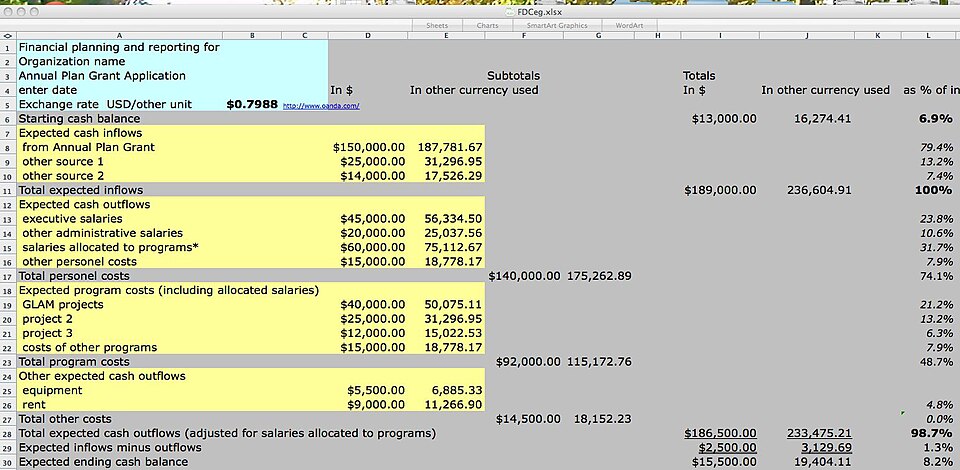 Sample budget spreadsheet used in accounting software (Image: Smallbones, CC0, via Wikimedia Commons)
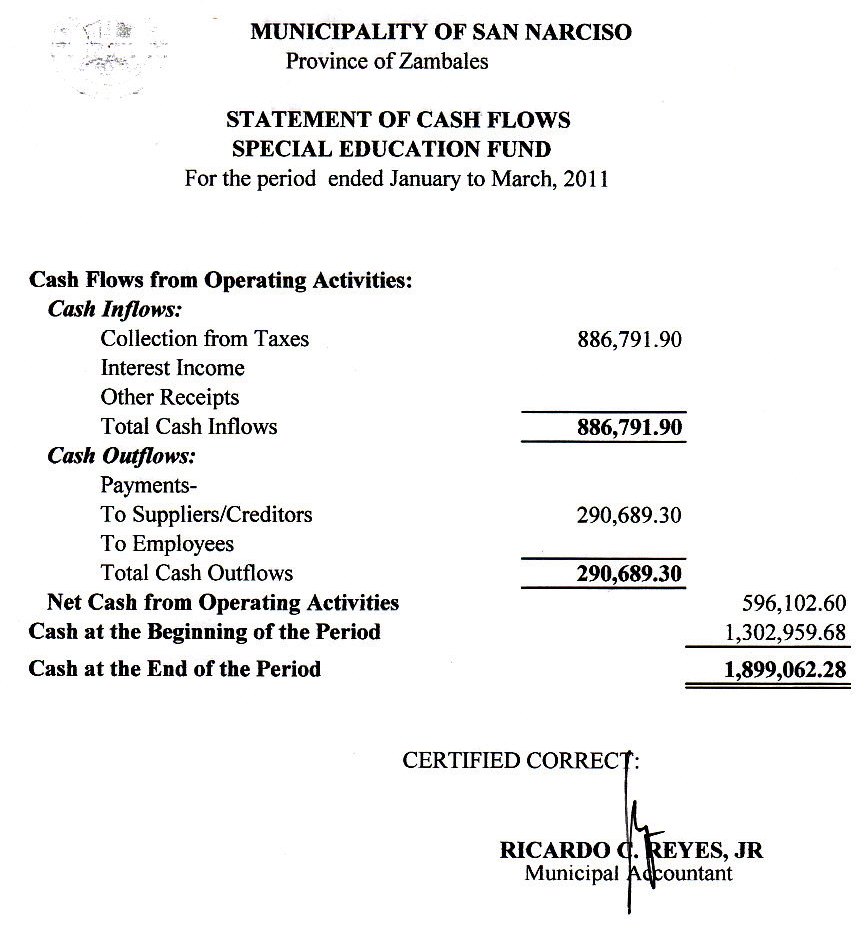 Cash flow statement example (Image: Ladyfwr, CC BY-SA 3.0, via Wikimedia Commons)
Based on the PU BBA (PU) syllabus for Basics of Managerial Accounting, unit 6.
Discussion
Loading…