Fundamentals of Operations ManagementUnit 106 min read
Supply Chain & Lean: Lean Tools, SCM Models, Waste Reduction & Agile Logistics
Unit 10 of Fundamentals of Operations Management covers supply chain management (SCM) frameworks, lean operations principles, waste elimination techniques, agile and resilient supply chains, and real-world case studies from Nepali and global companies like Daraz, Toyota, and Nabil Bank.
Key Concepts and Frameworks
Supply Chain Management (SCM) Defined
Supply Chain Management (SCM) is the integration of business processes from raw material suppliers to end customers, including procurement, production, logistics, and customer service. It aims to maximize value and minimize costs while meeting customer demands efficiently.
graph TD
A["Suppliers"] -->|"Raw Materials"| B["Manufacturing"]
B -->|"Finished Goods"| C["Distribution Centers"]
C -->|"Warehousing"| D["Retailers"]
D -->|"End Customers"| E["Customer Service"]
E -->|"Feedback"| A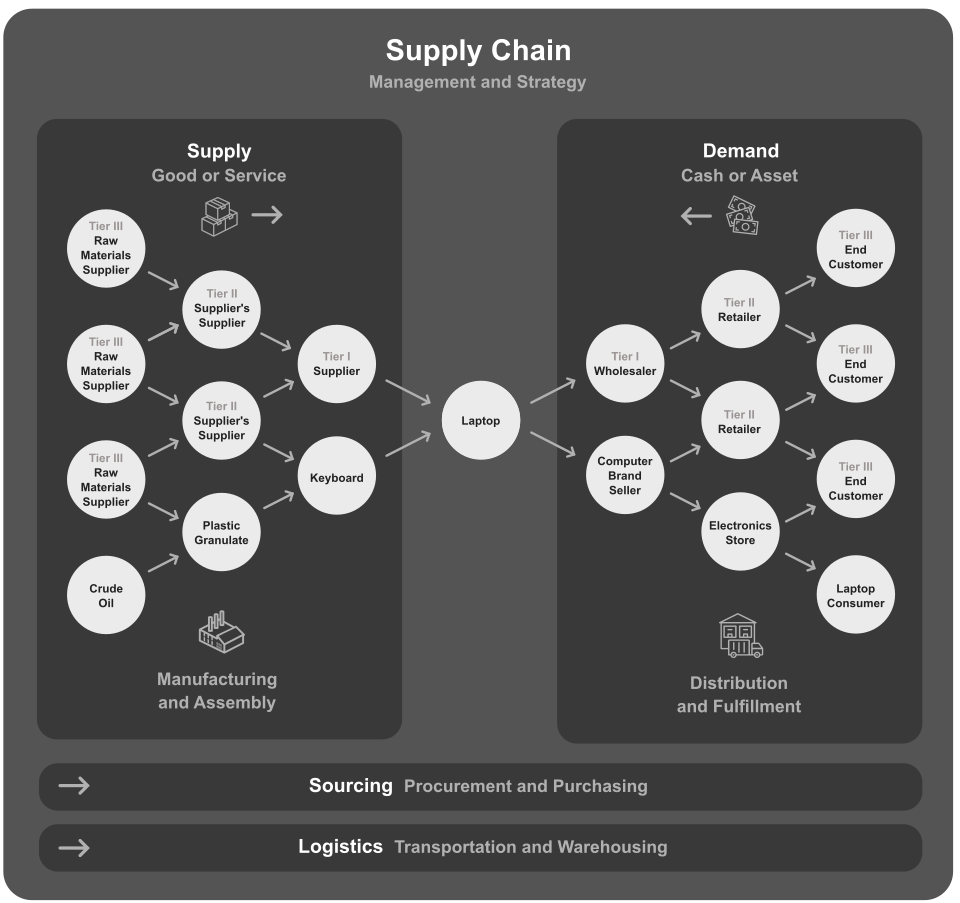 A visual representation of SCM stages from suppliers to customers. (Image: Miguel Garcia Gonzalez, CC BY-SA 4.0, via Wikimedia Commons)
Key Components of SCM
| Component | Description | Example in Nepal |
|---|---|---|
| Procurement | Sourcing raw materials and services. | Daraz sourcing goods from Chinese suppliers. |
| Production | Manufacturing or service delivery. | Nabil Bank processing loan applications. |
| Logistics | Transportation and warehousing of goods. | Pathao delivering food orders via logistics. |
| Customer Service | Post-sale support and feedback integration. | eSewa handling customer complaints. |
Lean Operations: Eliminating Waste
Lean operations, inspired by Toyota Production System (TPS), focuses on eliminating waste (Muda) while maximizing customer value. The 7 Wastes in lean are:
mindmap
  root((Lean Waste: 7 Types))
    Overproduction
    Waiting
    Transport
    Overprocessing
    Inventory
    Motion
    Defects
Lean Tools and Techniques
| Tool | Purpose | Example in Nepal |
|---|---|---|
| 5S Methodology | Workplace organization (Sort, Set in order, Shine, Standardize, Sustain). | Himalayan Java maintaining clean factory floors. |
| Kaizen | Continuous improvement through small, incremental changes. | NTC improving network reliability. |
| Value Stream Mapping | Visualizing workflow to identify inefficiencies. | Daraz optimizing order fulfillment. |
| Just-in-Time (JIT) | Producing only what is needed, when needed. | Chaudhary Group reducing inventory costs. |
Supply Chain Models and Strategies
1. Traditional vs. Agile Supply Chains
| Feature | Traditional Supply Chain | Agile Supply Chain |
|---|---|---|
| Focus | Cost efficiency, mass production. | Flexibility, customer responsiveness. |
| Inventory Levels | High (buffer stock). | Low (just-in-time). |
| Response to Demand | Slow (push-based). | Fast (pull-based). |
| Example | NEPSE stock trading (batch processing). | Pathao’s real-time order tracking. |
2. Resilient Supply Chains
Resilient supply chains adapt to disruptions (e.g., COVID-19, natural disasters). Key strategies:
- Dual Sourcing: Using multiple suppliers (e.g., Daraz sourcing from China and India).
- Localization: Reducing dependency on global suppliers (e.g., Nepal’s focus on local agriculture).
- Digital Twins: Virtual replicas of supply chains for real-time monitoring (used by Toyota).
flowchart TD
    A["Disruption (e.g., Lockdown)"] --> B["Assess Impact"]
    B --> C["Activate Backup Suppliers"]
    C --> D["Reroute Logistics"]
    D --> E["Communicate with Customers"]
    E --> F["Monitor & Adjust"]
Case Study: Daraz Nepal’s Supply Chain
Daraz, Nepal’s largest e-commerce platform, uses:
- Multi-Warehousing: Stores inventory in Kathmandu, Pokhara, and Biratnagar.
- Last-Mile Delivery: Partners with Pathao and local couriers for fast delivery.
- Lean Inventory: Uses JIT to avoid overstocking perishable goods (e.g., groceries).
Lean in Action: Nabil Bank’s Loan Processing
Nabil Bank applies lean principles to reduce loan approval time:
- Value Stream Mapping: Identified delays in document verification.
- Automation: Digitized loan applications (reduced processing time by 40%).
- Kaizen Teams: Regular feedback from employees to improve workflow.
flowchart TD
    A["Customer Applies Online"] --> B["Digital Verification"]
    B --> C["AI Risk Assessment"]
    C --> D["Approval in <24 hrs"]
    D --> E["Loan Disbursed"]
Exam Tip
- Define SCM and lean operations clearly (use Toyota’s 7 wastes as a reference).
- Compare traditional vs. agile supply chains (use Daraz vs. NEPSE as examples).
- Explain lean tools (5S, Kaizen, JIT) with real-world Nepali cases (Nabil Bank, NTC).
- Draw diagrams for:
- Supply chain flowcharts.
- Value stream mapping.
- Lean waste classification.
- Case study focus: Be ready to analyze Daraz, Toyota, or Nabil Bank in exams.
Final Note: Supply chain and lean operations are not just theories—they directly impact profitability, customer satisfaction, and sustainability. Companies like Daraz, Toyota, and Nabil Bank prove that efficient operations = competitive advantage. Master these concepts, and you’ll excel in both exams and real-world business roles.
Based on the PU BBA (PU) syllabus for Fundamentals of Operations Management, unit 10.
Discussion
Loading…