Business and SocietyUnit 69 min read
Business & Environment: Pollution, Sustainability & Green Strategies
Unit 6 of Business and Society explores how businesses interact with the environment—pollution impacts, sustainable practices, green marketing, and regulatory frameworks—with real-world cases from Nepal (e.g., NTC’s e-waste, Daraz’s carbon footprint) and global examples (e.g., Patagonia’s circular economy, Unilever’s s
Core Concepts
1. Business and the Environment: Definitions and Scope
Businesses operate within the natural environment (air, water, land, biodiversity) and the built environment (infrastructure, urban systems). Their activities—production, consumption, waste disposal—directly impact ecological systems.
Key Terms:
- Natural Environment: Unaltered ecosystems (forests, rivers, atmosphere).
- Built Environment: Human-made structures (factories, roads, buildings).
- Environmental Sustainability: Meeting present needs without compromising future generations’ ability to meet theirs (Brundtland Commission, 1987).
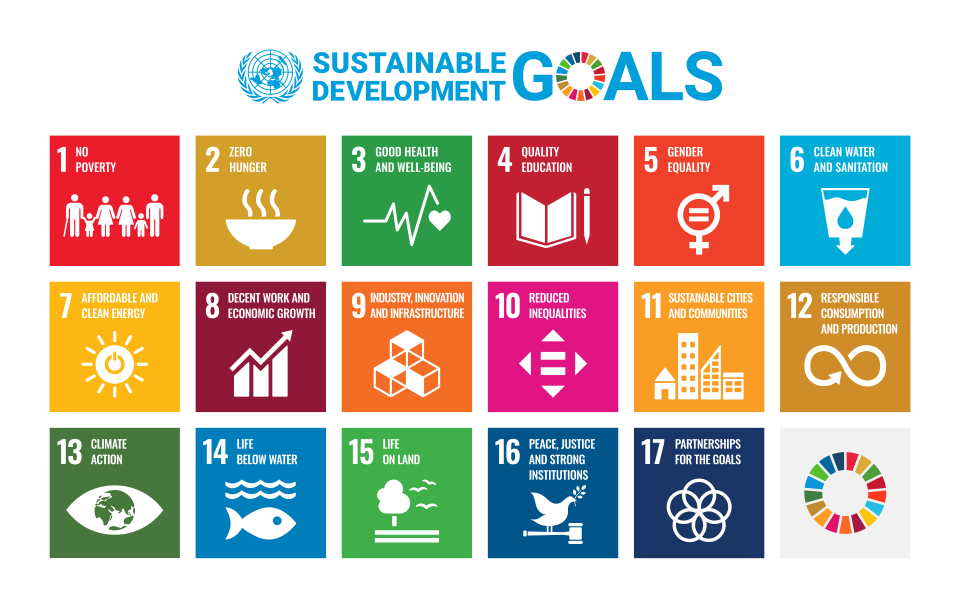 The 17 UN SDGs, with SDG 12 (Responsible Consumption) and SDG 13 (Climate Action) highlighted as critical for businesses. (Image: Own work using: File:Sustainable Development Goals.png and P, Public domain, via Wikimedia Commons)
2. Environmental Issues Faced by Businesses
Businesses contribute to environmental degradation through:
- Pollution: Air (CO₂, SO₂), water (industrial effluents), soil (pesticides, heavy metals).
- Resource Depletion: Over-extraction of minerals, deforestation, water scarcity.
- Waste Generation: Plastic waste, e-waste (e.g., Nepal’s NTC’s discarded mobile phones), hazardous waste.
- Climate Change: Greenhouse gas (GHG) emissions (e.g., Ncell’s carbon footprint from telecom towers).
Worked Example: Daraz’s Carbon Footprint Daraz (Alibaba’s Nepal arm) ships 1.5 million orders/month. A single delivery van emits ~2.5 kg CO₂/km. If 50% of orders are delivered within 24 hours (vs. 48 hours), the extra 10,000 km/month adds 25,000 kg CO₂—equivalent to 12.5 trees’ annual absorption. Solution: Daraz could:
- Optimize delivery routes (reducing distance by 15% → 3,750 kg CO₂ saved/month).
- Use electric vehicles (e.g., Pathao’s e-scooter deliveries).
3. Business Responses to Environmental Challenges
Businesses adopt strategies to mitigate harm and leverage sustainability as a competitive advantage.
A. Pollution Prevention and Control
| Strategy | Example (Nepal/Global) | Impact |
|---|---|---|
| Cleaner Production | Himalayan Java (organic coffee) | Reduces pesticide use by 90%. |
| End-of-Pipe Treatment | NTC’s e-waste recycling centers | Recovers gold/silver from 100,000 phones/year. |
| Zero-Waste Initiatives | Unilever’s "Sustainable Living Plan" | 100% recyclable packaging by 2025. |
B. Sustainable Resource Management
- Renewable Energy: Nepal Electricity Authority (NEA) uses hydropower (70% of Nepal’s energy).
- Circular Economy: Patagonia (USA) repairs old jackets (reducing waste by 30%).
- Water Conservation: Coca-Cola Nepal uses 3L water/L product (vs. global avg. 4L).
Worked Example: Nabil Bank’s Green Loans Nabil Bank offers low-interest loans for:
- Solar panel installations (saves 2.5 tons CO₂/year per household).
- Drip irrigation (saves 30% water for farmers). Impact: 500+ loans issued since 2020 → 1,250 tons CO₂ avoided.
C. Green Marketing and Consumer Trends
Businesses use eco-labels and sustainability claims to attract ethical consumers. Example:
- Daraz’s "Carbon Neutral Delivery" (offsets emissions via tree planting).
- Khalti’s "Green Payments" (digital transactions reduce paper waste).
Mermaid Diagram: Green Marketing Strategies
mindmap
  root((Green Marketing))
    Eco-Labels
      "Fair Trade Certified" (e.g., **Nepalese tea brands**)
      "Energy Star" (e.g., **LG refrigerators**)
    Sustainable Packaging
      "Biodegradable" (e.g., **Himalayan Salt Packaging**)
      "Reusable" (e.g., **Daraz’s cloth bags**)
    Cause-Related Marketing
      "1% for the Planet" (e.g., **Patagonia donates 1% of sales**)
      "Plant a Tree" (e.g., **Khalti’s referral program**)
    Life Cycle Assessment (LCA)
      "Cradle-to-Grave" (e.g., **Apple’s recycled aluminum MacBooks**)
4. Environmental Regulations and Compliance
Businesses must follow laws and standards to avoid penalties and reputational damage.
A. Key Environmental Laws in Nepal
| Law/Act | Scope | Example |
|---|---|---|
| Environment Protection Act (1993) | Pollution control, EIA for projects | NTC must submit EIA for new telecom towers. |
| Water Resources Act (1992) | Water use permits, conservation | Bhote Koshi Paper Mills must treat effluent. |
| Waste Management Rule (2002) | Waste segregation, recycling | Kathmandu Metro must separate e-waste. |
B. Global Standards
- ISO 14001: Environmental Management Systems (e.g., Toyota’s factories).
- Paris Agreement: Nepal’s NDC (Nationally Determined Contribution) targets 15% emission reduction by 2030.
Case Study: Toyota’s Hybrid Technology
- Problem: Traditional cars emit ~4.6 metric tons CO₂/year.
- Solution: Toyota Prius (hybrid) reduces emissions by 50%.
- Impact: Sold 15 million hybrids globally → 71.5 million tons CO₂ saved.
5. Business Models for Sustainability
| Model | Description | Example |
|---|---|---|
| Triple Bottom Line | Profit + People + Planet | Unilever’s "Sustainable Living Plan" |
| Cradle-to-Cradle | Products designed for reuse/recycling | IKEA’s furniture take-back program |
| Green Supply Chain | Sustainable sourcing/production | Nepalese tea estates (organic certification) |
| Carbon Offsetting | Compensating emissions via projects | Khalti’s tree-planting partnerships |
6. Challenges in Implementing Green Strategies
| Challenge | Root Cause | Solution |
|---|---|---|
| High Initial Costs | Solar panels, recycling tech | Government subsidies (e.g., NEA’s solar incentives) |
| Consumer Resistance | "Green premium" (higher prices) | Education campaigns (e.g., Daraz’s sustainability blogs) |
| Regulatory Gaps | Weak enforcement in Nepal | Public-private partnerships (e.g., NTC + NGOs for e-waste) |
| Greenwashing | False sustainability claims | Third-party certifications (e.g., Fair Trade, B Corp) |
In the Real World
eSewa and Digital Payments → Reduced Paper Waste
- Idea: Shift from cash to digital transactions.
- How: eSewa processes 500,000+ transactions/day, eliminating ~250,000 paper receipts/month.
- Impact: Saves 50 trees/month (assuming 1 receipt = 0.002 trees).
Pathao’s Electric Scooters → Lower Emissions
- Idea: Replace petrol scooters with e-scooters.
- How: Each Pathao e-scooter reduces CO₂ by 1.5 kg/km (vs. 2.5 kg/km for petrol).
- Impact: If 10,000 scooters run 50 km/day, annual savings = 273.75 tons CO₂.
Nepal Stock Exchange (NEPSE) → Sustainable Investing
- Idea: Green bonds and ESG (Environmental, Social, Governance) funds.
- How: Investors can buy Nepal’s first green bond (2021) to fund renewable energy.
- Impact: Raised $50 million for hydropower projects.
Exam Tip
How This Unit is Tested in PU Exams
Definitions and Concepts (20%)
- Expect short-answer questions on:
- Difference between pollution prevention and end-of-pipe treatment.
- Explain circular economy with an example.
- Example Question: "Distinguish between ‘natural’ and ‘built’ environment with reference to a Nepali business."
- Expect short-answer questions on:
Case Analysis (30%)
- Scenario-based questions (e.g., Daraz’s delivery emissions, NTC’s e-waste).
- Format: "Calculate the carbon footprint of 10,000 Daraz deliveries if 20% are delayed by 12 hours."
- Tip: Always show calculations (even if marks are for reasoning).
Comparison Tables (20%)
- Match strategies to businesses (e.g., "Which model does Patagonia use?").
- Example:
Business Strategy Impact Himalayan Java Organic farming 30% less water usage Nabil Bank Green loans 500+ solar installations
Critical Thinking (20%)
- Debate questions:
- "Is green marketing just a marketing gimmick?"
- "Can small businesses in Nepal afford sustainability?"
- Tip: Use real examples (e.g., "Nepalese tea stalls use plastic cups → switch to biodegradable ones").
- Debate questions:
Diagrams and Flowcharts (10%)
- Draw:
- A pollution prevention hierarchy (avoid → reduce → reuse → recycle → treat → dispose).
- A sustainable supply chain for a Nepali business (e.g., pashmina wool → fair trade → export).
- Draw:
Final Checklist for Full Marks
✅ Define key terms (e.g., "What is environmental sustainability?"). ✅ Use Nepali examples (NTC, Daraz, Nabil Bank, Himalayan Java). ✅ Show calculations (e.g., CO₂ savings, water usage). ✅ Compare strategies in tables. ✅ Link to regulations (e.g., "According to the Environment Protection Act, 1993..."). ✅ Critique challenges (e.g., "Greenwashing is a problem because...").
Based on the PU BBA (PU) syllabus for Business and Society, unit 6.
Discussion
Loading…