Basic Electrical EngineeringUnit 911 min read
Electrical Measuring Instruments: Types, Working & Applications
Unit 9 of Basic Electrical Engineering covers the principles, types, and applications of electrical measuring instruments—ammeters, voltmeters, wattmeters, energy meters, and multimeters—along with their working, errors, and real-world uses in power systems, labs, and industries.
TAKEAWAYS:
- Electrical measuring instruments are classified into analog (pointer-type) and digital types, each with unique working principles and applications.
- Ammeters measure current, voltmeters measure voltage, and wattmeters measure power, while energy meters record energy consumption over time.
- Instruments like multimeters combine multiple functions (voltage, current, resistance) and are essential for troubleshooting circuits.
- Errors in measurements (instrumental, observational, and environmental) must be minimized for accurate readings.
- Real-world applications include power distribution systems, electrical labs, and consumer electronics like smartphones and smart meters.
1. Introduction to Electrical Measuring Instruments
Electrical measuring instruments are devices used to measure electrical quantities such as current (I), voltage (V), power (P), energy (Wh), and resistance (R). These instruments are essential in:
- Power systems (transmission, distribution, and generation).
- Electrical labs (testing circuits, components, and devices).
- Consumer electronics (smartphones, laptops, and home appliances).
Classification of Measuring Instruments
Measuring instruments can be broadly classified into two types:
| Type | Description | Examples |
|---|---|---|
| Analog (Pointer-type) | Uses a moving coil or pointer to indicate the measured value on a calibrated scale. | Moving-coil ammeter, moving-iron voltmeter |
| Digital | Displays numerical values on an LCD or LED screen. | Digital multimeter, energy meter |
2. Basic Principles of Measuring Instruments
Most electrical measuring instruments operate based on the following principles:
A. Moving-Coil (Permanent Magnet) Instrument
Working Principle: A current-carrying coil placed in a magnetic field experiences a torque, causing the pointer to deflect.
Applications: Used in ammeters and voltmeters for DC measurements.
Advantages:
- High accuracy for DC measurements.
- Low power consumption.
Disadvantages:
- Cannot measure AC directly (requires rectification).
- Sensitive to mechanical vibrations.
flowchart TD
  A["Current (I) flows through coil"] --> B["Magnetic field (B) exerts torque on coil"]
  B --> C["Pointer deflects proportionally to current"]
  C --> D["Scale calibrated in Amperes (A) or Volts (V)"]
B. Moving-Iron Instrument
- Working Principle: A soft iron piece is attracted by a current-carrying coil, causing deflection.
- Applications: Used in AC voltmeters and ammeters.
- Advantages:
- Can measure both AC and DC.
- Rugged construction.
- Disadvantages:
- Lower accuracy compared to moving-coil instruments.
- Non-linear scale.
C. Electrostatic Instrument
- Working Principle: Uses electrostatic attraction/repulsion between charged plates to measure voltage.
- Applications: High-voltage measurements (e.g., in transmission lines).
- Advantages:
- Can measure very high voltages (up to 100 kV).
- No power consumption.
- Disadvantages:
- Slow response time.
- Affected by humidity and dust.
3. Common Electrical Measuring Instruments
A. Ammeter (Current Measuring Instrument)
- Function: Measures current (I) in a circuit.
- Connection: Always connected in series with the circuit.
- Types:
- Moving-coil ammeter (for DC).
- Moving-iron ammeter (for AC).
- Digital ammeter (modern, high-precision).
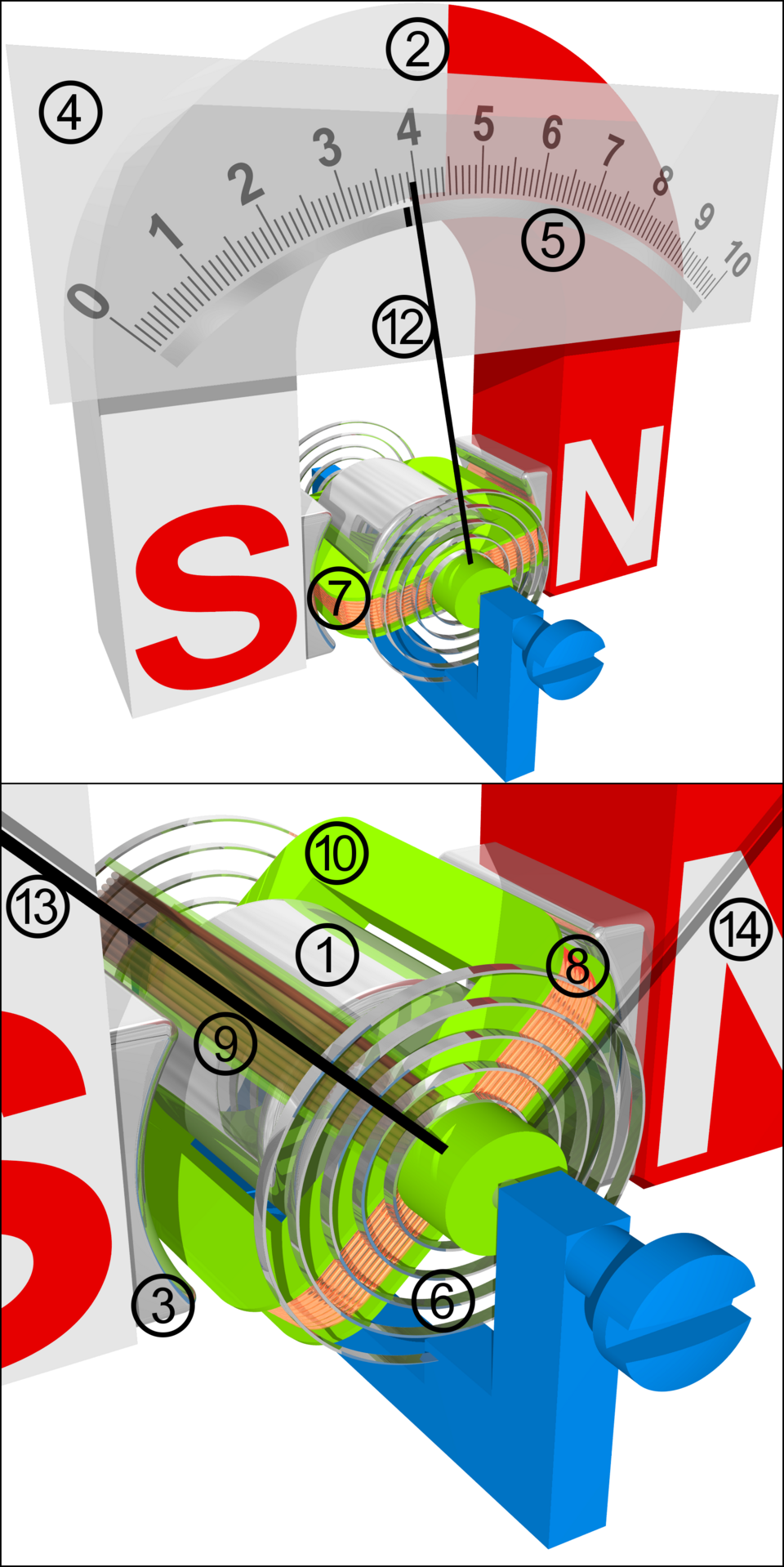 A typical moving-coil ammeter with a permanent magnet and calibrated scale. (Image: Søren Peo Pedersen (User:Peo) Reworked version Dr. Schorsch , CC BY-SA 3.0, via Wikimedia Commons)
- Example: If an ammeter reads 5 A in a circuit, it means 5 Amperes of current are flowing through it.
B. Voltmeter (Voltage Measuring Instrument)
- Function: Measures voltage (V) across two points in a circuit.
- Connection: Always connected in parallel with the component.
- Types:
- Moving-coil voltmeter (for DC).
- Electrostatic voltmeter (for high voltages).
- Digital voltmeter (common in labs).
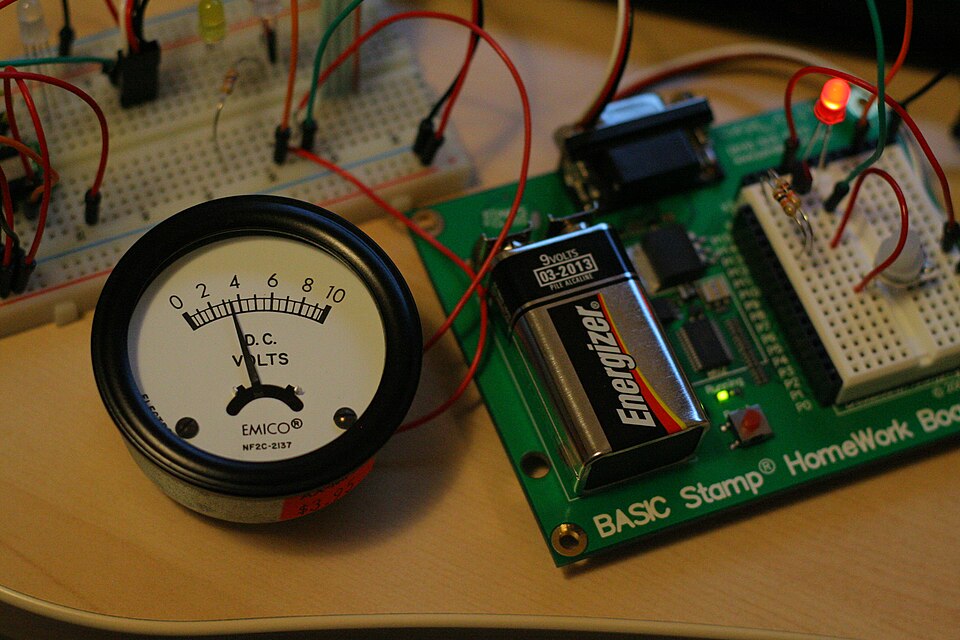 A typical analog voltmeter with a needle and scale. (Image: Michael Hicks, CC BY 2.0, via Wikimedia Commons)
- Example: If a voltmeter reads 230 V across a bulb, it means the potential difference between the two terminals is 230 Volts.
C. Wattmeter (Power Measuring Instrument)
- Function: Measures electrical power (P = V × I) in a circuit.
- Working Principle: Uses two coils (current coil and potential coil) to measure power.
- Connection:
- Current coil is connected in series.
- Potential coil is connected in parallel.
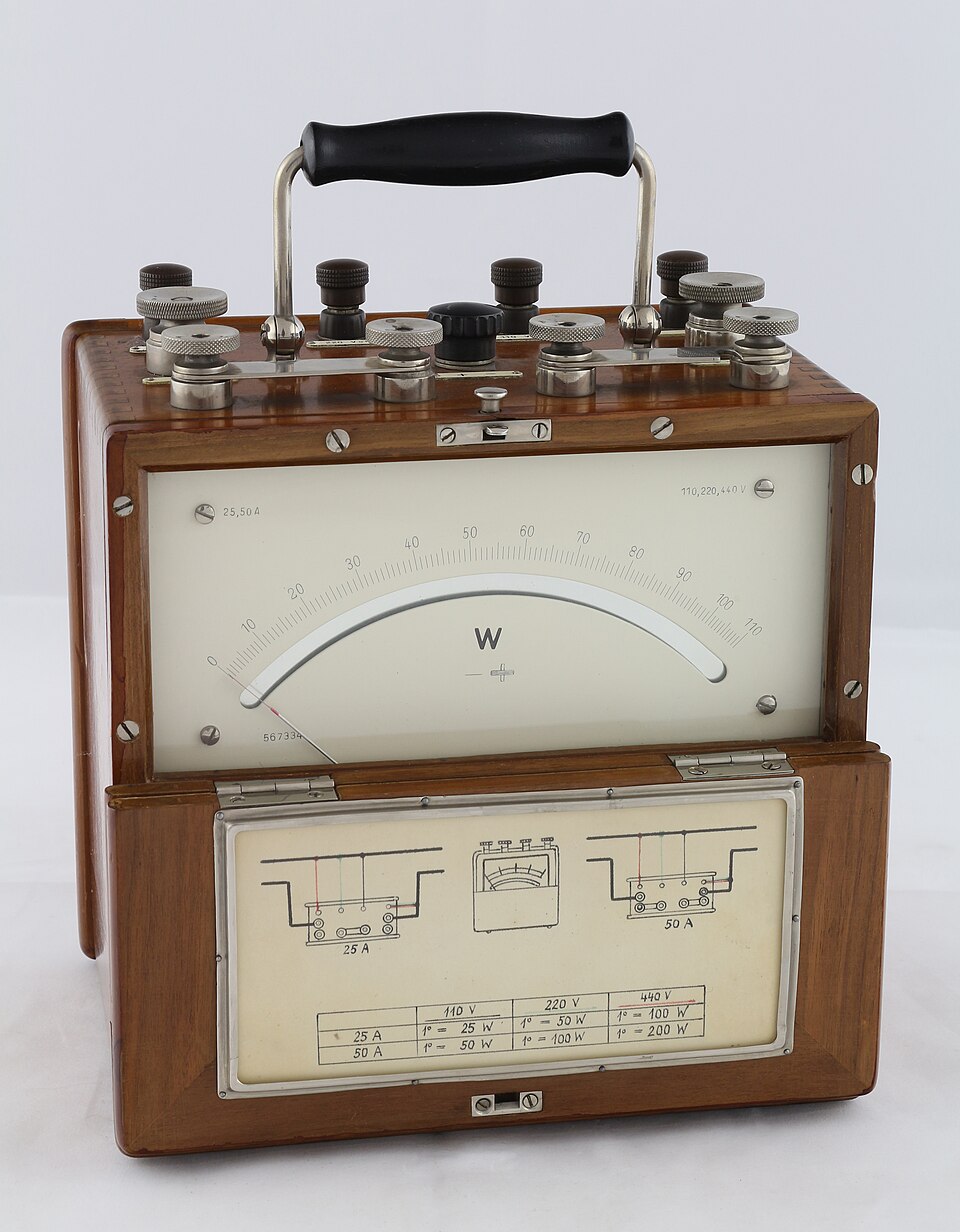 A wattmeter with current and potential coils. (Image: Franz Sachslehner, CC BY 4.0, via Wikimedia Commons)
- Example: If a wattmeter reads 500 W in a circuit, it means the power consumed is 500 Watts.
D. Energy Meter (Kilowatt-Hour Meter)
Function: Measures electrical energy consumption in kilowatt-hours (kWh).
Working Principle: Uses an induction motor principle to rotate a disk, which counts energy.
Applications:
- Used in homes, offices, and industries to bill electricity consumption.
- Example: The NTC (Nepal Electricity Authority) uses energy meters to measure household electricity usage.
Example: If an energy meter reads 1000 kWh, it means 1000 units of electricity have been consumed.
E. Multimeter (Combination Instrument)
- Function: Measures voltage, current, and resistance in one device.
- Types:
- Analog multimeter (pointer-type).
- Digital multimeter (DMM) (LCD display, more accurate).
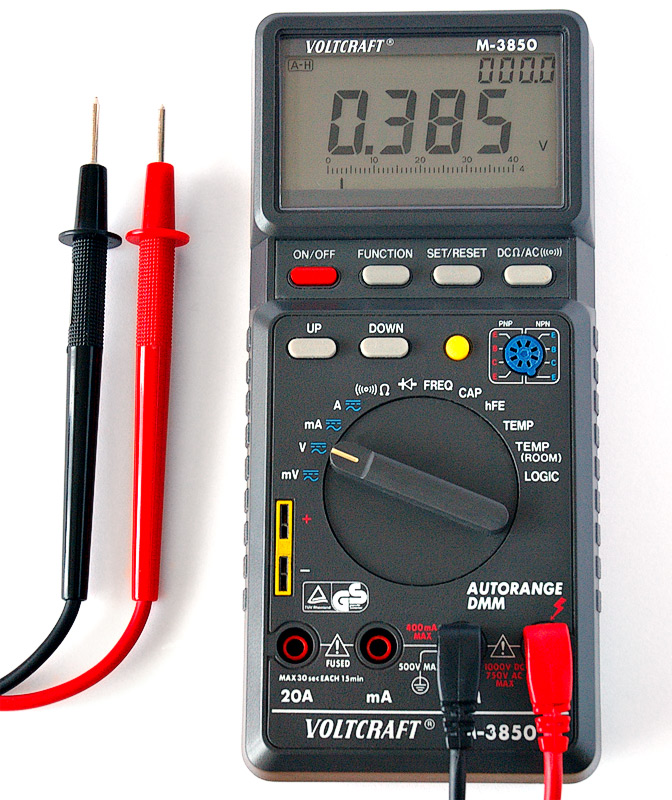 A digital multimeter with voltage, current, and resistance settings. (Image: André Karwath aka Aka, CC BY-SA 2.5, via Wikimedia Commons)
- Example:
A technician uses a digital multimeter to check:
- Voltage across a battery (12 V).
- Current flowing in a circuit (0.5 A).
- Resistance of a resistor (1 kΩ).
4. Errors in Measuring Instruments
No measuring instrument is 100% accurate. Errors can be classified as:
| Type of Error | Cause | How to Minimize |
|---|---|---|
| Instrumental Error | Faulty calibration, wear and tear, or manufacturing defects. | Use calibrated instruments, regular maintenance. |
| Observational Error | Human error in reading the scale (parallax error). | Read from a perpendicular angle. |
| Environmental Error | Temperature, humidity, or magnetic fields affecting readings. | Use instruments in controlled environments. |
5. Real-World Applications
A. In Nepal: NTC and Ncell
- NTC (Nepal Electricity Authority) uses energy meters to measure household electricity consumption.
- Example: If a family uses 10 units/day, the energy meter records this and NTC bills accordingly.
- Ncell uses multimeters in their service centers to test phone chargers and batteries.
B. In Smartphones and Laptops
- Charging circuits in smartphones use current sensors (ammeters) to regulate charging.
- Battery management systems use voltmeters to monitor voltage levels.
C. In Daraz and E-Commerce Logistics
- Warehouse management systems use current sensors to monitor power usage in servers and cooling systems.
- Delivery vehicles (like Pathao’s bikes) use multimeters to check battery health.
D. In Banks and ATMs
- ATMs use wattmeters to monitor power consumption and detect faults.
- Backup generators rely on energy meters to ensure uninterrupted power supply.
6. Worked Example: Measuring Power in a DC Circuit
Problem: A DC circuit has a 12 V battery connected to a 6 Ω resistor. Calculate the power dissipated in the resistor using a wattmeter.
Solution:
- Calculate current (I) using Ohm’s Law:
- Calculate power (P) using the power formula:
- Wattmeter reading: If connected properly, the wattmeter will display 24 W.
Real-World Tie-In:
- This is similar to how NTC bills households—they measure the power (in kW) consumed over time and convert it to energy (kWh) for billing.
7. Comparison of Analog vs. Digital Instruments
| Feature | Analog Instruments | Digital Instruments |
|---|---|---|
| Display | Pointer on a scale. | Numerical (LCD/LED). |
| Accuracy | Less accurate (affected by parallax). | Highly accurate (less human error). |
| Response Time | Slower (mechanical movement). | Faster (instantaneous reading). |
| Cost | Generally cheaper. | More expensive. |
| Applications | Old power systems, educational labs. | Modern labs, industries, consumer electronics. |
8. Exam Tip
- For short notes (e.g., "Color coding of resistors"):
- Remember the B-B-R-O-Y-G-W (Black-Brown-Red-Orange-Yellow-Green) sequence for resistor bands.
- Example: A resistor with bands Red (2), Red (2), Gold (5%) has a resistance of 22 × 10⁰ Ω = 22 Ω ±5%.
- For practical questions (e.g., "Speed Control of DC Motor"):
- Focus on armature voltage control and field flux control methods.
- Example: In a DC shunt motor, reducing the field current increases speed.
- For numerical problems:
- Always label units (A, V, W, Ω).
- Use Ohm’s Law (V=IR), Power Formula (P=VI), and Energy Formula (E=Pt).
- Diagrams are crucial:
- Draw circuit diagrams for ammeters, voltmeters, and wattmeters correctly (series/parallel connections).
- Label all components (e.g., "Current Coil," "Potential Coil").
Final Note: Electrical measuring instruments are the eyes of an electrician or engineer. Mastering their working principles, connections, and error sources will help you solve real-world problems and score well in exams. Practice drawing circuits and solving numerical problems regularly!
Based on the PU BE Computer (PU) syllabus for Basic Electrical Engineering, unit 9.
Discussion
Loading…