Communication TechniquesUnit 112 min read
Communication Process: Models, Channels & Protocols
Unit 1 of Communication Techniques explores the core principles of communication—models (linear, interactive, transactional), channels (physical/digital), protocols (rules for data exchange), and real-world applications in apps like eSewa and WhatsApp. Learn how messages flow, how errors are detected, and how systems l
TAKEAWAYS:
- Communication follows three models (linear, interactive, transactional) with distinct sender-receiver roles and feedback loops.
- Channels (wired/wireless, analog/digital) determine speed, reliability, and cost—critical for apps like Pathao’s GPS tracking.
- Protocols (e.g., TCP/IP, HTTP) define rules for data formatting, addressing, and error handling in networks like NEPSE’s stock trading system.
- Noise and interference degrade signals; techniques like error correction (parity bits, checksums) ensure data integrity in bank transactions.
- Real-world systems (eSewa’s payment gateway, WhatsApp’s end-to-end encryption) rely on layered communication models and protocols.
- Exam focus: Compare models, trace data flow in protocols, and explain how noise affects communication (e.g., NTC’s fiber-optic vs. mobile networks).
1. Definitions: What Is Communication?
Communication is the exchange of information between a sender and a receiver using a channel and a protocol. It involves:
- Sender: Originates the message (e.g., your phone when sending a WhatsApp text).
- Receiver: Decodes the message (e.g., the recipient’s phone).
- Message: The actual data (text, voice, binary code).
- Channel: The medium (air for radio, fiber for internet).
- Protocol: Rules governing how data is formatted, addressed, and transmitted (e.g., HTTP for web pages).
- Feedback: Receiver’s response (e.g., "read receipt" in WhatsApp).
Why does this matter? Without protocols, devices wouldn’t "understand" each other. For example, your laptop and a router use Ethernet protocol to share data, while your phone and a 4G tower use LTE protocol.
2. Models of Communication
Communication is classified into three models, each with different roles for sender/receiver and feedback mechanisms.
Model 1: Linear (One-Way) Model
flowchart LR
A["Sender"] -->|"Message"| B["Channel"] -->|"Message"| C["Receiver"]- Example: Radio broadcast, TV transmission.
- Key traits:
- No feedback from receiver.
- Sender controls the entire process.
- Limitations:
- No confirmation of receipt (e.g., you can’t know if your radio listener understood the news).
- Used where feedback is impossible (e.g., satellite TV signals).
Model 2: Interactive (Two-Way) Model
flowchart TD
    A["Sender"] -->|"Message"| B["Channel"] -->|"Message"| C["Receiver"]
C -->|"Feedback"| B -->|"Acknowledgment"| A- Example: Phone call, email exchange.
- Key traits:
- Receiver provides feedback (e.g., "I got your email").
- Communication is bidirectional but still structured.
- Limitations:
- Feedback may be delayed (e.g., waiting for a reply to an email).
- Used in customer service calls (e.g., Ncell helpline).
Model 3: Transactional Model
flowchart LR
    A["Sender/Receiver"] -->|"Simultaneous Message & Feedback"| B["Shared Field"]
B -->|"Ongoing Exchange"| A- Example: Live chat (WhatsApp call), group discussion.
- Key traits:
- Both parties simultaneously send and receive messages.
- Shared context (e.g., two people debating traffic routes in Kathmandu).
- Most efficient for real-time systems (e.g., Pathao driver-passenger chat).
- Advantages:
- Faster problem-solving (e.g., clarifying an order on Daraz).
- More natural (like face-to-face conversation).
Comparison Table:
| Model | Feedback | Direction | Example | Use Case |
|---|---|---|---|---|
| Linear | None | One-way | Radio broadcast | Emergency alerts (NTC) |
| Interactive | Delayed | Two-way | Email, phone call | Bank customer support |
| Transactional | Instant | Multi-way | WhatsApp call, live chat | Pathao ride coordination |
3. Channels of Communication
Channels are the pathways through which messages travel. They can be:
- Physical: Wired (copper cables, fiber optics) or wireless (radio waves, Bluetooth).
- Digital: Internet, mobile networks, satellite links.
- Analog: Traditional signals (e.g., voice over telephone lines).
Types of Channels
| Type | Example | Speed | Reliability | Cost | Use Case |
|---|---|---|---|---|---|
| Wired (Copper) | Ethernet cable | Medium | High | Low | Office networks |
| Fiber Optic | NTC’s fiber backbone | Very High | Very High | High | Internet backbone (Nepal) |
| Wireless | Wi-Fi, 4G/5G (Ncell) | High | Medium | Medium | Mobile internet |
| Satellite | Dish TV, GPS | Low (delay) | High | Very High | Remote area connectivity |
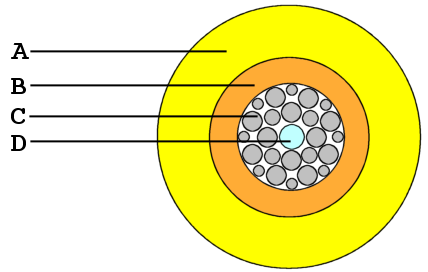 How NTC’s fiber-optic cables transmit data as light pulses. (Image: J.P.Lon at English Wikipedia, CC BY 2.5, via Openverse)
4. Protocols: Rules for Data Exchange
Protocols are agreed-upon rules that ensure devices can communicate. They define:
- Data format (e.g., text, binary, JSON).
- Addressing (e.g., IP addresses like
192.168.1.1). - Error handling (e.g., retries, checksums).
- Flow control (e.g., how fast data is sent).
Example: HTTP Protocol (Web Browsing)
When you visit daraz.com.np, this happens:
sequenceDiagram
    participant Browser as Your Browser
    participant Server as Daraz Server
    Browser->>Server: GET /product/123 (HTTP Request)
    Server-->>Browser: HTTP/1.1 200 OK (Response with HTML)
    Browser->>Server: POST /cart (Add to cart)
    Server-->>Browser: HTTP/1.1 200 OK (Confirmation)
Key HTTP Fields:
GET /product/123 HTTP/1.1
Host: daraz.com.np
User-Agent: Mozilla/5.0
Accept: text/html
- Request Line:
GET /product/123(action + resource). - Headers: Metadata (e.g.,
Hosttells the server which website you’re accessing).
Error Detection: Checksums
To ensure data isn’t corrupted (e.g., during a bank transfer), protocols use checksums:
- Sender calculates a checksum (e.g., sum of bytes modulo 256).
- Receiver recalculates and compares.
- If mismatched → error detected (e.g., retry or alert).
Example: Sending 1010 (binary):
- Sum =
1 + 0 + 1 + 0 = 2→ Checksum =0010. - If received as
1011, checksum recalculated as3→ Mismatch!
5. Noise and Interference
Noise is any unwanted disturbance that corrupts signals. Types:
- Physical: Electrical interference (e.g., power lines affecting Wi-Fi).
- Human: Typo in an email (semantic noise).
- Channel: Weak signal (e.g., poor 4G coverage in remote areas).
How Systems Handle Noise:
| Technique | Example | How It Works |
|---|---|---|
| Error Correction | QR codes, DVD error recovery | Adds redundant data to fix errors. |
| Retransmission | TCP protocol (internet) | Resends lost packets. |
| Modulation | FM radio, 5G signals | Encodes data in waves to reduce noise. |
Real-World Example:
- NTC’s Fiber Optics: Uses light pulses (immune to electromagnetic noise), ensuring stable internet even during load shedding.
- WhatsApp Encryption: Uses end-to-end encryption to prevent eavesdropping (noise from hackers).
6. Real-World Applications
Example 1: eSewa Payment Gateway
sequenceDiagram
    participant User as You (Phone)
    participant eSewa as eSewa Server
    participant Bank as Bank Server
    User->>eSewa: Scan QR (Request Payment)
    eSewa->>Bank: Verify Funds (HTTP Request)
    Bank-->>eSewa: Approve/Reject (Response)
eSewa-->>User: Confirmation (SMS/Notification)- Models Used:
- Transactional (real-time feedback between user and bank).
- Protocols: HTTPS (secure), SMS (for OTP).
- Channels: Mobile network (4G/5G), bank’s wired network.
Example 2: Pathao Ride Booking
- Channel: Mobile data (4G) + GPS (wireless).
- Protocol: Pathao’s custom API (like HTTP but for rides).
- Noise Handling: If GPS signal is weak, Pathao asks for manual location update.
- Feedback: Driver confirms pickup → transactional model.
Example 3: NEPSE Stock Trading
- Model: Transactional (buyers/sellers exchange orders instantly).
- Protocol: FIX (Financial Information eXchange) protocol for order matching.
- Noise: If a trade fails, the system retransmits the order.
7. Layered Communication Models
Most systems use layered models to organize communication tasks. The OSI Model (7 layers) is a standard:
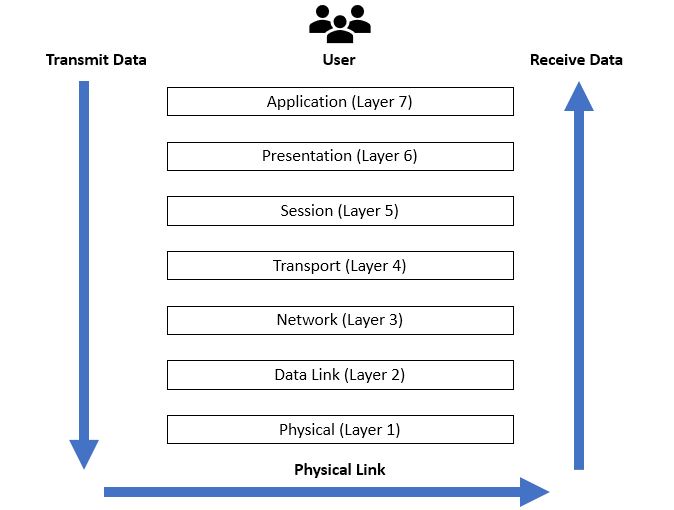
| Layer | Function | Example Protocol |
|---|---|---|
| Application | User interface (e.g., WhatsApp UI) | HTTP, FTP, SMTP |
| Presentation | Data format (e.g., encrypting messages) | SSL/TLS, JPEG compression |
| Session | Manages connections (e.g., call setup) | NetBIOS, RPC |
| Transport | End-to-end delivery (e.g., packet ordering) | TCP, UDP |
| Network | Routing (e.g., IP addresses) | IP, ICMP |
| Data Link | Framing (e.g., Ethernet frames) | Ethernet, PPP |
| Physical | Raw bits (e.g., electrical signals) | Wi-Fi, Fiber Optic |
Why Layers?
- Modularity: Change one layer without affecting others (e.g., upgrade from 4G to 5G only affects Physical/Data Link layers).
- Interoperability: Devices from different makers can communicate (e.g., your phone + a Chinese router).
8. Worked Example: Daraz Order Processing
Scenario: You order a product on Daraz. Trace the communication process.
- Model: Transactional (real-time updates between you, Daraz, and the seller).
- Layers Involved:
- Application: Daraz website (HTTP).
- Transport: TCP ensures all order packets arrive.
- Network: IP routes your request to Daraz’s server.
- Physical: Fiber optic cable carries data to Daraz’s data center.
- Protocols:
- HTTP: Sends your order.
- HTTPS: Secures payment info.
- SMTP: Sends order confirmation email.
- Noise Handling:
- If your internet drops, TCP retransmits lost packets.
- Daraz’s server uses checksums to verify order data integrity.
Exam Tip
Models: Always compare linear vs. interactive vs. transactional in terms of feedback and direction.
- Exam Q: "Why is WhatsApp more efficient than email for customer support?"
- Answer: WhatsApp uses a transactional model (instant feedback), while email is interactive (delayed replies).
Protocols: Draw a sequence diagram for real-world examples (e.g., eSewa payment, Pathao ride).
- Exam Q: "Explain how HTTP works when you visit daraz.com.np."
- Answer: Use the sequence diagram above + explain headers like
HostandGET.
Noise: Relate to real systems:
- Exam Q: "How does NTC reduce noise in fiber-optic cables?"
- Answer: Uses light pulses (immune to electromagnetic interference) + error correction in higher layers.
Layers: Memorize the OSI model and match protocols to layers (e.g., TCP is Transport, IP is Network).
- Exam Q: "Which OSI layer handles IP addressing?"
- Answer: Network Layer (Layer 3).
Worked Examples: Always tie theory to real apps (eSewa, WhatsApp, NTC). Examiners love this!
- Exam Q: "How does Pathao use communication models?"
- Answer: Transactional model for live chat + TCP for reliable ride data.
Final Checklist for Full Marks: ✅ Define sender, receiver, channel, protocol, feedback. ✅ Compare three models with examples (radio vs. WhatsApp call). ✅ Explain wired vs. wireless channels with speed/reliability trade-offs. ✅ Draw a sequence diagram for a real protocol (HTTP, eSewa). ✅ Describe error handling (checksums, retransmission) with a binary example. ✅ Link to Nepali apps (eSewa, Pathao, NTC) in every possible way. ✅ Sketch the OSI model and label a protocol to each layer.
Based on the PU BE Computer (PU) syllabus for Communication Techniques (ENG110), unit 1.
Discussion
Loading…