Algebra and GeometryUnit 89 min read
Sphere, Cone & Cylinder – definitions, equations, volumes & surface areas
Unit 8 of Algebra and Geometry: introduces the three fundamental quadric solids, derives their standard equations, computes volume and surface area, explores cross‑sections and real‑world applications, and provides worked examples and exam strategies.
Key points
- Standard equations of a sphere, right circular cone and right circular cylinder are derived from the distance formula.
- Volume formulas: \(V_{\text{sphere}}=\frac{4}{3}\pi r^{3}\), \(V_{\text{cone}}=\frac{1}{3}\pi r^{2}h\), \(V_{\text{cyl}}=\pi r^{2}h\).
- Surface‑area formulas include both curved and total areas; for a cone the slant height \(l=\sqrt{r^{2}+h^{2}}\) is essential.
- Cross‑sectional slices reveal circles whose radii depend on the solid’s geometry, useful for integration and engineering design.
- Real‑world examples: water‑storage cylinders (NTC), traffic cones (Daraz packaging), and Earth‑model spheres (Google Earth).
1. Introduction to Quadric Solids
A quadric solid is a three‑dimensional surface defined by a second‑degree polynomial in . The three most common in the syllabus are:
| Solid | Standard Equation | Key Parameters |
|---|---|---|
| Sphere | centre , radius | |
| Right Circular Cone | vertex , base radius , height | |
| Right Circular Cylinder | (independent of ) | axis through , radius , height |
These equations arise directly from the distance formula in three dimensions.
2. Sphere
2.1 Definition & Geometry
A sphere is the set of all points at a fixed distance from a centre .
- Radius : distance from centre to any point on the surface.
- Diameter .
2.2 Volume
Derived by integrating circular cross‑sections perpendicular to any axis:
2.3 Surface Area
A sphere’s surface area is the limit of the areas of infinitesimal patches:
2.4 Worked Example
Problem: A satellite dish is modelled as a spherical cap of radius cm and height cm. Find the volume of the cap.
Solution steps
The cap volume formula (derived from integration) is
Substitute cm, cm:
Numerically, .
3. Right Circular Cylinder
3.1 Definition & Geometry
A right circular cylinder consists of all points at a distance from a fixed line (the axis) and bounded between two parallel planes a distance apart.
- Base: a circle of radius .
- Height : distance between the two circular bases.
3.2 Volume
3.3 Surface Area
Lateral (curved) area: .
Total area (including two bases):
3.4 Worked Example (Real Situation)
Problem: NTC installs a water‑storage cylinder at a rural tower site. The cylinder has radius m and height m. Compute the amount of water (in litres) it can hold, assuming it is filled to the brim.
Solution
Volume in cubic metres:
Convert to litres (1 m³ = 1000 L):
The tank can store roughly 28 kL of water, sufficient for a month’s consumption of the tower staff.
4. Right Circular Cone
4.1 Definition & Geometry
A right circular cone is generated by rotating a right‑angled triangle about one of its legs (the axis).
- Vertex : tip of the cone.
- Base: a circle of radius .
- Height : perpendicular distance from vertex to base plane.
- Slant height .
4.2 Volume
4.3 Surface Area
Lateral area: .
Total area (including base):
4.4 Worked Example (Daraz Order)
Problem: Daraz ships an ice‑cream cone set. The cone has radius cm and height cm. Find the amount of ice‑cream (in cm³) that fits if the cone is filled to the brim.
Solution
Volume:
The cone holds about 33.5 cm³ of ice‑cream.
5. Cross‑Sections & Generating Curves
Understanding how a solid is sliced helps in both integration and practical design.
| Solid | Typical cross‑section (perpendicular to axis) | Resulting curve |
|---|---|---|
| Sphere | Plane at distance from centre | Circle of radius |
| Cylinder | Plane perpendicular to axis | Circle of radius (constant) |
| Cone | Plane perpendicular to axis at height | Circle of radius |
6. Comparison of Formulas
flowchart LR
    Q["Quadric Solids"]
    Q --> S["Sphere"]
    Q --> C["Right Circular Cone"]
    Q --> Y["Right Circular Cylinder"]
    S --> Vs["V = 4/3 π r³"]
    S --> As["A = 4 π r²"]
    C --> Vc["V = 1/3 π r² h"]
    C --> Ac["A = π r (l + r)"]
    Y --> Vy["V = π r² h"]
Y --> Ay["A = 2π r (h + r)"]| Property | Sphere | Cone | Cylinder |
|---|---|---|---|
| Volume | |||
| Curved Surface Area | |||
| Total Surface Area | |||
| Typical Use | Planetary models, ball bearings | Traffic cones, ice‑cream cones | Water tanks, pipelines |
Advantages & Disadvantages
| Solid | Advantages (engineering) | Disadvantages (manufacturing) |
|---|---|---|
| Sphere | Uniform stress distribution; minimal surface for given volume | Hard to pack efficiently; machining requires 5‑axis CNC |
| Cone | Easy to funnel materials; natural stability when placed tip‑down | Small base area limits load‑bearing |
| Cylinder | Simple extrusion; high volume‑to‑surface ratio | Ends create stress concentrations; requires sealing at both faces |
7. Real‑World Applications
7.1 Water‑Storage Cylinders (NTC)
NTC’s remote tower sites often use vertical steel cylinders to store rainwater. The volume formula directly determines how many days of operation the tower can sustain without external supply.
7.2 Traffic Cones (Daraz)
Daraz sells orange traffic cones used by road‑maintenance crews. The cone’s slant height determines the material needed for the outer shell, while the volume helps estimate the amount of foam filler for stability.
7.3 Earth as a Sphere (Google Earth)
Google Earth renders the planet as a sphere of radius m. Surface‑area calculations are essential for satellite‑coverage planning and for converting raster image data (pixels per square kilometre).
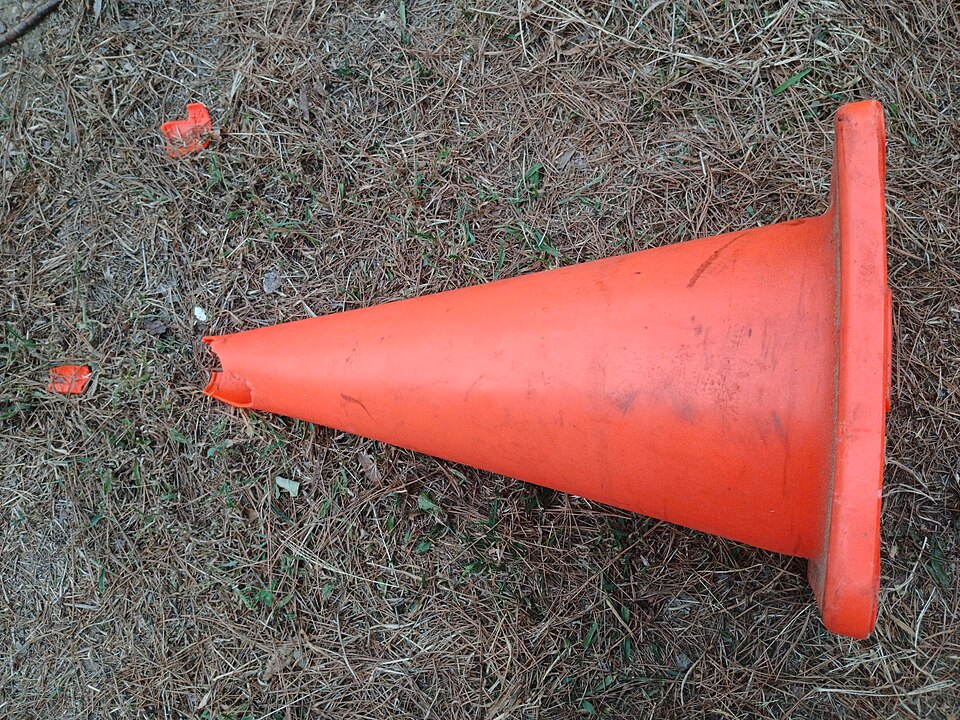 Orange traffic cone used on Nepali roads (Image: Ser Amantio di Nicolao, CC BY-SA 4.0, via Wikimedia Commons)
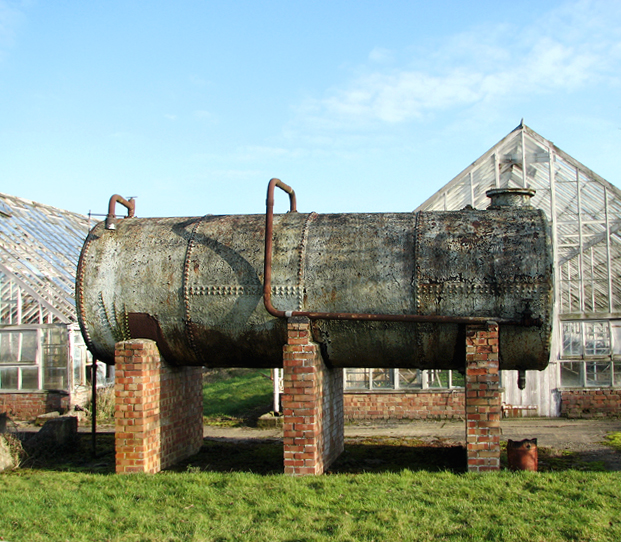 Steel water‑storage cylinder at a telecom tower (Image: Evelyn Simak, CC BY-SA 2.0, via Wikimedia Commons)
8. Worked Example Integrated with Real Situation
Scenario: A new e‑commerce fulfillment centre (Daraz) plans to install a cylindrical storage silo for bulk rice. The silo must hold 150 m³ of rice. The design constraints are: radius cannot exceed 2 m due to floor‑space limits. Determine the minimum height required and compute the total surface area (including top and bottom) for painting.
Solution
Required volume .
Choose the maximum allowable radius .
Solve for height from :
So a height of ≈ 12 m satisfies the volume requirement.
Total surface area:
The centre will need roughly 175 m² of paint.
9. Common Mistakes & How to Avoid Them
| Mistake | Why it Happens | Correct Approach |
|---|---|---|
| Forgetting the slant height in cone surface‑area calculations | Confusing height with slant height | Always compute first |
| Using diameter instead of radius in formulas | Rushing through the problem | Write down explicitly before substitution |
| Mixing up lateral vs total area for cylinders | Overlooking the two circular ends | Remember: lateral ; total adds |
| Assuming a cone’s cross‑section radius is constant | Ignoring linear scaling with height | Use similarity: radius at height is |
10. Quick Reference Sheet
- Sphere: , .
- Cylinder: , , .
- Cone: , , , .
Exam tip
- Memorise the three core formulas (volume & total surface area) as a single block; they differ only by a constant factor (1, 1/3, 4/3).
- Always draw a quick sketch with labelled before substituting numbers – the sketch prevents unit‑mix‑ups and reveals which radius (base vs slant) the problem needs.
- For cross‑section questions, write the generic circle radius expression first (e.g., for a sphere) then integrate; many marks are awarded for the correct set‑up even if integration is left incomplete.
- Check the units: convert litres ↔ m³, cm ↔ m, etc., before finalising the answer.
- In multi‑part questions, answer the easiest part first (usually volume) to secure marks, then proceed to surface‑area or slant‑height calculations.
Based on the PU BE Computer (PU) syllabus for Algebra and Geometry (MTH150), unit 8.
Discussion
Loading…