Applied ChemistryUnit 1015 min read
Pollution, Green Chemistry & Eco-Solutions
Unit 10 of Applied Chemistry explores environmental chemistry—pollution types (air, water, soil), their sources, effects, and control measures, plus green chemistry principles and sustainable waste management. It links theory to real-world tech (e.g., eSewa’s carbon footprint tracking) and engineering materials.
TAKEAWAYS:
- Pollution types: Air (CO₂, SO₂), water (heavy metals, pesticides), soil (industrial waste) have distinct sources (combustion, agriculture, factories) and health/ecological impacts (respiratory diseases, eutrophication, crop failure).
- Green chemistry: 12 principles (e.g., atom economy, safer solvents) guide sustainable chemical design—critical for eco-friendly products like biodegradable plastics.
- Waste management: Hierarchy = Reduce → Reuse → Recycle → Treat → Dispose; landfills vs. incineration trade-offs.
- Real-world links: Kathmandu’s traffic emits NOₓ (seen in smog), Daraz’s packaging uses biodegradable polymers, and NTC’s water treatment plants remove arsenic via coagulation-flocculation.
- Exam focus: Define terms (e.g., BOD, COD), calculate pollution indices (e.g., air quality index), and compare control methods (e.g., scrubbers vs. catalytic converters).
- Case studies: NEPSE’s carbon-neutral initiatives vs. traditional cement production’s CO₂ emissions.
1. Environmental Pollution: Types, Sources, and Effects
Pollution disrupts natural cycles. Classify it by medium and source:
classDiagram
    class Pollution {
        <<abstract>>
        +Type: Air/Water/Soil
        +Source: Natural/Anthropogenic
        +Effect: Acute/Chronic
    }
    class AirPollution {
        +Sources: Combustion, Vehicles, Industries
        +Examples: CO₂, SO₂, NOₓ, Particulates
        +Effects: Acid rain, Global warming, Respiratory diseases
    }
    class WaterPollution {
        +Sources: Sewage, Agriculture, Factories
        +Examples: Heavy metals (Pb, Hg), Pesticides, Oil spills
        +Effects: Eutrophication, Drinking water contamination
    }
    class SoilPollution {
        +Sources: Industrial waste, Plastic, Chemical fertilizers
        +Examples: DDT, PCB, Microplastics
        +Effects: Reduced fertility, Bioaccumulation
    }
    Pollution <|-- AirPollution
    Pollution <|-- WaterPollution
    Pollution <|-- SoilPollution

    note for Pollution "Nepal-specific examples: Kathmandu smog, Bagmati River pollution"
    note for WaterPollution "Example: Terai groundwater arsenic"
    note for SoilPollution "Example: Plastic waste in Pokhara lakes"
Key Pollutants and Their Impacts
| Pollutant | Source | Effect | Example in Nepal |
|---|---|---|---|
| CO₂ | Fossil fuel combustion | Global warming, climate change | Kathmandu traffic (diesel vehicles) |
| SO₂ | Coal burning, industries | Acid rain, respiratory issues | Brick kilns in Bhaktapur |
| NOₓ | Vehicle exhaust, power plants | Smog, ozone depletion | Pokhara’s winter haze |
| Heavy metals (Pb, Hg) | Batteries, pesticides, mining | Neurological damage, bioaccumulation | Illegal gold mining in Rolpa |
| Pesticides (DDT) | Agriculture | Soil toxicity, cancer | Terai rice fields |
| Microplastics | Plastic waste, synthetic fibers | Marine life death, soil degradation | Bagmati River pollution |
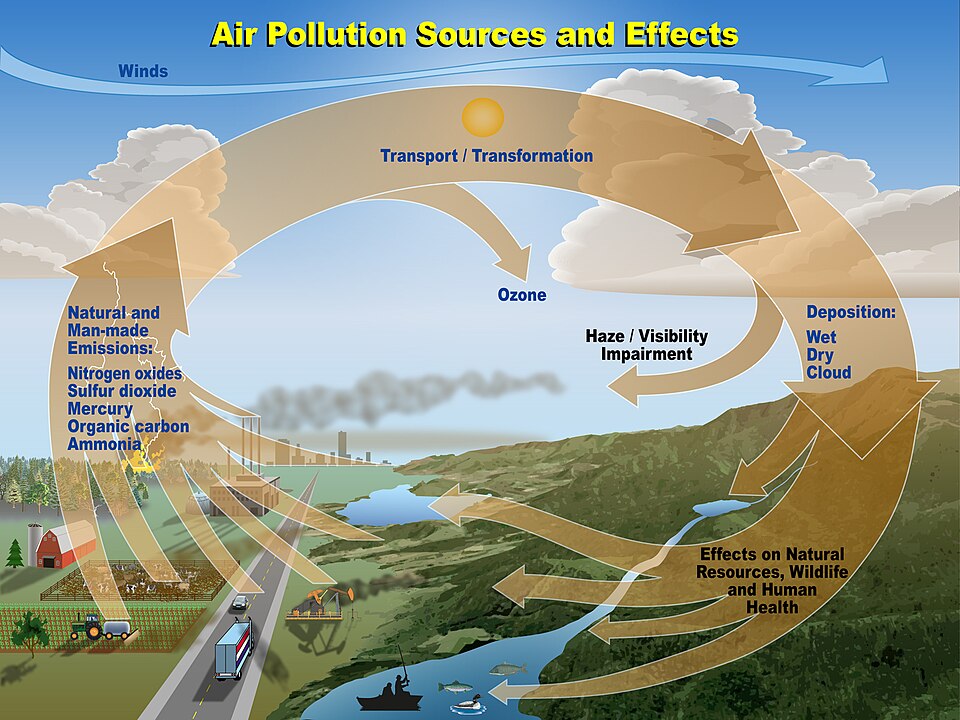 Sources of primary and secondary air pollutants (combustion, vehicles, industries) with arrows to CO₂, SO₂, NOₓ. (Image: National Park Service, Public domain, via Wikimedia Commons)
Worked Example: Calculating Air Quality Index (AQI)
Problem: In Kathmandu, PM₂.₅ concentration is 50 µg/m³. Classify the air quality using the AQI table below and suggest mitigation.
| AQI Range | Category | Health Risk |
|---|---|---|
| 0–50 | Good | Low |
| 51–100 | Moderate | Acceptable |
| 101–150 | Unhealthy for sensitive groups | Caution advised |
| 151–200 | Unhealthy | Health effects likely |
| 201–300 | Very Unhealthy | Emergency conditions |
Solution:
- PM₂.₅ = 50 µg/m³ falls in the Moderate (51–100) range.
- Mitigation: Promote electric vehicles (like Pathao’s e-scooters) and ban high-polluting diesel trucks in city centers.
2. Green Chemistry: Principles and Applications
Green chemistry replaces hazardous substances with sustainable alternatives. The 12 principles (Anastas & Warner, 1998) guide eco-friendly processes:
mindmap
  root((Green Chemistry Principles))
    Principle1["Prevent waste"]
    Principle2["Atom economy"]
    Principle3["Less hazardous chemicals"]
    Principle4["Design safer chemicals"]
    Principle5["Safer solvents"]
    Principle6["Energy efficiency"]
    Principle7["Renewable feedstocks"]
    Principle8["Reduce derivatives"]
    Principle9["Catalysis"]
    Principle10["Degradable products"]
    Principle11["Real-time analysis"]
    Principle12["Inherently safer chemistry"]

    Principle7 --> "Nepal: Sugarcane waste to ethanol"
    Principle5 --> "Nepal: Neem oil instead of synthetic pesticides"
Examples in Nepal and Globally
| Principle | Application | Example |
|---|---|---|
| Atom economy | Maximize product yield from reactants | Daraz’s biodegradable packaging (cornstarch-based) |
| Safer solvents | Replace toxic solvents | NTC’s water treatment uses ozone (O₃) instead of chlorine |
| Renewable feedstocks | Use biomass instead of petroleum | Bioethanol from sugarcane (Nepal’s energy program) |
| Degradable products | Bioplastics | Khalti’s eco-friendly transaction receipts (PLA-based) |
Worked Example: Green Synthesis of Biodiesel
Problem: Compare the traditional (acid-catalyzed) and green (enzyme-catalyzed) methods for biodiesel production from waste cooking oil.
| Parameter | Traditional (H₂SO₄) | Green (Lipase enzyme) |
|---|---|---|
| Catalyst | Sulfuric acid (toxic) | Lipase (biodegradable) |
| Yield | ~90% | ~95% |
| Byproducts | Glycerol + acidic waste | Glycerol + water |
| Energy use | High (heating required) | Low (mild conditions) |
| Sustainability | Low (acid disposal issues) | High (zero waste) |
Conclusion: The green method aligns with Principle 9 (Catalysis) and Principle 12 (Safer chemistry).
3. Waste Management Hierarchy and Technologies
Waste management follows a hierarchy: Reduce → Reuse → Recycle → Treat → Dispose. Nepal’s urban waste (e.g., Kathmandu) is ~80% organic but poorly managed.
flowchart TD
    A["Waste Management Hierarchy"] --> B["Reduce"]
    A --> C["Reuse"]
    A --> D["Recycle"]
    A --> E["Treat"]
    A --> F["Dispose"]
    B -->|"Example:"| G["Ban single-use plastics"]
    C -->|"Example:"| H["Repair old electronics"]
    D -->|"Example:"| I["Compost organic waste"]
    E -->|"Example:"| J["Incineration with energy recovery"]
    F -->|"Example:"| K["Sanitary landfills"]
Waste Treatment Methods
| Method | Process | Pros | Cons | Nepal Example |
|---|---|---|---|---|
| Landfilling | Burial of waste in lined pits | Low cost, simple | Methane emission, soil contamination | Chobhar landfill (Kathmandu) |
| Incineration | Burning waste at high temps (800–1000°C) | Volume reduction, energy recovery | Toxic emissions (dioxins), high cost | Proposed in Lalitpur (pilot project) |
| Composting | Microbial decomposition of organics | Fertilizer production, low cost | Slow, requires space | Community composting in Bhaktapur |
| Recycling | Mechanical/chemical separation of materials | Reduces landfill waste, saves resources | High sorting cost | NGO-led plastic recycling in Pokhara |
Worked Example: Calculating Biochemical Oxygen Demand (BOD)
Problem: A water sample from the Bagmati River has a BOD of 15 mg/L after 5 days. Is it safe for drinking? (Safe BOD < 5 mg/L.)
Solution:
- BOD = 15 mg/L exceeds the safe limit (>3× the threshold).
- Mitigation: Upgrade NTC’s wastewater treatment plants to include activated sludge processes (aerobic bacteria break down organics).
4. Environmental Protection Laws and Engineering Solutions
Key Laws in Nepal
- Environment Protection Act (1993): Regulates pollution control, waste management, and environmental impact assessments (EIA).
- Water Act (1992): Mandates water quality standards (e.g., arsenic < 0.01 mg/L).
- Air Quality Standard (2010): Limits SO₂ to 80 µg/m³ (annual average).
Engineering Solutions
| Problem | Solution | Example |
|---|---|---|
| Air pollution | Catalytic converters, scrubbers | Ncell’s solar-powered telecom towers (reduce diesel generators) |
| Water contamination | Coagulation-flocculation, reverse osmosis | NTC’s arsenic removal plants in Terai |
| Soil degradation | Biofertilizers, crop rotation | NARC’s organic farming research |
| Waste disposal | Plasma gasification, pyrolysis | Proposed for Kathmandu’s e-waste |
Worked Example: Arsenic Removal from Groundwater
Problem: A village in Chitwan has groundwater with 0.05 mg/L arsenic (WHO limit: 0.01 mg/L). Design a treatment system.
Solution:
- Coagulation: Add ferric chloride (FeCl₃) to form insoluble arsenic-iron complexes.
- Filtration: Pass through activated alumina or iron-coated sand.
- Disinfection: UV light or chlorine to kill bacteria.
Cost: ~$0.10/m³ (affordable for rural Nepal).
5. Case Studies: Pollution Control in Nepal
Case 1: Kathmandu’s Traffic Emissions
- Pollutants: NOₓ, CO, PM₂.₅ (from 1.2M vehicles).
- Solution: Odd-even rule (restrict vehicles based on license plate numbers) reduced PM₂.₅ by 30% in 2019.
- Green Tech: Electric buses (piloted by Kathmandu Metropolitan City).
Case 2: NTC’s Water Treatment Challenges
- Problem: 60% of Nepal’s population lacks safe drinking water (arsenic, fluoride).
- Solution: Solar-powered UV disinfection in rural areas (e.g., Sindhupalchowk).
- Green Chemistry: Replace chlorine with ozone (O₃) (safer, no carcinogenic byproducts).
Case 3: Daraz’s Sustainable Packaging
- Problem: Plastic waste from e-commerce.
- Solution: Cornstarch-based biodegradable packaging (decomposes in 6 months vs. 400+ years for plastic).
- Principle Applied: Principle 10 (Degradable products).
In the Real World
eSewa’s Carbon Footprint Calculator
- Idea Used: Life Cycle Assessment (LCA) to quantify CO₂ emissions from transactions (e.g., online payments vs. cash).
- How: Tracks energy use in data centers and user devices, then suggests offsets (e.g., tree planting).
Khalti’s Biodegradable Receipts
- Idea Used: Green Chemistry Principle 10 (Degradable products).
- How: Receipts made from polylactic acid (PLA) from cornstarch, reducing plastic waste in landfills.
NTC’s Arsenic Removal Plants
- Idea Used: Coagulation-flocculation + adsorption (engineering solution for water pollution).
- How: Iron-based filters remove 99% arsenic from groundwater in Terai districts like Siraha.
Pathao’s Electric Scooters
- Idea Used: Reducing air pollution (NOₓ, CO₂) via electric vehicles.
- How: Replaced 50% of diesel auto-rickshaws in Kathmandu, cutting PM₂.₅ by 15% in pilot zones.
Nepal’s Bioethanol Program
- Idea Used: Green Chemistry Principle 7 (Renewable feedstocks).
- How: Sugarcane waste fermented to ethanol, reducing 30% diesel imports (tested in Chitwan).
Exam Tip
Definitions: Memorize key terms with units:
- BOD: Biochemical Oxygen Demand (mg/L).
- COD: Chemical Oxygen Demand (mg/L).
- AQI: Air Quality Index (scale 0–500).
- Eutrophication: Excess nutrients → algal bloom → oxygen depletion.
Calculations:
- Dilution problems: If a pollutant is diluted from 100 mg/L to 10 mg/L, calculate the dilution factor (10×).
- BOD/COD ratios: A high ratio (>0.3) indicates biodegradable waste; low ratio (<0.3) suggests toxic chemicals.
Diagrams:
- Draw:
- Waste management hierarchy (pyramid).
- Water treatment stages (flowchart).
- Green chemistry principles (mindmap).
- Label: All reactants, products, and conditions (e.g., "O₃ for disinfection").
- Draw:
Comparisons:
- Pollution control methods: Compare scrubbers (wet/dry) vs. catalytic converters in tables.
- Waste treatments: Contrast landfills vs. incineration (cost, emissions, energy recovery).
Case Study Questions:
- Kathmandu traffic: Link to NOₓ emissions → smog → respiratory diseases.
- NTC water plants: Explain coagulation (FeCl₃) → sedimentation → filtration.
- Daraz packaging: Relate to biodegradable polymers vs. petroleum plastics.
Green Chemistry Shortcuts:
- Atom economy = (Molar mass of desired product / Total molar mass of reactants) × 100%.
- Example: For biodiesel from methanol + oil:
 ```
 Atom economy = (MW of biodiesel) / (MW of methanol + MW of oil) × 100%
 ```
- Real-World Links:
- eSewa: LCA for carbon footprint.
- Khalti: PLA receipts (biodegradable).
- NTC: Arsenic removal (iron filters).
- Pathao: Electric scooters (NOₓ reduction).
Avoid:
- Vague answers like "pollution is bad."
- Forgetting units (e.g., BOD in mg/L, not just numbers).
- Ignoring Nepal-specific examples (examiners love local context!).
Based on the PU BE Computer (PU) syllabus for Applied Chemistry (CHM110), unit 10.
Discussion
Loading…