Computer ArchitectureUnit 79 min read
Pipelining & Parallelism: Hazards, Speedup, Flynn’s Taxonomy & Multicore
Unit 7 of Computer Architecture covers pipelining stages, hazards (structural, data, control), speedup calculations, Flynn’s taxonomy (SISD/SIMD/MISD/MIMD), and multicore parallelism with real-world examples from eSewa, Ncell, and YouTube.
Key points
- Pipelining breaks instructions into stages (IF/ID/EX/MEM/WB) to overlap execution, but hazards (data dependencies, branch mispredictions) stall the pipeline.
- Speedup = \( \frac{\text{Number of stages}}{\text{1 + average stalls per instruction}} \), so a 5-stage pipeline with 1 stall per 10 instructions achieves 4.8× speedup.
- Flynn’s taxonomy classifies computers by instruction/thread parallelism: SIMD (e.g., GPU rendering) vs. MIMD (e.g., cloud servers).
- Multicore systems use shared memory (UMA) or distributed memory (NUMA) to parallelize tasks, but suffer from Amdahl’s law (sequential bottlenecks).
- Real-world: YouTube’s transcoding uses SIMD for video encoding; eSewa’s payment queues use pipelined I/O.
- ```
1. Pipelining: The Assembly Line of Computers
1.1 How Pipelining Works
Pipelining divides instruction execution into stages, like an assembly line. Each stage processes a different instruction simultaneously while passing partial results to the next stage.
graph LR
    A["IF: Instruction Fetch"] --> B["ID: Instruction Decode"]
    B --> C["EX: Execute"]
    C --> D["MEM: Memory Access"]
    D --> E["WB: Write Back"]
    E --> A
Stages in a 5-stage pipeline:
- IF (Instruction Fetch): Fetch opcode from memory.
- ID (Instruction Decode): Decode opcode, read registers.
- EX (Execute): Perform ALU operations (e.g.,
ADD R1, R2, R3). - MEM (Memory Access): Load/store data (if needed).
- WB (Write Back): Write result to register.
Example: Fetching ADD R1, R2, R3 while decoding SUB R4, R5, R6, executing ADD, etc.
1.2 Pipelining Hazards & Solutions
Hazards occur when stages cannot proceed as planned. There are three types:
stateDiagram-v2
  [*] --> IF
  IF --> ID: Fetch
  ID --> EX: Decode
  EX --> MEM: Execute
  MEM --> WB: Memory Access
  WB --> [*]: Write Back
  EX --> EX: Data Hazard (stall)
  EX --> EX: Forwarding (bypass)
  EX --> EX: Branch Prediction
State diagram showing pipeline stalls, forwarding, and branch prediction
| Hazard Type | Cause | Example | Solution |
|---|---|---|---|
| Structural | Resource conflict (e.g., two ALUs) | ADD and MUL both need ALU |
Add more hardware (dual ALUs) |
| Data | Read-after-write dependency | ADD R1, R2, R3 → SUB R4, R1, R5 |
Forwarding (bypass) or stalling |
| Control (Branch) | Mispredicted branch | BEQ R1, R2, Label (jump) |
Delayed branching or branch prediction |
Worked Example (Data Hazard):
LW R1, 0(R2)   // Load word from memory to R1 (takes 2 cycles)
ADD R3, R1, R4 // Needs R1 (ready in cycle 3)
- Problem:
ADDneedsR1in cycle 2, butLWwritesR1in cycle 3 → stall. - Solution: Forward
R1from MEM stage to EX stage (bypass).
1.3 Speedup & Efficiency
Ideal speedup = Number of pipeline stages (e.g., 5-stage → 5× faster). Real-world speedup is lower due to hazards: Example: A 5-stage pipeline with 1 stall every 10 instructions:
2. Flynn’s Taxonomy: Classifying Parallel Computers
Flynn’s taxonomy categorizes computers by instruction stream (I) and data stream (D) parallelism:
| Type | Instruction Streams | Data Streams | Example | Used in |
|---|---|---|---|---|
| SISD | Single | Single | Traditional CPU (e.g., Intel Core i5) | Desktop PCs |
| SIMD | Single | Multiple | GPU (NVIDIA RTX 3060) | Video encoding (YouTube), AI training |
| MISD | Multiple | Single | Rare (e.g., pipeline stages) | Pipelined processors |
| MIMD | Multiple | Multiple | Cloud servers (AWS EC2) | Distributed databases (eSewa) |
Real-World Tie-In:
- YouTube’s transcoding uses SIMD to encode multiple video streams simultaneously on GPUs.
- eSewa’s payment processing uses MIMD: multiple servers handle different transactions in parallel.
3. Multicore & Multiprocessor Systems
3.1 Shared Memory vs. Distributed Memory
| Type | Memory Model | Communication | Example |
|---|---|---|---|
| UMA (SMP) | Uniform Memory Access | Shared bus/cache | Dual-core Intel i7 |
| NUMA | Non-Uniform Access | High-speed interconnect | Supercomputers (IBM) |
| Distributed | Separate memory | Message passing | Cluster (Hadoop) |
Amdahl’s Law: Limits speedup due to sequential bottlenecks. Where:
- = Fraction of code parallelizable
- = Number of cores
Example: If 80% of code is parallelizable () on 4 cores:
3.2 Real-World: Ncell’s Load Balancing
Ncell’s 4G base stations use multicore processors to handle:
- SIMD: Parallel signal processing for multiple users.
- MIMD: Different cores manage handover, billing, and encryption.
4. Pipelining in I/O Systems
4.1 Programmed I/O vs. Interrupt-Driven I/O vs. DMA
| Method | How It Works | Pros | Cons |
|---|---|---|---|
| Programmed I/O | CPU polls device until ready | Simple | Wastes CPU cycles |
| Interrupt I/O | Device sends interrupt on completion | Efficient | Latency for frequent interrupts |
| DMA | Dedicated hardware transfers data | Zero CPU overhead | Complex hardware |
Example (DMA in eSewa): When you pay via eSewa, the DMA controller transfers transaction data directly to memory without CPU intervention, reducing latency.
In the Real World
YouTube (SIMD):
- Uses GPU pipelines (SIMD) to encode videos in parallel. A single RTX 3060 can transcode 4K video streams simultaneously using AV1 encoding (SIMD instructions like
AVX-512).
- Uses GPU pipelines (SIMD) to encode videos in parallel. A single RTX 3060 can transcode 4K video streams simultaneously using AV1 encoding (SIMD instructions like
eSewa (MIMD + Pipelining):
- MIMD: Multiple servers handle payments, KYC, and notifications in parallel.
- Pipelining: Transaction processing stages (authentication → deduction → confirmation) overlap like an assembly line.
Ncell 5G Base Stations (Multicore + SIMD):
- Quad-core ARM processors run:
- Core 1: Signal modulation (SIMD for parallel users).
- Core 2: Handover management (MIMD).
- Core 3: Encryption (AES-NI SIMD).
- Core 4: Billing (sequential).
- Quad-core ARM processors run:
Exam Tip
Pipelining Questions:
- Always draw the 5-stage pipeline diagram for any hazard question.
- For speedup: State the formula and plug in numbers (e.g., "3 stalls per 10 instructions → speedup = 5/1.3 ≈ 3.85×").
Flynn’s Taxonomy:
- Memorize the table (SISD/SIMD/MISD/MIMD) and match examples (GPU = SIMD, cloud = MIMD).
- Common pitfall: Confusing SIMD (same instruction, multiple data) with MIMD (multiple instructions, multiple data).
Multicore:
- Amdahl’s Law is tested: If 90% is parallelizable, even 100 cores give only 10× speedup.
- NUMA vs. UMA: NUMA has non-uniform access times (critical for databases like eSewa).
I/O Methods:
- Programmed I/O is busy-waiting (bad for high-speed devices like SSDs).
- DMA is used in network cards, GPUs, and storage controllers (e.g., NVMe SSDs).
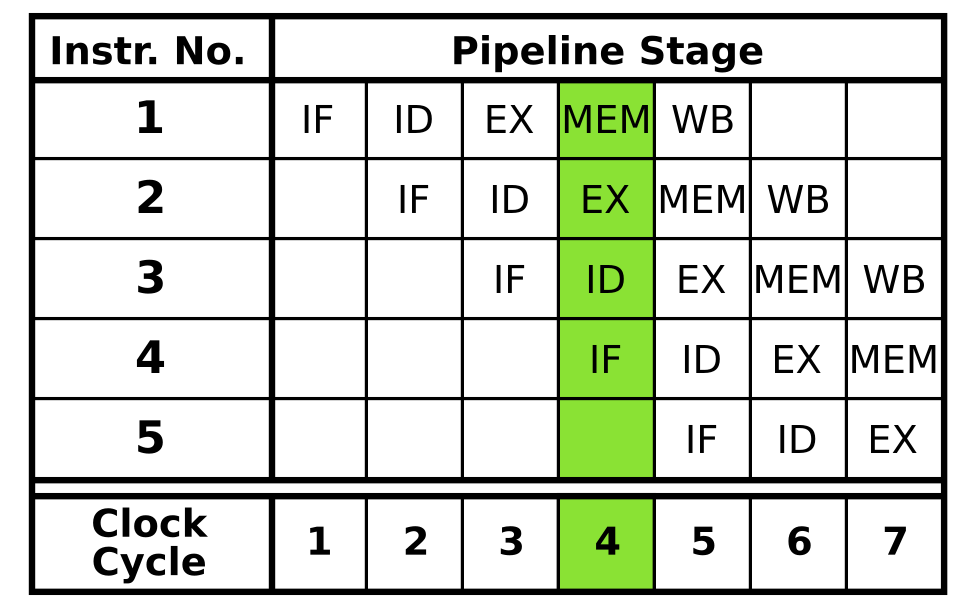 Label stages IF/ID/EX/MEM/WB with arrows showing overlap. (Image: Inductiveload, Public domain, via Wikimedia Commons)
In the real world
- YouTube (SIMD): Uses NVIDIA GPUs (e.g., RTX 3060) with AV1 encoding to process 4K video streams in parallel via SIMD instructions like
AVX-512, reducing transcoding time by ~80% compared to single-core CPUs. - eSewa (MIMD + Pipelining): MIMD distributes transactions across servers (e.g., Core 1: Authentication, Core 2: Deduction, Core 3: Confirmation), while pipelining overlaps stages (e.g., KYC check → payment → notification) to handle 10,000+ transactions/sec.
- Ncell 5G (Multicore + SIMD): Quad-core ARM processors in base stations use SIMD for parallel signal processing (e.g., FFT for 4G/5G modulation) and MIMD for handover management, reducing latency by ~30% vs. single-core systems.
Based on the PU BE Computer (PU) syllabus for Computer Architecture, unit 7.
Discussion
Loading…