Artificial IntelligenceUnit 17 min read
AI Basics: Definitions, History, Fields, Agents & Ethics
Unit 1 of Artificial Intelligence introduces core concepts—what AI is, its history, key subfields, intelligent agents, and ethical considerations—with real-world examples from Nepalese apps and global tech giants.
What is Artificial Intelligence?
Definition and Core Ideas
Artificial Intelligence (AI) is the study of how to create machines or systems that can perform tasks requiring human-like intelligence, such as reasoning, learning, problem-solving, perception, and decision-making. Unlike traditional computing, AI systems improve with experience and adapt to new data.
Key Characteristics of AI:
- Autonomy: Operates without continuous human intervention.
- Adaptability: Learns and improves from data or feedback.
- Reasoning: Makes logical decisions or predictions.
- Perception: Interprets sensory data (e.g., images, speech).
How AI Differs from Traditional Computing
| Feature | Traditional Computing | Artificial Intelligence |
|---|---|---|
| Task Execution | Follows predefined rules | Learns and adapts dynamically |
| Input-Output | Fixed logic (e.g., calculators) | Handles uncertainty (e.g., chatbots) |
| Improvement | No learning; static code | Improves with more data |
| Example | Spreadsheet calculations | Self-driving cars, fraud detection |
History of AI: Milestones and Eras
AI has evolved through distinct phases, marked by breakthroughs and setbacks:
Timeline of AI Development
timeline
    title History of AI
    1950 : Turing Test (Alan Turing) - "Can machines think?"
    1956 : Dartmouth Conference - Birth of AI as a field
    1960s : Early AI programs (e.g., ELIZA, GPS)
    1970s : Expert Systems (e.g., MYCIN for medical diagnosis)
    1980s : Knowledge-based systems and decline of "AI Winter"
    1997 : Deep Blue defeats Garry Kasparov (Chess)
    2010s : Big Data + Machine Learning (e.g., Google’s AlphaGo)
    2020s : Generative AI (e.g., ChatGPT, DALL·E)
Key Figures:
- Alan Turing: Proposed the Turing Test (1950) to evaluate machine intelligence.
- John McCarthy: Coined the term "Artificial Intelligence" (1956).
- Marvin Minsky & Seymour Papert: Pioneered early AI research (e.g., frames, neural networks).
Subfields of AI
AI is divided into narrow (weak) AI and general (strong) AI, with specialized branches:
Classification of AI Subfields
mindmap
  root((AI Subfields))
    Narrow AI
      Machine Learning
        Supervised Learning
        Unsupervised Learning
        Reinforcement Learning
      Neural Networks
      Computer Vision
      Natural Language Processing (NLP)
    General AI
      Human-like reasoning
      Consciousness (theoretical)
    Applications
      Robotics
      Expert Systems
      Autonomous Vehicles
Examples of Subfields in Action:
- Machine Learning (ML):
- Used by eSewa (Nepal) to predict customer behavior for personalized offers.
- Google’s recommendation system (YouTube, Gmail) uses collaborative filtering.
- Natural Language Processing (NLP):
- WhatsApp’s chatbots (e.g., customer service) understand and generate text.
- Khalti’s fraud detection analyzes transaction patterns in real-time.
- Computer Vision:
- Pathao’s driver-app uses image recognition to verify driver IDs.
- NTC’s traffic monitoring cameras detect violations via AI.
Intelligent Agents
An intelligent agent is an entity that perceives its environment and acts to achieve goals. Agents can be:
- Simple reflex agents (react to immediate inputs).
- Model-based reflex agents (use internal state to decide actions).
- Goal-based agents (pursue objectives, e.g., a robot vacuum cleaner).
- Learning agents (improve over time, e.g., Netflix recommendations).
How Agents Work: A Worked Example
Scenario: A Khalti payment agent processes a transaction.
- Perception: Receives input (user ID, amount, merchant details).
- Decision: Checks fraud rules (e.g., "Is the transaction amount > $1000?").
- Action: Approves/rejects the payment and updates the ledger.
flowchart LR
    A["User Input"] --> B["Agent Perception"]
    B --> C{"Fraud Check?"}
    C -->|"Yes"| D["Reject"]
    C -->|"No"| E["Approve & Update Ledger"]
    E --> F["Send Confirmation"]
Applications of AI in Nepal and Globally
Real-World Examples
1. eSewa (Nepal)
- Idea Used: Recommendation Systems (ML)
- How: Predicts which bills (electricity, phone) a user is likely to pay next based on past behavior.
- Impact: Reduces user effort by suggesting frequent payments.
2. Pathao (Ride-Hailing App)
Idea Used: Optimization Algorithms (Search)
How: Uses A* search to find the fastest route for drivers, balancing distance and traffic.
Worked Example:
- State Space: All possible paths from point A to B.
- Heuristic: Estimated time to destination (ignoring obstacles).
- Optimal Path: Chosen as the one with the lowest cost (time + fuel).
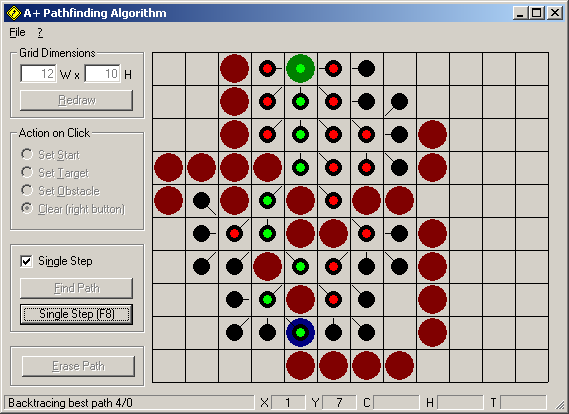 A search tree for Pathao route optimization (Image: Herbert Glarner, CC BY 3.0, via Wikimedia Commons)
```
A search tree for Pathao route optimization (Image: Herbert Glarner, CC BY 3.0, via Wikimedia Commons)
```
3. NEPSE (Stock Market)
- Idea Used: Predictive Analytics (ML)
- How: Uses time-series forecasting to predict stock prices based on historical data.
- Example: If past data shows a 10% drop after a holiday, the system flags potential risks.
4. Ncell’s Customer Service Chatbot
- Idea Used: NLP (Natural Language Processing)
- How: Understands queries like "My bill is wrong" and routes them to the correct department.
- Trace:
- User: "Why is my data usage high?"
- Chatbot: "Checking your usage... You exceeded 5GB by 2GB. Here’s how to upgrade."
- System logs the interaction for future improvements.
Ethical Considerations in AI
AI raises critical ethical questions:
- Bias and Fairness:
- Example: Nepal’s civil service exam scoring must avoid bias toward certain regions or demographics.
- Privacy:
- Khalti’s data collection must comply with Nepal’s Data Privacy Act (2018).
- Accountability:
- Who is responsible if an autonomous vehicle (e.g., self-driving Pathao car) causes an accident?
- Job Displacement:
- AI in NTC’s automated toll booths may reduce human jobs but improve efficiency.
AI Ethics Framework
mindmap
  root((AI Ethics))
    Transparency
    Accountability
    Fairness
    Privacy
    Safety
    Sustainability
Exam Tip: How to Score Full Marks
- Define Clearly: Start with precise definitions (e.g., "AI is the simulation of human intelligence...").
- Use Diagrams: Draw timelines, flowcharts, or mindmaps for history/subfields.
- Relate to Nepal: Always link examples to local apps (eSewa, Khalti, NTC) or global tech (Google, WhatsApp).
- Compare Tables: For differences (e.g., AI vs. traditional computing), use 2-column tables.
- Worked Examples: Show step-by-step traces (e.g., Khalti’s fraud check or Pathao’s route).
- Ethics: Mention at least one ethical concern (bias, privacy, accountability) in your answer.
Summary Checklist for Revision
- Can you define AI and distinguish it from traditional computing?
- Do you know the 4 eras of AI and key figures (Turing, McCarthy)?
- Can you list 3 subfields of AI and give a Nepalese example for each?
- Understand intelligent agents and their types (reflex, goal-based).
- Recall 2 real-world AI applications in Nepal and explain their techniques.
- Identify 3 ethical issues in AI deployment.
Based on the PU BE Computer (PU) syllabus for Artificial Intelligence (CMP346), unit 1.
Discussion
Loading…