Compiler DesignUnit 412 min read
Top-Down Parsing: Recursive Descent, LL(1), Predictive Parsing & Backtracking
Unit 4 of Compiler Design explores top-down parsing techniques, covering recursive descent parsing, LL(1) grammars, parsing tables, and backtracking methods with worked examples, real-world applications, and visual traces of parsing steps.
What is Top-Down Parsing?
Top-down parsing is a syntax analysis technique where the parser starts with the start symbol of the grammar and derives sentences by expanding non-terminals into production rules. It builds the parse tree from the root down to the leaves, unlike bottom-up parsing which builds it from the leaves up.
Key Characteristics:
- Goal: Match the input string against the grammar.
- Direction: Top-down (start symbol → leaves).
- Method: Uses leftmost derivation (always expand the leftmost non-terminal).
- Tools: Recursive descent, LL(1) parsing tables, backtracking.
1. Recursive Descent Parsing
Recursive descent parsing is a direct implementation of top-down parsing using recursive functions, one for each non-terminal in the grammar.
How It Works:
- The parser calls a function for the start symbol.
- For each non-terminal, it matches the leftmost symbol and recursively processes the rest.
- If a terminal is expected, it checks if it matches the current input token.
- If no match, it backtracks (retry alternative productions).
Example Grammar:
Consider this simple grammar for arithmetic expressions:
E → T E'
E' → + T E' | ε
T → F T'
T' → * F T' | ε
F → ( E ) | id
This grammar is left-recursive (e.g., E → T E'), which causes infinite recursion in recursive descent. We eliminate left recursion to make it work:
E → T E'
E' → + T E' | ε
T → F T'
T' → * F T' | ε
F → ( E ) | id
After left-recursion elimination (replace A → Aα | β with A → β A' and A' → α A' | ε), it becomes:
E → T E'
E' → + T E' | ε
T → F T'
T' → * F T' | ε
F → ( E ) | id
Now, it is suitable for recursive descent.
Recursive Descent Implementation (Pseudocode):
def parse_E():
    parse_T()
    while current_token == '+':
        consume('+')
        parse_T()

def parse_T():
    parse_F()
    while current_token == '*':
        consume('*')
        parse_F()

def parse_F():
    if current_token == '(':
        consume('(')
        parse_E()
        consume(')')
    else:
        consume('id')

def consume(token):
    if current_token == token:
        current_token = next_token()
    else:
        error()
Trace of Parsing id + id * id:
| Step | Function Called | Action | Current Token | Stack/Input |
|---|---|---|---|---|
| 1 | parse_E() | Calls parse_T() | id | id + id * id |
| 2 | parse_T() | Calls parse_F() | id | id + id * id |
| 3 | parse_F() | Matches id, consumes |
+ | + id * id |
| 4 | parse_T() (back) | Checks for * (none) |
+ | + id * id |
| 5 | parse_E'() | Matches +, consumes |
id | id * id |
| 6 | parse_T() | Calls parse_F() | id | id * id |
| 7 | parse_F() | Matches id, consumes |
* | * id |
| 8 | parse_T'() | Matches *, consumes |
id | id |
| 9 | parse_F() | Matches id, consumes |
$ | $ |
| 10 | Success! | All tokens matched | $ | $ |
2. LL(1) Parsing
LL(1) parsing is a table-driven top-down parsing method. It uses a parsing table to decide which production to apply next based on the current non-terminal and the next input token (1 lookahead).
LL(1) Grammar Requirements:
- Leftmost derivation: Always expand the leftmost non-terminal.
- Left-recursion free: No productions like
A → Aα | β. - No common prefixes: No two productions of the same non-terminal can have the same prefix (e.g.,
A → αβ | αγis allowed, butA → α | αβis not).
Constructing the LL(1) Parsing Table:
- Compute FIRST sets: For each non-terminal, find the set of terminals that can appear as the first symbol in any derivation.
- Compute FOLLOW sets: For each non-terminal, find the set of terminals that can appear immediately after it in any derivation.
- Fill the table: For each non-terminal
Aand terminala, ifA → αanda ∈ FIRST(α), addA → αtoM[A, a]. Ifε ∈ FIRST(α), addA → αtoM[A, b]for allb ∈ FOLLOW(A).
Example: LL(1) Table for Arithmetic Expressions
Grammar (after left-recursion elimination):
E → T E'
E' → + T E' | ε
T → F T'
T' → * F T' | ε
F → ( E ) | id
FIRST and FOLLOW Sets:
| Non-Terminal | FIRST Set | FOLLOW Set |
|---|---|---|
| E | { (, id } | { $, ) } |
| E' | { +, ε } | { $, ) } |
| T | { (, id } | { +, $, ) } |
| T' | { *, ε } | { +, $, ) } |
| F | { (, id } | { *, +, $, ) } |
LL(1) Parsing Table:
| ( | id | + | * | ) | $ | |
|---|---|---|---|---|---|---|
| E | E→T E' | E→T E' | ||||
| E' | E'→+T E' | E'→ε | E'→ε | |||
| T | T→F T' | T→F T' | ||||
| T' | T'→ε | T'→*F T' | T'→ε | T'→ε | ||
| F | F→(E) | F→id |
Parsing id + id * id Using LL(1) Table:
- Start with
Eand inputid + id * id $. M[E, id] = E → T E'→ Stack:T E', Input:+ id * id $.M[T, id] = T → F T'→ Stack:F T' E', Input:+ id * id $.M[F, id] = F → id→ Popid, Input:+ id * id $.M[T', +] = T' → ε→ Stack:E', Input:+ id * id $.M[E', +] = E' → + T E'→ Stack:+ T E', Input:id * id $.- Consume
+,M[T, id] = T → F T'→ Stack:F T' E', Input:* id $. M[F, id] = F → id→ Popid, Input:* id $.M[T', *] = T' → * F T'→ Stack:* F T' E', Input:id $.- Consume
*,M[F, id] = F → id→ Popid, Input:$. M[T', $] = T' → ε,M[E', $] = E' → ε→ Accept!
3. Backtracking in Top-Down Parsing
Backtracking is used when the parser tries one production and fails, then retries another. It is simple but inefficient for large grammars.
Example: Backtracking for Ambiguous Grammar
Grammar:
E → E + T | T
T → T * F | F
F → ( E ) | id
To parse id + id * id:
- Try
E → E + T:- First
Ederivesid, then+matches, but the nextTcannot deriveid * id(fails).
- First
- Backtrack and try
E → T:Tderivesid * id(success).
Disadvantages of Backtracking:
- Inefficient: May explore many invalid paths.
- Not suitable for large grammars: Exponential time complexity in worst case.
4. Comparison: Recursive Descent vs. LL(1) Parsing
| Feature | Recursive Descent | LL(1) Parsing |
|---|---|---|
| Implementation | Recursive functions | Table-driven |
| Grammar Requirement | Left-recursion free | LL(1) grammar (no common prefixes) |
| Efficiency | Fast for simple grammars | Slower table lookups but deterministic |
| Error Handling | Easy to implement | Requires stack management |
| Backtracking | Possible (inefficient) | Not needed (deterministic) |
| Use Case | Small, simple grammars | Complex grammars with lookahead |
In the Real World
eSewa (Nepal):
- Idea Used: Top-down parsing for validating user input in forms (e.g., checking if a submitted transaction follows the correct syntax for payment requests).
- How: The backend compiler-like system uses parsing tables (similar to LL(1)) to ensure that API requests (e.g.,
pay?amount=1000&to=12345) conform to the expected grammar before processing.
Khalti (Nepal):
- Idea Used: Recursive descent parsing for JSON/XML validation in API responses.
- How: When a merchant sends a request like
{"amount": 500, "to": "user123"}, Khalti’s backend uses a parser to verify the structure matches the expected schema (e.g.,Order → {amount: Number, to: String}). If invalid, it rejects the request early.
YouTube (Global):
- Idea Used: LL(1) parsing for query syntax validation.
- How: When you search for
"compiler design tutorials after 2020", YouTube’s backend first parses the query to ensure it follows the allowed syntax (e.g.,query → term | term "after" year). This helps in generating correct search results and filtering invalid inputs.
Bank Loan Interest Calculators (Nepal: NMB, Global IME):
- Idea Used: Top-down parsing for formula validation.
- How: When you input a loan formula like
interest = principal * rate * time, the calculator’s parser checks if the input follows the correct grammar (e.g.,Expression → Term | Term + Term). If you enterinterest = principal *, it flags the error before computation.
Visualizing Top-Down Parsing
1. Parse Tree for id + id * id
        E
       / \
      T   E'
     / \   / \
    F  T' +  T
   /    / \   / \
 id   *  F  F  T'
          / \    \
        id  T'    ε
             / \
            F   ε
           / \
         id   ε
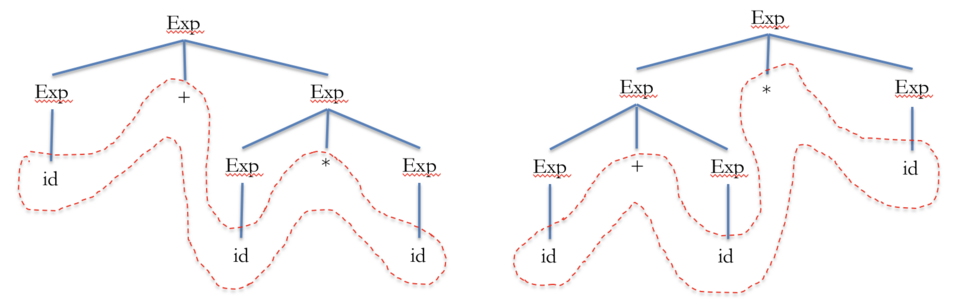 A labelled parse tree for `id + id id` showing how top-down parsing builds the structure. (Image: AIProf, CC BY-SA 4.0, via Wikimedia Commons)
2. LL(1) Parsing Stack Trace
flowchart TD
    A["Stack: E\nInput: id + id * id $"] --> B["Action: E → T E'\nStack: T E'\nInput: id + id * id $"]
    B --> C["Action: T → F T'\nStack: F T' E'\nInput: id + id * id $"]
    C --> D["Action: F → id\nStack: T' E'\nInput: + id * id $"]
    D --> E["Action: T' → ε\nStack: E'\nInput: + id * id $"]
    E --> F["Action: E' → + T E'\nStack: + T E'\nInput: id * id $"]
    F --> G["Consume +\nStack: T E'\nInput: id * id $"]
    G --> H["Action: T → F T'\nStack: F T' E'\nInput: id * id $"]
    H --> I["Action: F → id\nStack: T' E'\nInput: * id $"]
    I --> J["Action: T' → * F T'\nStack: * F T' E'\nInput: id $"]
    J --> K["Consume *\nStack: F T' E'\nInput: id $"]
    K --> L["Action: F → id\nStack: T' E'\nInput: $"]
    L --> M["Action: T' → ε, E' → ε\nStack: ε\nInput: $"]
    M --> N["Accept!"]
3. Backtracking Example for E → E + T | T
flowchart TD
    A["Try E → E + T\nStack: E + T\nInput: id + id * id $"] --> B["First E → id\nStack: + T\nInput: + id * id $"]
    B --> C["Match +\nStack: T\nInput: id * id $"]
    C --> D["Try T → T * F\nFails: T cannot derive id * id"]
    D --> E["Backtrack to E → T\nStack: T\nInput: id + id * id $"]
    E --> F["T → id * id\nSuccess!"]
Exam Tip
- Grammar Checks: Always verify if a grammar is LL(1) before attempting to build a parsing table. Check for:
- Left recursion.
- Common prefixes (e.g.,
A → αβ | αγis okay, butA → α | αβis not).
- FIRST and FOLLOW Sets: Memorize how to compute them. For example:
FIRST(A)includes terminals derivable fromAin one step.FOLLOW(A)includes terminals that can appear afterAin any derivation.
- Parsing Table Construction: Practice filling the table for small grammars. A common mistake is forgetting to add
εproductions forFOLLOWsets. - Recursive Descent vs. LL(1):
- Recursive descent is easier to implement for simple grammars.
- LL(1) is more efficient for complex grammars but requires table construction.
- Backtracking: Only use it if the grammar is not LL(1). In exams, prefer LL(1) or recursive descent for efficiency.
- Worked Examples: Always show stack/input traces for parsing steps. Examiners love detailed traces!
- Real-World Links: Relate parsing to API validation (e.g., eSewa/Khalti) or query processing (e.g., YouTube search). This can earn bonus marks for application awareness.
Common Pitfalls to Avoid:
- Left Recursion: Forgetting to eliminate it can lead to infinite loops in recursive descent.
- Incomplete FIRST/FOLLOW Sets: Missing
εin FIRST sets or FOLLOW sets can cause parsing table errors. - Ambiguous Grammars: LL(1) parsers cannot handle ambiguous grammars (e.g.,
E → E + E | E * E). Prefer unambiguous grammars. - Stack Underflow: In LL(1), ensure the stack is managed correctly to avoid underflow errors.
Based on the PU BE Computer (PU) syllabus for Compiler Design (CMP360), unit 4.
Discussion
Loading…